


My partner’s job took us to Lausanne, Switzerland, for several weeks in 2023. The city, which rises above Lake Geneva, has dramatic differences in elevation, the streets perched on various planes. It’s easy to get lost there. Because my knowledge of French is rudimentary at best, I felt free of myself while somehow also more myself. Without access to language, and often without direction, I found a greater availability of attention: to the senses, to memory, to raw emotion—a vertiginous experience, like the Alps themselves. We traveled a lot that year and the next, and my touchstone was always poetry, even in languages I didn’t understand. I suspect that travel offers a sideways route to discovery the way poems and other literature do—if you’re open to it. And writers—think Bishop, Baldwin, Shelley et al—so often are. “Should we have stayed at home and thought of here?” (Bishop “Questions of Travel”)—Dickinson did, as well as anyone.
After a day out in the rain, there’s finally
enough sun to polish the ivory and gold
buildings of the Belle Époque.Out in, a locution I love. Out in
the halls of our building, shoes wait
for their children. I am not their mother.I saw my own last night in a dream
in which she appeared even more
dead. Because I speak the language herebadly, I prefer to look at things
than talk with people. That may be true
of me in general—it’s hard to saya thing you mean that means
something. In the text introducing French
poetry, which I boughtat a used bookstore to get in out
of the rain, the previous owner
has written, in small thready scriptsideways: fleurs beauté quatrain one,
éphémère quatrain two,
femme beauté final tercet. It’s a poem,like so many by men from the 16th century,
about seizing pleasure—and others—
before we get ugly and die.It argues a meaning and, given
the marginalia, the student understood
that, too—or learned it.Someone upstairs is crooning
with a faint vibrato, like my mother’s
father used to do, and though he neversang Elvis, more tenor than baritone,
I hear him in it, and accept that
gift. I wish to be more like the seniorseated at the café this morning,
glad for the napkin tucked under her chin
by the server. I wish to be the server,and the child whose mother
shielded his ears from the squeal of the Métro,
and I wish to be the mother.Like Apollinaire’s calligramme “Il pleut”—
no notes—I wish to be more
than mean. Windows on our building’scircular stair reveal greater depths
of lake as I climb and, when open, one
anonymous perfume pours in from each.Out in the street a small dog yaps,
tethered to someone who prefers
that style of dog, and, sensing the preference,barks all it wants.
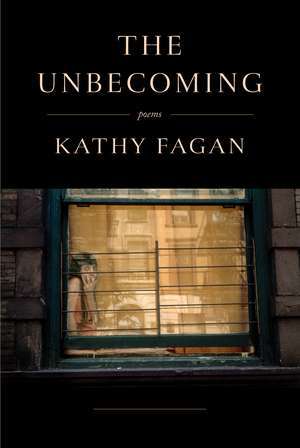
Excerpted from The Unbecoming. Copyright ©2026 by Kathy Fagan. Used with permission of the publisher, W. W. Norton & Company, Inc. All rights reserved.


