


While addressing the COVID-19 pandemic and cancer, Eric LeMay’s fifth book, The First 649 Days: Essays and Other Acts of Love is a bighearted love letter, an unabashed treatise on love of child and love of self.
The author, who is equally adept at writing about German philosophy (Heidegger for Beginners), cheese (Immortal Milk), and his Ohio upbringing (In Praise of Nothing), here sheds light on loss and love. Through diverse forms, including essays, journal entries, erasure poems, and a primary-colored children’s book, LeMay wrestles with illness, identity, isolation, and the paradoxically terrifying and bliss-inducing aspect of new parenthood. A book-length memento mori, LeMay’s renderings of family life traverse the author’s cancer diagnosis and treatment as well as the COVID-19 pandemic’s numbered days—dark woods indeed. But a levity in tone, playful forms, and a well-earned sweetness win out in this book-length exhortation to: love, love, love.
The first essay in the collection, “Ohio Ground,” sets us readers in time and space. “Ohio has always marked me,” writes the author and professor, who returned in midlife to live and work in Appalachian Ohio—LeMay directs the creative writing program at Ohio University—after living for decades in cities mainly along the East Coast. The piece begins: “From my kitchen window, I can see the grove of white pines where I’d like to be buried.”
Where a lesser essayist might go on to ruminate about mortality and burial rites, LeMay’s focus stays with the stand of trees awhile, a spot that “looks very much alive.” This focus makes it and the next essay, a chronicling of LeMay’s son Roland’s “Birth Story,” replete with details of his wife Kristin’s emergency C-section and a nurse named Joy, feel like a perfect pairing. These are the essayist’s bookends, life and death, with loving volumes—however ordinary-seeming at the outset—to discover in between.
Among those volumes dedicated to new parenthood, “Mapa”—baby Ro’s mashup of “Mama” and “Papa”—allows LeMay to interrogate society’s expectations of fatherhood, and his own, with disarming humor. When he feels he’s failed at being a “dad,” he tries being a “mom,” going so far as to attempt to penetrate the inner circle of moms at library story time and the community center. What follows is a 200-word sentence, a stream of consciousness pronouncement of uber-earnest English professorial, sleep-deprived new parent hilarity that also, smartly, hearkens back to that tree stand of life and death that started the collection. Here’s a taste:
I said, brightly, how the other day I was watching Kristin breastfeed and I noticed that Ro had these delicate blue veins spreading outward from the corner of his mouth … and how, under the skin of Kristin’s nipple, I could see similar blue veins … and how watching them reminded me of the tree of life … that we are, by our very natures, branches of one another … and I said all of this, brightly, to all the moms, who were now all staring at me because, as I said, I didn’t want it to get weird.
Along with its humor, LeMay’s exploration of roles within family life help him see and eventually name his own “true gender” as a nonbinary person. Mapa “made the invisible visible,” he writes. “It showed me a truth about myself I’d never seen and maybe never would have seen had Ro not said it.”
It’s this kind of searching and meaning-making through words, even the words of a small child, that the essay form does so well—especially in LeMay’s masterful hands. The collection’s titular “The First 649 Days” is a pandemic-era journal with entries beginning on March 11, 2020, and ending on December 19, 2021. The entries explore everything from vaccinations and the washing of groceries to strained visits with family and schooling from home. The narrative arc feels massive (and takes up the bulk of the collection at more than 120 pages) beginning as it does with, “Today we entered lockdown.” But it’s the tiny details that set this pandemic journal apart. At the conclusion of the 649 days, LeMay recounts Ro’s excitement at the prospect of attending school the next day. “It feels like he’s starting a new chapter,” LeMay writes. “It feels like we all are. Earlier in the week, Ro invented a song. It goes like this: ‘I start up in Minnesota and I go down to Colorado, following the Tree of Life!’”
While the pandemic-era journal has gravitational pull, the multi-formed braided essay “Remember Me” feels like the emotional heart of LeMay’s book—the gooey center, if you will. In this essay is where we find the collection’s purpose: “Yet I myself am the subject of my book. And through it I’m trying to find the self I hope to be, the self my son may one day become.”
In one of the essay’s strands, LeMay turns to the 16th century French philosopher and humanist Michel de Montaigne, who created the genre of the essay (from essayer, “to try”) as a way to “reckon with death” and a means by which to be remembered after his death. Enduring his own dark night of the soul—LeMay is diagnosed with tonsil cancer when his son is just one-and-a-half—our author also hangs on to the “thin hope” that his words will outlive his body, that his readers will keep his memory alive.
“Remember Me,” which was a 2019 Cutbank Chapbook Contest winner, also includes strands of less-essayed journaling about the here and now: LeMay’s cancer treatment, Ro’s first words and favorite foods, and the nearby “Hillsides filled with leaves.” In contrast to the Montaigne strand, the journaling reads like a contemporary digital persona, characterized by quick shifts in subject.
LeMay retains agency over his story perhaps most poignantly in the erasure poetry he creates from hospital paperwork, yet another strand in the braided essay. A few examples (though better viewed as organically-crafted images): “The wound / was turned over / and remained”; “Do you / Are you / Have you / more”; and “please do not / Depart”
Living, and loving, are exercises in trying. Any person, any parent can attest to this struggle. As a cancer patient and writer trying to own—and love—his own story, LeMay seems to feel the struggle fiercely. “This isn’t the first time I’ve tried. Since I’ve gotten sick, I’ve tried to write and rewrite my life as it is now.” It is in these moments, full of candor, that we most feel the author at our side.
Of course, “Remember Me” is also what the ghost of Hamlet’s father says to Hamlet before he disappears. Through his essaying, LeMay discovers a truth we only come to understand as we age, a truth that accelerates at the prospect of sickness and death: we become our mothers and fathers if we live long enough. And if we live long enough, we realize we too will die, which makes us love life all the more. “Now, when I hold my son in my arms and we do our little version of the play, I realize he’s Hamlet,” the author writes. “I’m the father in the play, the dead father. I’m the ghost.”
To be a good essayist is to be in love with form as function. As a multimedia artist, LeMay shines in richly varied forms, each with distinctly different purposes. In “Text Our Dead,” he presents his pandemic-era project by the same name, a vehicle whereby the grieving could send texts to lost loved ones:
So I did what you do with a grief-soaked idea that comes to you on a sleepless night in the middle of a global pandemic. I registered an internet domain, built a website, bought a phone, got a new line, and created Text Our Dead, where you can send a text to your dead.
The piece titled “1-13-21” juxtaposes a log of rising “U.S. Daily Deaths” during the pandemic in one column, with the story of LeMay’s father’s hospitalization in a second, and a debrief from the author in a third. The form reminds one of a comparative analysis, or doctor’s charting, or the kind of daily planner used by the most anxious of people. The words and meanings but up against each other, making new meaning from proximity. In one column: “1-30-21: 2,982”; in the second, “He said not to tell us.”; and in the third, “We are a family that doesn’t love one another enough. Or too much,” LeMay writes.
In “Sorrow-Borne,” LeMay co-creates short birdseed erasure poems with the birds in the woods. “Here are poems of transspecies collaboration,” he writes. “Here are poems involved in an ecosystem. Here are poems that take wing.” A couple favorites:
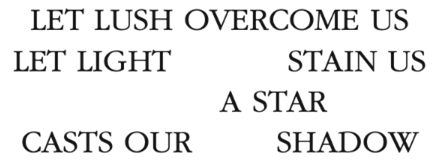
And one that calls to mind Gerard Manley Hopkins’ “Ah, bright wings”:

There is a temptation to fly, to flee, when confronted by great loss or great love, maybe especially love of self. Instead, LeMay’s final essay in his collection shows him essaying hard, working out how best to love himself by showing his truest self as a nonbinary person to the person he loves most, his six-year-old son. LeMay orchestrates a “Taste Test” for young Ro, of different colors and flavors of sherbet meant to represent the different genders, “a little more child-friendly than queer theory,” the author explains.
The story is sweet in its searching. There is no roadmap for such a conversation. LeMay leads with love—and sugar. Like the best essays, and like the collection on the whole, the reader is left to uncover and discover the love between the lines meant just for us.


