Ryan Frigillana: Tears, Blood, Sweat at Silver Eye Center for Photography, Pittsburgh, August 27-November 7, 2026.
Leo Hsu: In Tears, Blood, Sweat, currently on view at Silver Eye Center for Photography, we encounter work from three projects, made over eight years. Across these projects, you explore who you are, what matters to you, and what has shaped both your personal experience and also broader immigrant and Filipino American experiences. You recognize the power of visual culture and also see art as a tool for subverting and critiquing it, and you recognize making pictures as a way of asserting agency, intention, and critique.
The exhibition builds on work you have previously published as books. Your first book, Visions of Eden (2020) is framed in scripture passages and includes your own family archival photos, stills from family videos, reproductions of letters and cards, contemporary images of your family and environment, and images appropriated from Arthur Maxwell’s illustrated Bible stories.
It seems that the book form holds a special significance for you, offering a way to bring your work together. Let’s explore how you think about images, their relationship to one another, and how they come together as books. We’ll discuss three of your books, considering both the projects they present and the books themselves as art objects.
Can you please tell us how this came together and what it was in response to? What did you experience while reviewing the different kinds of pictures that make up this project?
Ryan Frigillana:
Thanks for having me and for this conversation. This is really wonderful to revisit some of these older bodies of work that inform a lot of the work that I’m making today. Visions of Eden really came from me wanting to explore my background in Seventh Day Adventism. I was raised on these images from the illustrated Bible story books when I was a kid.
I was interested in the idea of recreating the visual chronology of the Bible from beginning to end, from the story of creation through Christ’s crucifixion and Resurrection, and then ultimately the second coming. And I wanted to illustrate those events through my own family. I was interested in the idea of Eden, or a place like Utopia. In the Bible, Eden is the first home of mankind and, after sin, mankind was banished from this home. So I was thinking of the parallel between that story and the story of my family’s migration from the Philippines, this idea of leaving our original home and in a sense being banished from it due to circumstances, and then this lifelong state of, at least for me, trying to return to that home, or that idea of home, which in the Bible is similar. We’re banished from this paradise and humankind spends their life trying to return to this idea of heaven or of utopia.
I was thinking of those parallels. I was pulling from my family albums, not really thinking specifically of the context of the images from my family album but just thinking of them as storytelling vehicles.
For me, it just started off as an exercise of, “how can I illustrate the Bible through my family’s history?” But through that exercise, deeper themes started to evolve and I started to follow those themes, like the idea of separation. I was thinking of the idea of the Bible as a love letter; in the church, we are told that the Bible is this love letter from God to his creation, so I interspersed letters from my grandparents who were in the Philippines. I was interested in this idea of correspondence.
And that’s how it started to branch out. There were all these different elements I started to pull from. But I think the emotional heart of that project was my separation from my grandparents. I was thinking of that idea of being separated from your loved ones, from your home. And in the Bible, we’re sort of separated from God and there’s always this eternal search for God.
And I was just using all these different elements, like the letters, the video stills, the album photographs, to speak to that idea of separation, longing, banishment. And the search for a reconnection.
LH: Thank you. So it began as an exercise and the Bible served as a framework initially, but through the process of it, you found yourself more and more identifying with returning to your family as a kind of paradise. Was there a realization at some point in the process of the exercise that made you feel that this was really going to be a vehicle for that?
RF: I can’t pinpoint an exact moment where it happened. I knew that I wanted this thing to exist as a book–that was the ultimate goal because the Bible is the book, and I was interested in that container of a book, the book as a container for ideas and for stories. As I was pulling all these different disparate materials together, I think that’s when it started to click that there’s something deeper here than just a visual exercise of retelling a story. The more I started accumulating and looking, that’s when these deeper themes started to reveal themselves to me.
LH: Thank you. Let’s move on to your second book. The Weight of Slumber (2021) has a more consistent mood throughout. It feels like a different kind of subjective experience than Visions of Eden. Dreamlike images are accompanied by small notes of everyday information like the weather and winning lottery numbers. You made these pictures during COVID lockdowns. Making the pictures itself was a form of processing. When did you realize that you wanted this to be a book and how did you think about what form it would take?
RF: With The Weight of Slumber, I didn’t start that work with the idea of it being a book. I didn’t really intend for it to be anything at all. It was really just a reaction to the times and the circumstances that we were all going through. During the lockdowns, I had just experienced separation from a partner of nearly six years. So with that, coinciding with the lockdowns, there was a sort of amplification of isolation and grief and yearning and uncertainty. I was just collecting images. During the lockdowns we couldn’t leave our homes, we weren’t able to really be around other people, so I was pulling from what was available and accessible to me, whether that was photographs that I made within the boundaries of my own home or images that I collected off the internet, like found eBay photographs of couples, which I was drawn to. I was drawn to the gestures of couples, gestures of touch and care. So I bought these snapshots of couples from eBay. I was pulling from National Geographic magazines, specifically looking at images of water as a way of thinking about grief. Water is a recurring motif in that work. I focus on water’s duality–it can be violent, it can be soft, it can be calming, but it can also be suffocating. It takes many forms, and for me, that reflected my grieving experience during that time of the COVID lockdowns.
I didn’t think any of this would become a book, and it really wasn’t until a residency opportunity at Penumbra Foundation in New York City presented itself, where you can propose a book idea. A risograph process is a very low-fi kind of printing which emphasizes half tone dots. So I thought, maybe all these images that I was collecting, these black and white images, in my grief, whether they’re my own photographs or photographs, maybe the risograph process could be a way of unifying all of these things and having them live in a book. So that’s when the possibility of the book came to mind for me. When I got that residency opportunity, that’s when it all really came together, and I was able to work with the people at Penumbra Foundation to develop a body of work into something physical and tangible, which is very much what the work is about: touch or the lack of touch at the time.
LH:
Did you feel like you had been waiting for an opportunity to be expressed?
RF: Yeah, like, I said, I didn’t think of it as a project. At first, it was just me accumulating things, accumulating images. That’s often how a lot of my work begins–there’s an accumulation of things, whether it’s an accumulation of looking, or collecting or noticing something and then trying to make sense of that.
LH: Your most recent book PATMOS (2025) is a color newsprint broadsheet that includes no obvious text and is entirely rephotographed images from cable news and Maxwell’s illustrated Bible stories. The images are cropped to create uneasy compositions and zoomed in to show high contrast, saturated, almost hallucinatory pixels. Zeros and ones represent words, which I understand are the title and back matter of the book. This feels continuous with both previous book projects, referring to the tensions we experience around visual culture and how context can confer both power and meaning, and recognizing how images can stay with you. You amplify these images in order to draw attention to their power and as a result also take their power away. How do you think about this project in relation to these other books?
RF: PATMOS really came from feelings of anxiety and fear and trepidation. I mean, The Weight of Slumber also came from a dark place, but it was from a place of longing. Whereas with PATMOS, it was really more of a guttural reaction to the events of that time, during the 2020 and 2024 elections, and the anxiety and trepidation I was feeling from the current administration, and the inundation of images that I was bombarded with during those campaigns. And again, it didn’t start off as an idea for a book. It was just me collecting images, or responding to what I was feeling at that time, and I was responding by photographing my screen. It was the only thing that I saw in that moment of uncertainty and trepidation where I felt I had some control. So, photographing became an act of control for me, right? I felt, this is one thing I could control, one thing I could do in this moment where I sort of felt helpless.
That’s how the screen images came about. It’s a collection of images made by me photographing my screen because it felt like a cathartic process. And then the biblical imagery sort of came after that. With Visions of Eden, through collecting and accumulating, broader questions started to reveal themselves. The same thing happened with PATMOS, where I was collecting the screen images, but then, in doing so, broader questions started to reveal themselves to me. I started to think of contemporary images as these prophetic visions, similar to how John in the Bible received visions from God, almost like visions of the future, visions of the Apocalypse, and visions of Salvation.
I started to think of the way images can manipulate us. How they shape our perception of idealism, of salvation, who we pedestalize in a way. That’s how the collages came to be with the Bible story images, and then the screen grabs. I just wanted to recreate that feeling of, again, the anxiety and frenzy, but then I think in being able to manipulate these images and collaging them and abstracting them, I was exercising some control over things that I felt I didn’t have a lot of control over and maybe that’s a way of again subverting the initial purpose of those images.
LH: I really appreciate how all of these projects, which may not even start as projects, are these processes of you thinking about where the power lies in images, and what is important to you and whether it’s you pushing back against something, or you embracing something like the idea of family.
LH: Anyone visiting the exhibition Tears, Blood, Sweat, will see the strong throughline of your family, as well as the way you move through different modes of thinking about images. Before this exhibition was designed, how did you think about PATMOS in relation to projects like Manong and Balikbayan which are more specifically about family and Filipino American experiences?
RF: When I was making PATMOS, I don’t know if I really was thinking about those projects. Making things or making these projects is just a way of me embracing the multiplicity of my experience. And that means I come from a first generation Filipino background, I was raised as an Adventist, all of these things inform me, and I don’t think they can be separated. For me, the work that I make is just embracing those things. I’m not trying to paint one picture of what a Filipino American might be. So when putting the exhibition together, you can kind of see the totality of what makes me, my experience, so individual, and maybe in that specificity others can see parallels for themselves, or they can see themselves in these stories or maybe value their own specificities, the things that make them unique or their stories. That’s what I love about the exhibition, is that I was able to create this experience that is unique, and specific, and in that specificity, it can touch on more Universal things.
LH: Absolutely. I think that the power of it is that it’s really you. It’s this expression of perspectives, questions, experiences, and lines of inquiry that you might have, but it’s all very seated within one person in this very expansive way.
RF: Thank you. I think as I’ve grown more as an artist, I’m leaning more into the specificity. Maybe before, I had this idea that there’s only certain stories I should tell or I could tell. But leaning into these things, it expands possibilities for me and makes my practice more rich, I feel.
LH: You talked about how Visions of Eden had to be a book because it was responding to the Bible as a book. I’d be curious to hear about how you decided on newsprint specifically for PATMOS. Do you have anything to add about how books exist as objects or art objects themselves?
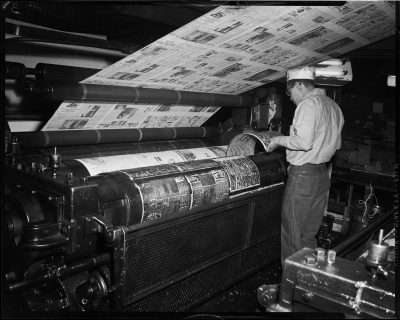
RF: To answer the question about how PATMOS came to be as a newsprint, that just reflects the idea of media or mass circulated media imagery and news media specifically, so I wanted to recreate that tabloid format, or that feeling of holding a newspaper.
It’s an unbound book, it’s a tabloid. That format reflects the instability of the images. You can freely reshuffle them and reorganize them and re-sequence them if you’d like. I think that speaks to the idea of agency again, having some form of control over the images that you hold.
I’ve always been drawn to the book because I’m interested in the idea of the book as a container for ideas, and as a way for people to see work beyond an exhibition. It can travel to places you wouldn’t imagine. And it can reach people who otherwise wouldn’t be able to see the work.
I’ve always been interested in photography as a medium of limitations. For me, that’s one of the beautiful things about the medium–inherently it’s a limited medium, and it’s a limited language but in that limitation there’s possibilities. And for me the same goes for the book. It’s such a limited container, you’re limited by the space, the size, limited by your funding, even. But I think leaning into those limitations creates beautiful possibilities. So, that’s why I really enjoy making book projects. Because it reflects my interest in photography as a whole.