

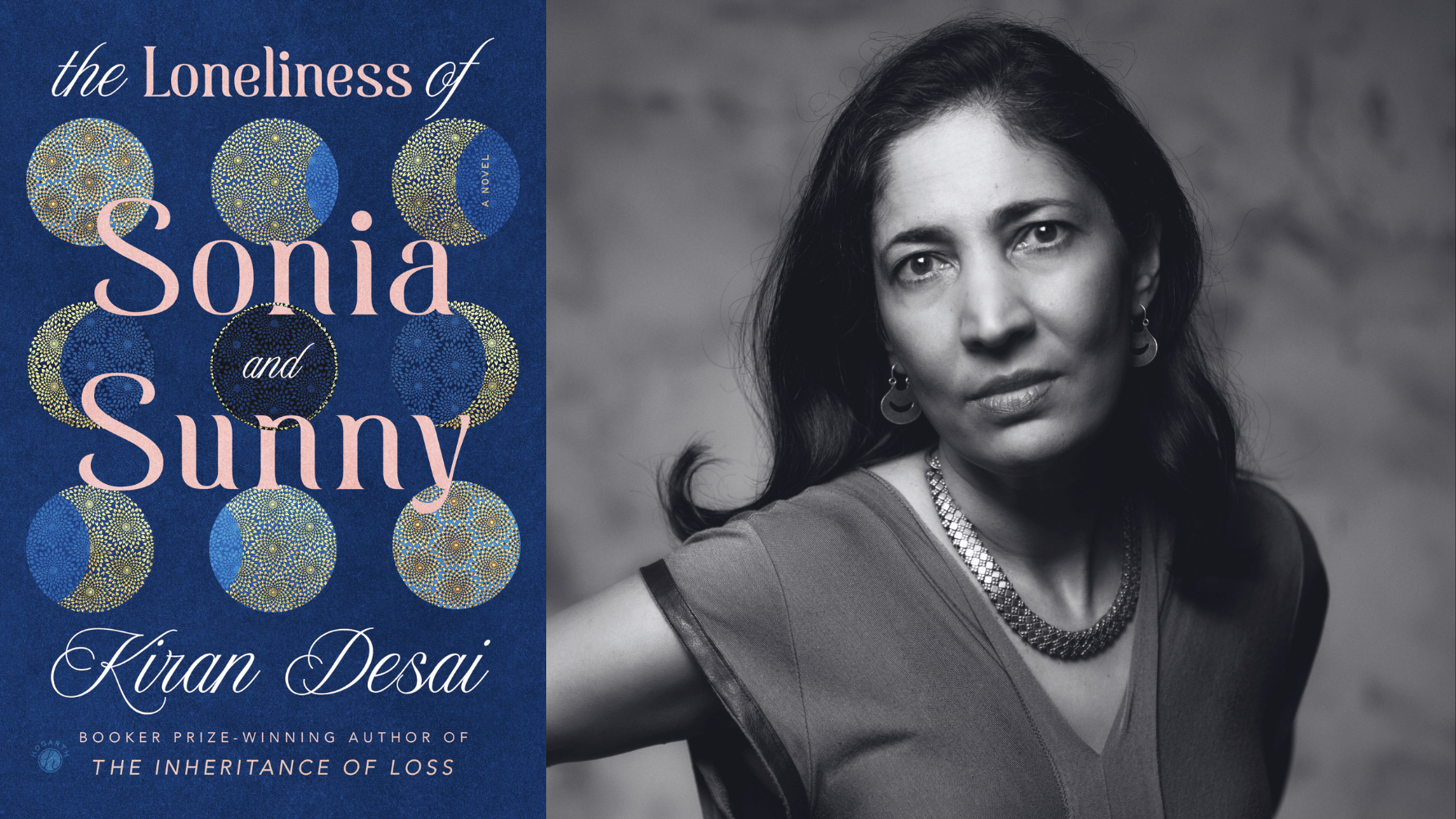
When Kiran Desai won the Man Booker Prize in 2006 for The Inheritance of Loss, she was thirty-five, the youngest woman ever to take home the award at the time and suddenly the voice of a global generation. Her novel about migration and memory captured the dislocations of modern life with wry precision. Nearly two decades later, her gaze feels even more necessary.
Desai spent her first fourteen years in India, before leaving for England and then the United States, where she came of age as a writer alongside her mother, novelist Anita Desai. She writes dexterously about distance — between nations, between people, both social and emotional distance, between who we are and who we imagine ourselves to be. That same distance marked her own long pause between novels.
Her new novel, The Loneliness of Sonia and Sunny, is a decades-spanning love story that crosses continents and generations. Within weeks of publication, it vaulted onto the 2025 Booker Prize shortlist, confirming her return as one of the year’s major literary events.
The making of Sonia and Sunny was relentless. By 2013, Desai reportedly had amassed 5,000 pages of notes; she describes herself as stubborn, obsessed, determined to let the novel take shape in its own time. Neighbors once suggested an intervention — “you need to come out of your house,” she recalls. She laughs at those stories now, but the truth is she relished the dissolution of normal life. She worked through mornings, afternoons, evenings. She traded the world outside for the world in her head.
To take twenty years to write a novel in a culture of constant presence is, in its own way, an act of defiance. Desai’s creative process mirrors the novel’s structure: layered, unhurried, and mellifluous. “I wanted to write a love story with old-fashioned beauty,” she says, “but also one that accepts the impossibility of belonging.”
Now fifty-four, Desai remains one of contemporary literature’s most exacting observers, a writer who describes fiction not as escape but as examination — “a way,” she says, “to hold complexity without simplifying it.”
Pittsburgh gets a front-row seat to this moment. Desai returns to City of Asylum’s LitFest on Oct. 19 to discuss the new book in conversation with Anderson Tepper, her first appearance there since 2022, just weeks before the Booker winner is announced in London on Nov. 10.
Speaking from her home in Queens, Desai is warm and dryly funny, her sentences curling into laughter one moment and dissolving into thought the next. In this conversation, she reflects on her daily writing rituals, the endurance of art, and why beauty still matters.
Q: After nearly two decades between novels, were you always writing during that time or waiting for the next story to take shape?
Desai: I think a book is not just life, it’s all the days that go into it. I was writing every day and working every day because that’s just what I do. I get up in the morning and go straight to my desk. I was creating material, making notes, keeping diaries — things I hope I can use for the future. Now that I’ve finished this book and done some publicity, I’ll begin that process again: daily thoughts and details, which are essential for building a novel.
I worked for years before the idea of this book emerged: a long, unresolved romance on one side, and on the other, a story about globalized loneliness in all its forms — political, cultural, emotional. The book grew out of those pages, though there are many strands that never made it into the final version.
Q: What does a perfect writing day look like for you?
Desai: A quiet morning is ideal. Silence. I go to my desk and work as honestly as I can. Usually, I write well for about four hours, until two o’clock, then take a break and return in the evening for a few hours. Mornings are clearer, more analytical; evenings are more imaginative, freer. It’s a rhythm. Quiet days, regular work.
Q: You’ve lived in India, England, and the United States. How do you navigate being both insider and outsider wherever you go?
Desai: I think that’s true for so many of us now. We carry all our experiences at once; we might be in New York, but our minds are still with family in India or with politics there. For a writer, that duality can be very useful. It lets me write from both directions, inside out and outside in.
Writers who grow up entirely within one culture aren’t always forced to hold that mirror up to themselves. But for those of us who’ve traveled from overseas, it’s unavoidable, and often quite helpful. Sonia, the aspiring novelist in my book, thinks about this constantly: how her work will be seen and read in a Western context. Writers from the non-Western world are often read politically, and I think it’s wise to be aware of that. It helps you understand your own place in the world.
Q: Do you still feel connected to India as a creative subject, or has that relationship become more reflective over time?
Desai: While I was writing this book, my father was still alive, and I went back often to the home where I grew up. That was a precious resource. I would have thought my connection to India would lessen, that my work would move toward the U.S., but it didn’t.
I wanted to trace an arc from my grandparents’ generation to the globalized present, and that took me back to India. I also knew that once my father and that home were gone, I’d lose that living connection. So I thought of this book as perhaps the last time I could write about India in that way — the India of my grandparents, who believed deeply in a secular, democratic country.
A novel, in a way, works like a museum. I wanted to preserve some of that India before it fades completely.
Q: Were Sonia’s grandparents inspired by your own?
Desai: They really were. I didn’t know my mother’s parents, and that mystery invited imagination. I did know my father’s parents — not well, but we visited every year. I wish I’d asked them more questions. They lived extraordinary lives: my grandfather studied English under a streetlamp and eventually joined the Civil Service; my grandmother never learned English, but she adapted to a completely different world.
When I look back, my respect for them is enormous. Their generation transformed India. Our own journeys abroad seem small beside theirs.
Q: You describe loneliness as central to this novel. Do you think writers need solitude to create, or can it become destructive?
Desai: Solitude can be exquisite when you’re writing. Because I’m alone so much, I write intensely; I fill that space with the people in my imagination. I’ve known other writers who can only work amid noise, but I work best in quiet. That’s when I can hear the rhythm of my sentences, and the book begins to speak back.
Q: You grew up surrounded by writers, your mother Anita Desai among them. How did you carve your own imaginative space within that lineage?
Desai: I was lucky. My mother was already publishing by the time I was born, and she worked through what she describes as quite a lonely time in Indian writing in English. There were very few writers then, maybe R.K. Narayan, and later Salman Rushdie’s Midnight’s Children changed everything. Then came Arundhati Roy’s The God of Small Things, and suddenly Indian writers were being published internationally.
I’ve lived through that evolution, from being the only Indian in my high school in Reagan’s America to now, when Indian writers are part of the literary landscape. My own work remains in that diaspora space, the in-between. That’s where I still locate my stories.
Q: Do you ever share drafts with your mother?
Desai: Yes, but only complete drafts. She has extraordinary taste and a critical eye, but she’s also my mother, so there’s a softness in her reading. She understands the landscapes I write from, even when a piece isn’t fully realized yet. I’m incredibly lucky for that.
Q: Your prose has a musical quality with its long, luminous sentences, but also humor and wit. Do you think about rhythm consciously while writing?
Desai: I think a book should always be both tragic and comic, because that’s life. In India, we love humor; people seek it out. My father loved to laugh. So I try to reflect life as it is: light and dark together. My first book leaned more comic; I was too young then to include the darker shades. Sonia and Sunny feels more balanced with more humor, but also more depth.
Q: You’ve mentioned music and painting as creative influences. What role do they play in your writing?
Desai: Music provides a kind of architecture for thought. It teaches you about rhythm, repetition, emotion. I listened to a lot of my father’s favorite music while writing, Sultan Khan on the sarangi, Sufi songs by Nusrat Fateh Ali Khan and Abida Parveen. That mystical strain shaped the book in ways I can’t quite trace.
And I love painting. I studied art in college, and I go to museums everywhere I travel. On book tours, I always visit local galleries. The last time I was in Pittsburgh, I went to City of Asylum and a few of the smaller museums; they were fantastic.
Q: Do you write toward an ending you already know, or does the story reveal itself when you surrender control?
Desai: The story reveals itself. I wrote multiple endings while seeking what felt right to the characters and events. There were practical matters and more esoteric ones as well that needed to come together.
Q: You’ve said the book grew from over a thousand pages. What did trimming that excess teach you about writing and about letting go?
Desai: It was difficult to cut, yet essential to cut for the book to move, so I could reveal connections and echoes that otherwise would have remained buried. I think I’m going to try to be more conscious about this process next time around.
Q: What’s something small or funny about you that would surprise readers who imagine you as serious?Desai: I’m quite lazy about getting out of bed in the morning. I know if I had a dog or a child, life would be otherwise. But since I don’t, I allow myself that little luxury of taking my time.


