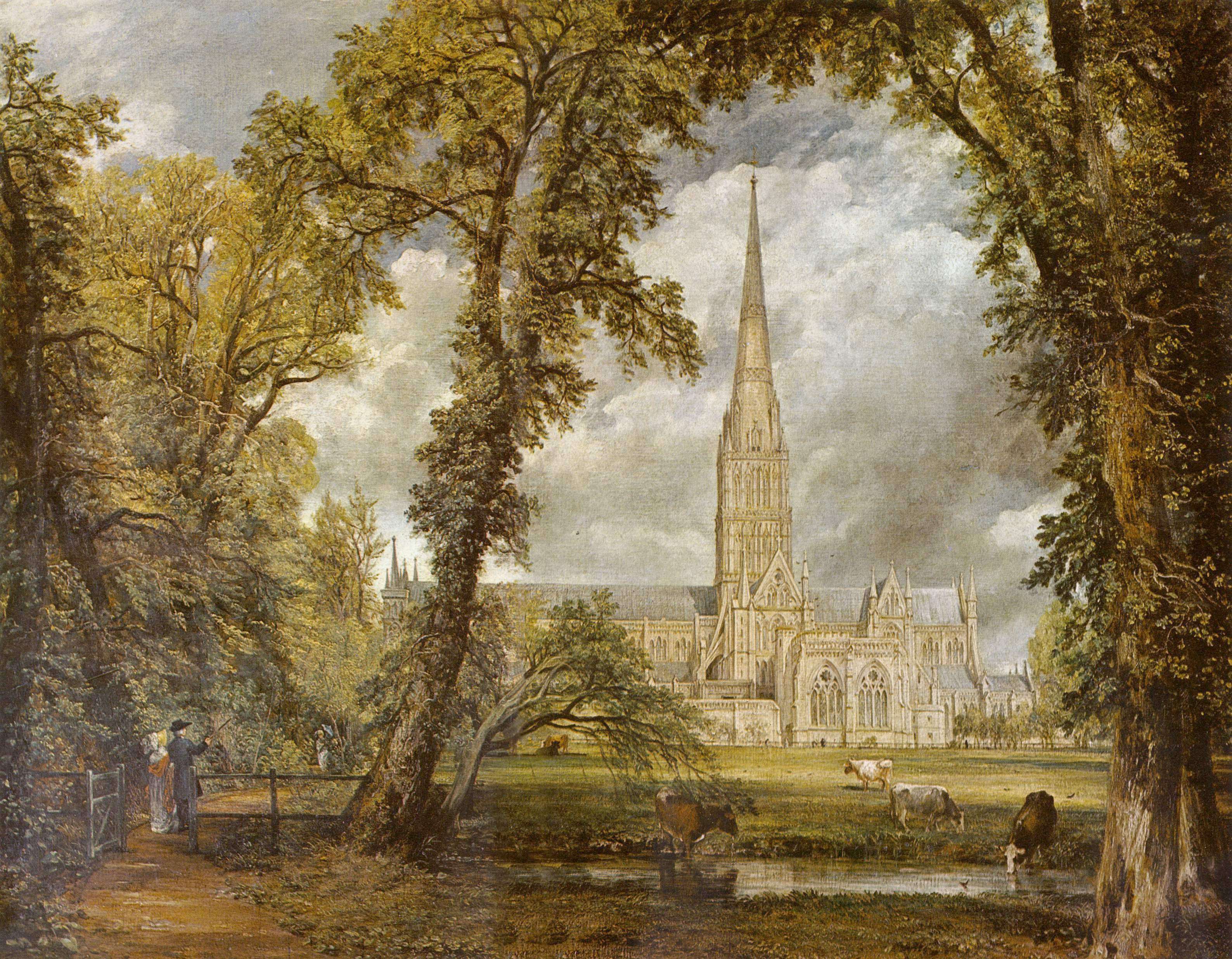
The University of Pittsburgh’s Heinz Chapel would disappoint John Ruskin. Like one’s first attempt at love after heartbreak, the neo-Gothic only numbs the ache left by its medieval predecessor. I imagine Ruskin cross-armed and scowling in these pews by my side, scanning for traces of his beloved Gothic in Heinz’s oak altar and limestone canopy. The nave is purpled by stained-glass the color of cobalt-blue bottles and a nosebleed. He would trace the textured columns with his eyes closed to that violet light, waiting for her answer to his touch. But the Gothic, as Ruskin remembers her, does not ensoul these stones. Heinz’s single spire points skyward, shaking its frail little finger at heaven.
I first read Ruskin’s 1853 essay “The Nature of Gothic” for a literature class while surviving the cadaverous, midwinter months of university. He writes both frantically and with tenderness. He is a pervert and a voyeur and disturbed. I found myself smitten and wholeheartedly convinced by his whimsy and false confidence. I read the piece as confessional, and I believe his inner world is as sensitive as my own. To me, his essay is a love letter to brutality.
Ruskin’s pries cathedrals open by their jaws and their joints. He peers at the grim histories of their makers. He presses at the God-shaped bruise on his heart. Our demented delight is shared, and my obsession is both voluntary and incurable. Bittersweetly, Ruskin makes peace with the unknown, for his Gothic rejects his advances while encouraging his interest. Ruskin’s language captures sweet, summer meadows that wilt and then harden into vicious thorns. His desire blooms by night, but he reaches for the sun.
We begin with Ruskin’s assertion that there does, indeed, exist a “true” nature of Gothic architecture. I hesitate to take him at his word, which, like a mirage on a white-hot dune, oscillates between truth and belief. Ruskin posits a dualistic account in response, claiming that the Gothic is comprised of an immaterial soul and a material body. The structure is not necessarily a cage. It is bone and muscle, bound together by carved tendons and a stone spine.
Living bodies thus require organs. Ruskin suggests that it is not merely the stone vessel in which the Gothic’s nature resides, but also in the sufficient unification of “ideas” supplied by those who labored upon a cathedral. From this golden ratio, life erupts. By humanizing the enigmatic Gothic, Ruskin diffuses its mystical nature by way of brute-force dissection.
Indeed, incisions give us glimpses of our inner worlds. According to Ruskin, we intuit the Gothic in our minds, but we lack the words for its description. Despite his presumptuousness, I believe Ruskin simply seeks kinship through this generalization. Perhaps his assumption is self-soothing, howled into a void, unanswered. The Gothic is similarly measured in desire. We are to blame for its power over us. I wish that we could sit in Heinz together, stone-still and silent enough to feel the chapel’s tremoring pulse. I understand the Gothic as a wild horse. Despite promising her freedom, Ruskin clutches her by the bridle. We cannot free what was never ours, but Ruskin tries—earnestly. And yet, she breaks free from his heavy hand. He reaches into the empty air, hoping for one more stroke along her flank.
In hot pursuit, he ushers us across Europe from a bird’s eye. He requests only “a moment,” but drags us past peninsulas and over mountains, through creeks and valleys, between trees in every shade of green. The Mediterranean is “ancient” and “sleeping.” Its countries recline in the afternoon heat, paved in gold and perfumed by jewel-toned flowers that pour over the edges of their terraces like water. The South bathes in ease. Even stormfronts drag, half-awake above the sun-stained fields, otherwise surrounded by blue sky and bluer sea.
Here, Ruskin’s prose approaches poetry. He fingers every palm frond and bougainvillea; he squints towards ivory mountain ranges that flash when struck by the setting sun. Ruskin’s South is lovely and lazy. Here, passion sweeps him off his soap box and into the pages of a diary. Europe’s bare midriff arcs into a “vast belt of rainy green” before us. Crisp, shadowed by heavy-boughed forests and veiled by mist. Northward, still, the land “heaves” and “splinter[s]” into grim swathes of rock and thorn. Endlessly plagued by storms and shoved by belligerent ocean waves, this place is both bony and sodden. Trees topple, exhausted by the wind. Gloom bruises the landscape and snuffs out the sun. Here, we soar above the birthplace of the Gothic.
There exists in me a rhythmic pain. It’s there and then it’s gone again, blinking with the cadence of a lighthouse perched upon these cliffs. Repressing one’s heart leads only further into discomfort. Like stripping the velvet off new antlers, there exists pleasure in abandoning one’s past comforts. The Gothic exists in the same halfway place, both eroded and restored by the baring of its battered soul. It is elusive and erotic and a myth. One mustn’t deny mysteries their freedom.
Balanced between dread and delight, Ruskin makes peace with human imperfection. What I imagine he would like to say is that we live in borrowed bodies. We grow and then decay again. All living things are, to some extent, irregular and deficient, and these qualities are “sources of beauty” in ourselves and our neighbors, in our craftsmen and artisans, in our foxhunting horse and the hound at his heels, in the oaks and the cedars, and perhaps even the crocuses long-gone before the snow melts. To avoid change is to paralyze oneself.
Ruskin thus requests that we “either make a tool of the creature, or a man of him.” To Ruskin, craft is itself a force of nature. When free to work as they wish, laborers shed their shackles. There exists tension in Ruskin’s tactile description of creation. Human touch thus proves vital to a healthy and satisfied soul. The Gothic “cannot exist without” the savageness vital to our creation and survival. We must rake through the thick thorns of tragedy and emerge both with wounds and hands full of berries.
So, what do we gain from a laborer’s transformation into a man? On artistry, Ruskin writes that “the idea of reading a building…and getting the same kind of delight out of the stones as out of the stanzas never enters our mind for a moment.” Let’s change that, he seems to say. Ruskin notices that “there is indeed rhythm in the verses, quite as strict as the… rhythm of the architecture,” but beneath our proclivity for definitions and grammar rules lurks a more transcendent pleasure towards the art.
The Gothic arches depart both from tradition and each other; every individual differed slightly from its neighbor. Emerging from cryptic cathedral halls, Ruskin squints into the sun with a hand at his brow, mumbling that change is “most delightful after some prolongation of monotony, as light appears most brilliant after the eyes have been for some time closed.” Understanding the Gothic is thus an endless process of enlightenment. At a whim, the Gothic may “shrink” or “expand,” it may “coil into a staircase” and then “spring into a spire.” Half-baked cathedrals warm and soften, melting at a touch. Then they harden and swell with a will of their own, finally bending to their maker’s whims. The Gothic curtsies and tantrums in the same breath. The Gothic welcomes its own submission. But make no mistake, for its venom remains.
The Gothic dirties itself with bile and sweat. Unlike poetry’s “feeble utterances” of some profound sensation beyond oneself, architecture voices one’s interiority. Further, say we corner Ruskin and describe to him the sensation of pain. Say then that we reach out and pinch Ruskin’s arm. Now, he grasps the rift between concept and experience. Herein lies the difference between the Gothic and other architectural styles. The latter describes pain while the former inflicts it. Thus, the Gothic yearns for peace felt only by the dead. She roots around inside herself, searching for something she will never find. Of her rampages, only a star-shaped scar remains. In this endless eventide the Gothic traces her throbbing forehead like a maiden might touch a captive unicorn’s brow— a magical and disastrous place.
Perhaps the laborer finds himself uninspired. Tossing aside his chisel and wiping his filthy hands upon his clothing he absconds from his work. Sun-scalded and exhausted, he makes for the forest. There, the laborer discovers his truest muse.Ruskin breathes deeply into these woodland visions with introspection bordering on worship. The laborer harvests handfuls of swaying sweet grass and braids them into crowns. Imagination yields an endless springtime, graced by fragrant blossoms and rolling hills, great and green, peaceful in their stasis. Likewise, our laborer must bravely face the eventual browning leaf and the graying sky, clasping the Gothic’s hand and placing a weedy coronet upon her head.In the morning-misted air he breathes deeply like a young bull, shooting hot air from his nostrils and pawing deep rifts in the easy dirt. And yet, he curls into himself with a lamb’s love. The Gothic laborer welcomes mortal strength and likewise its feebleness.
To spread the forest open by its palest, outer petals and study the pink virtue within proves challenging to even the most generous, but the Gothic laborer developed an “intense affection” for the landscape’s wordless language. While often raw and painful from his work, the laborer’s soul is likewise flooded with overgrowth. Change, too, proves bloody when forced in “the haste of the hunter and the rage of the combatant.” But when coaxed by the sun or the silver play of moonlight, the laborer “is at once soothed and satisfied” in the same fashion as the changing day directs a flower. Beneath its more tumultuous qualities, the Gothic yearns also for the tranquility felt on walks amongst the trees.
The Gothic reminded her makers that value followed from connection. In return for mapping the ash tree’s bark or transcribing the river-reed’s song, one would be “sustained by the gifts, and gladdened by the splendour, of the earth.” Think not of grass’s contribution to the weaving of a basket or the breaking of a fall. Instead, consider the delicacy required of one’s chisel when recreating every blade beneath a stone saint’s bare feet.
Having discovered a sufficiently sized rock, our laborer lowers himself flat and considers the canopy’s graceful waltz above. The boughs peer down at him with a doctor’s attention and a child’s curiosity; he closes his eyes when the sun sprinkles through the leaves. Ruskin interrupts the afternoon reverie, stating that “the Gothic did not arise out of, but developed itself into a resemblance to vegetation” at her makers’ behest. The next day, our laborer recalls the forest as he works. He erects tremendous textured columns in the cathedral’s main hall. From them sprout interlacing arches, perfectly tangled by an unseen wind and casting an unfelt shade upon the nave. Ruskin believes that we engrain nature’s beauty into stone over time, which “influenced at once the heart of the people, and the form of the edifice.” For, in its infancy, the Gothic battered the land through brute strength and fanaticism. Fear blinded its builders, yielding walls built for protection in exchange for a near-constant darkness.
As wars subsided and adrenaline waned beyond the convent gate, “the stony pillar grew slender and the vaulted roof grew light, till they had wreathed themselves into the semblance of the summer woods at their fairest.” Peace sways like a sapling beneath trees far more ancient than any living man. Cathedrals sleep among their mossy trunks. Where unnamed blossoms once bloomed and were “trodden down in blood,” beyond the outer walls, “sweet monumental statues were set to bloom for ever, beneath the porch of the temple, or the canopy of the tomb.”
Our laborer need only walk barefoot and ungloved beyond his worksite, accepting the forest’s loose hug. Perhaps he’ll linger there in the clearings and the creeks that wind beyond the paths he knows. He watches the white afternoon amber into evening. He senses God’s touch upon that place. Rhododendrons fluff themselves against the coming dark. Lilacs lean upon the smaller rocks—which in the violaceous dusk—look more to our laborer like headstones. A rook titters in the dogwood. By night, the forest clasps him between its praying hands. We bear our world’s history, branded by its iron in a place we cannot see. Grief blankets our laborer’s small paradise, reminding him of a past he never lived. Tomorrow, our laborer rises with the sun in bed beside him. He wonders if he dreamt about those woods. That night he asks God for salvation. And God will tell him to look at his hands.
Ruskin identifies an “energy” ensconced in the Gothic whose temperature I struggle to name. He describes a constant, upward reaching. This movement implies quickening in vigor, like the still-crisp, early spring. But, also, a nettle’s pause by frost into a defensive posture. Blunt and beautiful, the Gothic braves her endless winter, wistful still for promised warmth. Ruskin says our laborer’s “habit of hard and rapid working” imbues the Gothic with her contradictions. The once-emerald field quiets itself beneath snowbanks and rabbits’ feet, waiting patiently as our laborers return and return and return. The Gothic’s rigidity also proves her resilience. She freezes and thaws, bludgeoned by wind and sleet. Her creators work until the dirt yields, darkened by spring showers; their souls prickling like a sleeping limb might when shaken back to life.
The Gothic curses the laborer who condemned her spirit inside a form not built to last. She begs for her freedom, cracking and collapsing in protest when built too tall or too wide. Wavering beneath the weight of the laborers’ design, the Gothic weeps for her failing bones. In her ribcage, a monk balances a vast choir of candles. Stained glass plugs the gashes left by her decay. Worshippers hum prayers to themselves in her halls. The Gothic guards this hungry army, opening herself wider, embracing those who stayed.
Still, the Gothic wonders about the laborer. Her body, lovingly crafted, was “sent like an unperplexed question up to heaven” for which she now receives no answer. But maybe he will return to that forest of his youth. Maybe he will remember his hunt for her image in the trees and the wind which traced wrinkles on the rivers’ surface. He will remember how their fear was mutual. The Gothic’s, a doe’s, stark-still among the crabapples; his, a hunter’s, squinting past his arrow and admiring her one last time before he shoots. Her creation was itself an act of violence. But, like a good hunter should, our laborer uses every part of the animal. Every visitor gets their bite. As willingly as her creator loosed his arrow, equally did her flesh accept its point. She settles into the undergrowth, disappearing beneath a floral blanket. And finally, she sleeps, like an ancient monster or a fawn waiting for its slain mother.
In a world more perfect than this one, Ruskin admits defeat. Instead, he whistles for the Gothic as one might call for his lover’s attention across a crowded room. Our ever-patient scholar would indulge her proficiency for stubbornness, asking only that she show herself to him.
When our long-gone laborer constructed the Gothic, he did so gently, despite his callouses or his bottled-up frustration. Elusive as she may be, we still recognize the Gothic’s silhouette playing on the wall and incensing the cathedral with the smell of roses. So, in this decidedly imperfect and imaginary world, Ruskin and I sit patiently through the organist’s sonorous afternoon practice. Heinz Chapel’s hall darkens to mauve, and I can tell the sun is setting. Familiar with rush hour bus routes and a coat too thin for Pittsburgh’s winter after dark, I would gather myself up and set Ruskin loose.
Outside Heinz Chapel, the plum-purple evening stains my hands and face. Fresh air hands my freedom back, slowly and then all at once. I wonder, walking now, if I will ever understand the Gothic. Half of me hurts in her absence, the other breathes a shuddering sigh of relief. My search felt sweet at first. The Gothic faithfully haunted my every dream. Here I stand exhausted, empty-handed, and content. The Gothic, thoroughly pleased by my retreat, might linger in my peripheral vision. A somersaulting, sable feather; a cloven hoofprint in the dirt; the humid, golden sunset after a storm; a coyote, dead on the side of the road; a graveyard; two rivers converging into one, shushing and rolling, celebrating the great distance its waters have yet to travel.