When I give workshops on public writing, I often share the anecdote of a hypothetical (but very real) professor who has published in top-tier academic journals, and then they come to my office saying they are ready to write an op-ed for the New York Times. I have to gently let them down and explain that they might want to try for some more midway points, first: all the arts and culture magazines and websites that aren’t quite the NYT but are perhaps more reachable and can still, in fact, help them reach wider audiences with their research. Build up to the Times, maybe?
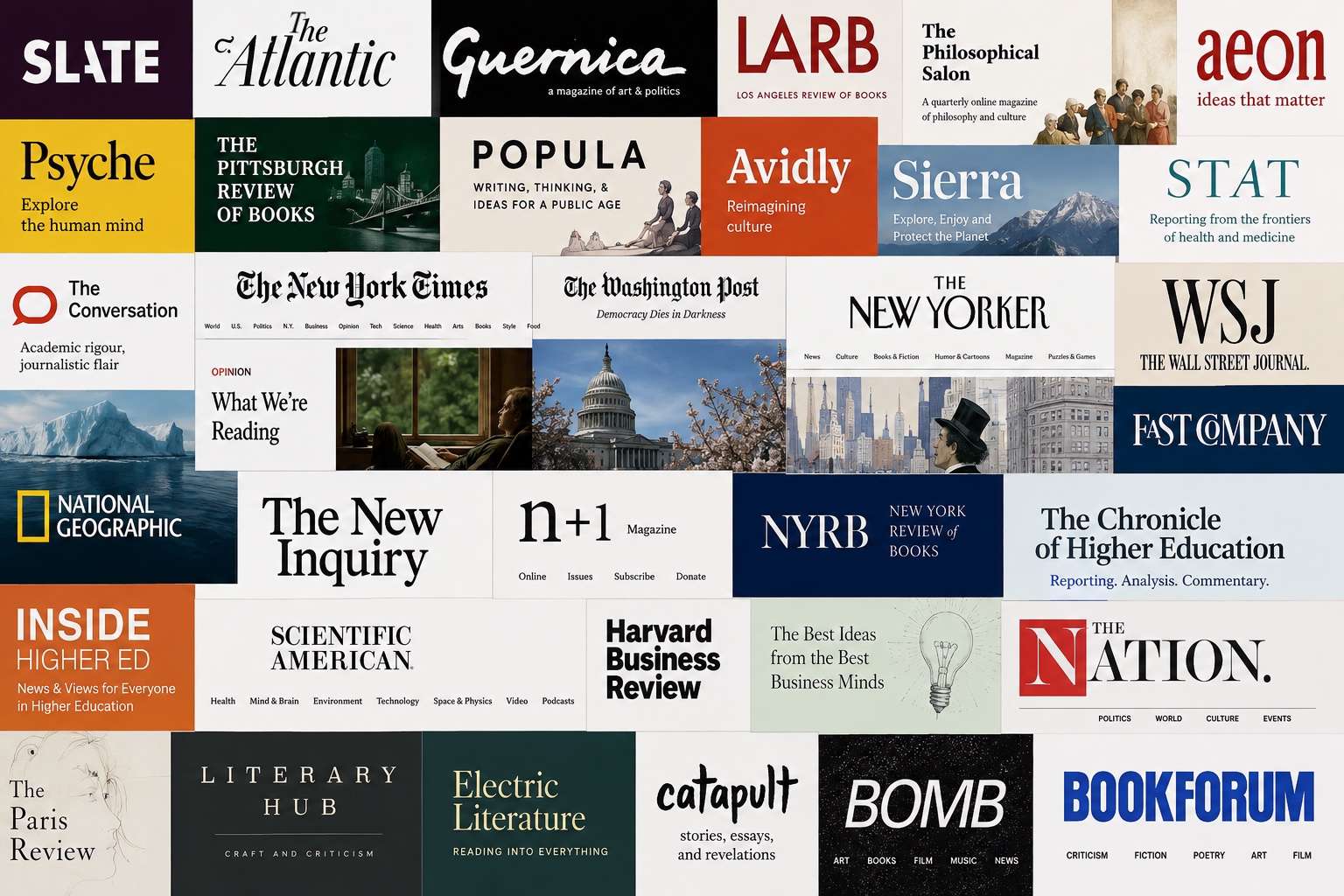
The problem is that there used to be a lot more of these places out there. In my workshops I usually show a slide with a collage of dozens of homepages of sites where smart, free, and open-to-the-public writing lives. Some of those places have shut down. Others have imposed debilitating paywalls. Still others have tribalized and have become harder to write for as an outsider. Others remain live, but they drip out just a few pieces a year, and no one knows how or who is running the show.
My interest in this realm has always been to look for active spaces beyond disciplinary associations or academic publications, where someone in a scholarly position could nevertheless share their ideas, their expertise, their research, their creative work—whatever. Sometimes that means trying out a new form of writing, whether that’s the personal essay, the book review, or the interview conversation. I was probably inspired by the era of blogging, when it was so easy—maybe too easy—to just ramble on for a few hundred words about whatever you’d just read or seen on the screen, and then hit POST. This was self-publishing, but it sure looked real and felt good, especially the ‘public’ part of it, where you’d never know who might stumble upon it! And, for some people at least, I think it provided some ad hoc training in media and publishing. (It did for me.)
Of course, those were more innocent days of the internet. A lot happened over the next twenty years. Now we’re at a moment when the media ecosystem is in disarray, editors and writers are on the run, scandals erupt around every corner, thought-police patrol for viewpoint diversity, and resources are drying up like groundwater in Phoenix. It’s no wonder that a lot of literary and cultural websites are having a hard time staying viable in this moment.
It got to the point where when scholars came to my office to talk about the short essay or op-ed they wanted to write for general audiences, I was beginning to feel a bit constrained: Could I help them turn it into a research explainer for The Conversation? (Always a solid option, if we could do it!) Did we have an in-house publication somewhere at our university that would welcome the piece? Otherwise…the odds were getting increasingly long that we could find a home for their writing, much less cut through the noise to garner an audience. Even if someone gets lucky, or has the right connections, to get an opinion piece or essay in the New York Times, it’s maybe a few hours of celebration and attention, then whoosh—on with the next onslaught of news, horror, crisis, etc.
Then one day in 2025 I got an email from Ed Simon, who was newly hired at Carnegie Mellon, who was announcing the imminent launch of the Pittsburgh Review of Books, modeled somewhat after the preeminent LARB—but cloudier, perhaps rightly so for darker times.
It’s fun to launch a new project like this: The initial release, the first publications, the lineup of forthcoming pieces! What’s really thrilling, though, is to sustain momentum, and to persist. And PRoB has persisted. Ed has done a brilliant job gaining momentum, attracting contributors, involving students, and overall just creating an inviting platform for established and emerging writers around the arts, contemporary society, and ideas. This is no small feat, given the cultural backdrop. But somehow Ed has managed this and kept PRoB real and ongoing, covering an array of authors, topics, and current issues while avoiding any easy labeling.
Ed even made a space for an idea I’d been incubating for a while, which was to reboot the essay side of a book series my colleague Ian Bogost and I co-founded and have co-edited since 2013, Object Lessons. So we put together the column Impressions at PRoB, which are exactly 500-word essayettes on single things, each with a custom illustration by my partner Lara Schaberg. We’ve published almost 40 so far, and have some gems in the pipeline—and we are always open to submissions.
There’s something deceptively old-fashioned about PRoB, and the notion of the “review of books.” It’s non-threatening, the landing page almost even resembles a website that could have existed in my beloved blogosphere of yore. There are no ads. The writing is not exactly long-form, but neither is it over before you know it, in the way that has become normal even in many prestige outlets. It’s a place for writing to get you thinking, or writing to clue you into a new book, or to prompt revisit an old one newly relevant. But, in that clever way that humanities professors used to remind students that “everything is a text,” the book part of PRoB is just the opening gambit. There’s so much space here to explore, to discover, to write into. It’s kind of like that recent movie Backrooms, without the freaky unconscious.
Here’s to the next year(s) of PRoB, which I have no doubt will bring in more excellent contributors and a variety of themes unimaginable as of now. My office is so glad to have PRoB online and actively publishing, even (and especially) in this chaotic, content-glutted time.
Hey, I wrote a whole essay and haven’t even mentioned AI yet! I haven’t done that in a while. Okay, back to your regularly scheduled programming.