“Anything one does every day is important and imposing and anywhere one lives is interesting and beautiful. And that is all as it should be.” – Gertrude Stein
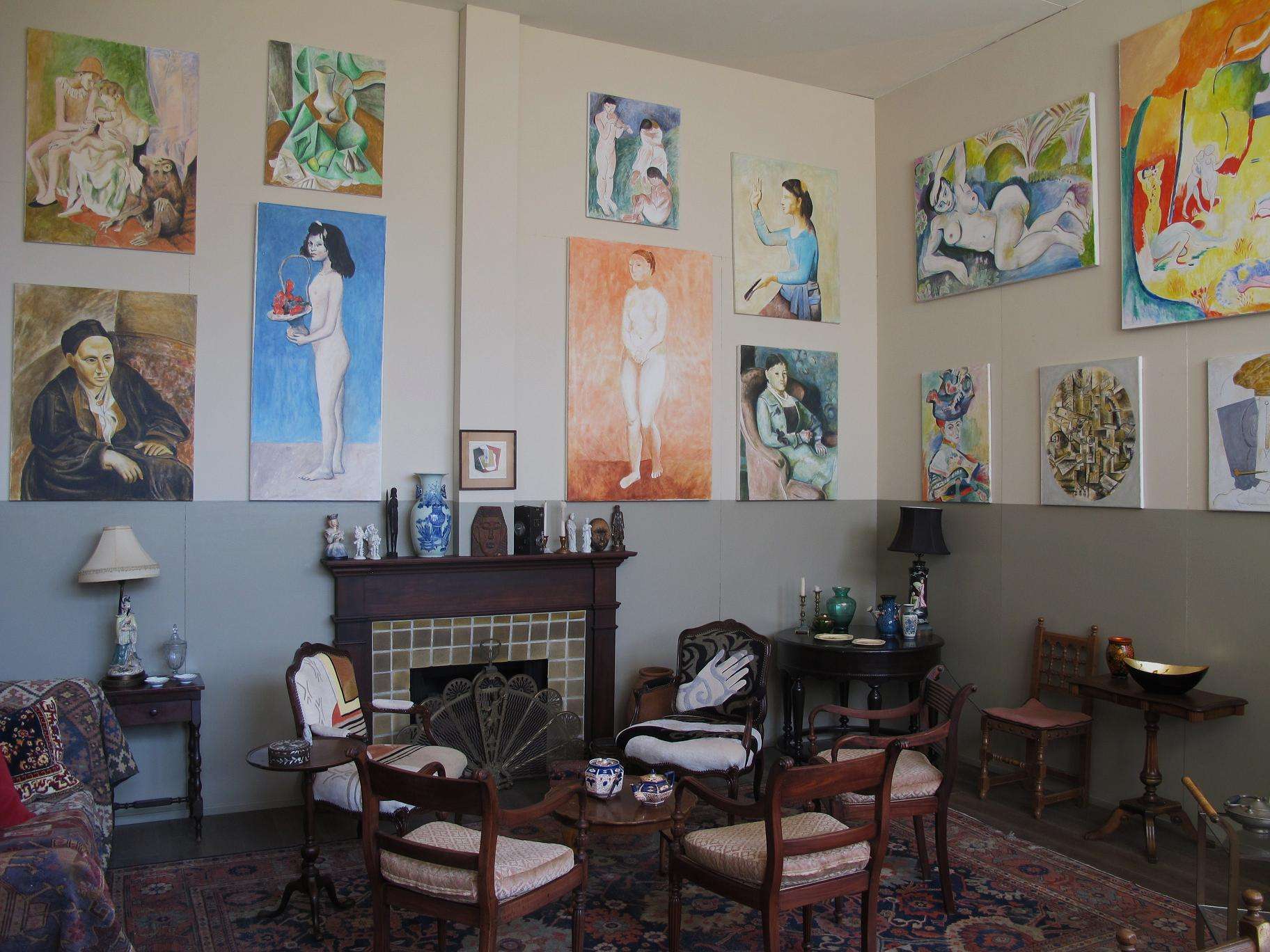
When I first read Moveable Feast in high school, I dreamt of literary salons—being invited to Gertrude Stein’s 27 Rue de Fleurus in Paris, where she held court with Hemingway and Fitzgerald, surrounded by paintings by Matisse and Picasso and Cezanne, who’d show up, too, to drink wine and tea and bicker over beauty.
Gertrude Stein, born in Pittsburgh, 1874, but forever Paris. Always that. Paris. That other world. Paris. Something ineffable, the scent of violets, the light always on the verge of sunset or sunrise. Paris. Another world, so filled with books and music and art, so far from my own.
***
My husband and I live in the house I grew up in, at 303 Hillcrest Drive in Trafford. For years, we loved to host big parties. Because we’re writers who have more books than furniture, and because like-things attract like-things, the friends we’d gather for those parties were also mostly other furniture-challenged writers and poets and artists, musicians, photographers and painters. My husband and I have been also gifted with a few wonderful chef-pals, because food is art, and actors, because empathy is art, and a stand-up comedian or two, because laughing at the world, especially now, is oxygen.
And the best gift: not a single literary critic in the bunch. (Sorry, Gertrude Stein.)
The gatherings were loud and crowded and we loved it. Our tiny ranch house – kitchen cabinets sighing on the verge of collapse, the carpet juice-box-stained and threadbare – would be overrun, not enough seats around the wobbly dining table and mismatched chairs we snagged from Facebook Marketplace, heavy pours of wine all around.
Silsbe would bring his magic bag filled with books he’d unearthed from his job as a bookseller and pass them around like communion. Pajich would bring his guitar and play some new songs he’d been working on and within minutes anyone could sing along. Amy would sit down at the untuned piano and somehow make it sound glorious. Louie would show us his paintings, transcendental skeletons mostly, that would one day cover nearly every space on our walls. Syl’s brown-butter chocolate cookies, still warm, would make everyone swoon. Beth’s sourdough bread, wrapped in sunflower tea towels, was love incarnate.
We’d read poems to one another and talk about books and movies and plays and restaurants and, yes, even politics and the devastating state of the world. Music sprawled from our basement out into the perfect, chemically treated lawns of our suburban street. This probably kept our neighbors up, though they were always sweet about it and never called the cops.
If this sounds like bragging, okay. I love the community we had, still have, all these gifted, strange, beautiful people. Looking back now, it was a glorious time, our own Rust Belt version of Bohemia, except with none of the pretense that might have come with that word, or with Gertrude Stein and wild-woman Natalie Clifford Barney and their beautiful, elusive, illustrious Paris salons.
Our house in Trafford, Pennsylvania didn’t offer crystal goblets or fainting couches or tea sets. No naked women arrived on horseback, and our backyard lacked a Doric temple to dance around. We don’t even have a She Shed. But I like to think Hemingway would have liked it here, especially the bookshelf his books have all to themselves, such is our love for the man and his work.
Still, you should see that carpet.
***
Looking back now, those times feel as precious to me as maybe the intellectual and literary gatherings in those earlier centuries felt to the people who gathered in them.
And then I was diagnosed with cancer and took months to recover. And then the pandemic happened, and all the isolation that came with that. It seemed like in those few years, the axis of the earth, or at least our tiny place on it, shifted. The bloodless technology that at first seemed like salvation—Zoom, Facetime—replaced in-person gatherings. Texts replaced the email that replaced the voicemail that replaced human conversations. The isolation came fast but hung on. The full weight of adulthood sucker-punched many of us. Ailing and dying parents. Struggling kids turned young adults in a strange new world. Lost income. Fear. Politics. So much of that.
It’s been a long time since we hosted one of those parties.
“I forgot how to people,” one of my sweet writer/students said when we came back to in-person classes, post-pandemic, post-masks and after many months of online lessons.
People as a verb.
People as something lost.
***
When I think about the role Pittsburgh Review of Books and publications like it play in the world, more specifically in my life, I think back to those parties. All those wonderful conversations. The music. The poems. Passionate ideas and dreams lighting tiny fires everywhere. The connections I felt that made life feel meaningful.
We’re getting back there, I think—learning to people again–but, like with most losses, something lovely and new has sprouted in the meantime.
When I long for literary companionship, exciting conversations, ecstatic poems, stories that light me up and hold me close to others—when gathering together around a table feels impossible because the silliness of the world has made it so—I am thankful for dear Ed Simon and The Pittsburgh Review of Books.
Publications like PRoB—filled with the voices of all those vibrant humans debating and contemplating and celebrating literary life—provide a community that no house—not our little space in Trafford, not Stein’s two-story in lovely Paris, not Clifford Barney’s athenaeum—could hold.
Anyone anywhere who’s longing for good conversation and inspiration can turn to PRoB and find it. At a time when other media have abandoned their book sections, at a time when so many have written off the United States as a post-literate society, PRoB and other publications like it hold fast to the belief that writing and art matter, that they are our most human gifts, and providing a space for them is like offering a life raft to someone drowning.
Pittsburgh, my home country, has often felt left out of the national conversation around writers and literature, and yet Pittsburgh is home to one of the most essential publishers of poetry in the nation—The University of Pittsburgh Press. It’s home to Autumn House Press, an award-winning independent publisher, and a vibrant community of bookstores. Pittsburgh, in case anyone needs reminding, is the home of the first of many Carnegie Libraries, such is the importance of literature in our steel-city beginnings. Pittsburgh is, in short, a literary hub—see dear Samuel Hazo and The International Poetry Forum, established in 1966, which hosted every major American poet from W.H Auden to Mary Oliver, and is now revived under the direction of Jake Grefenstette.
Did I mention Gertrude Stein was born here?
PRoB honors Pittsburgh’s literary history, but it also shines a light on the incredible range of contemporary writers and artists who make their homes here. In PRoB, readers find Pittsburgh writers like Scott Silsbe (the same Silsbe whose magic bag of books lit up those parties long ago), and Jason Irwin and Jenny Ashburn and Kristofer Collins and Jessica Manack and so many of the contemporaries I long to have around my dining room table someday soon, when the world lets up a bit. But for now, they’re here with me.
As is, sweet everything, Willy Vlautin, not from Pittsburgh but one of my favorite writers, who, in an interview with Matt Petras in a recent issue of PRoB, reminds us:
“Life can be really funny….there can be a lot of love in that world and a lot of fun and humor. The day-to-day life is not that bad when you’re not in a dark situation.”
Even Gertrude Stein takes her seat in the PRoB salon. In a recent issue, Francesca Wade revives Gertrude Stein in an exploration of Wade’s biography of Stein, An Afterlife.
“I was interested,” Stein writes, likely about sneak-reading her beloved Alice B. Toklas’s private letters, “but not more than I am in every one .
Imagine Gertrude Stein, the mother of all salonnierres, invited into Trafford, Pennsylvania. What would she think of our rusted-out mill, our tiny cafes, our potholes and lovely woods? Imagine her being interested in us all.
PRoB makes it so.
In PRoB, poets visit. Objects come alive. Writers and thinkers and philosophers converge in a space that, like the best salons, is vigorous, astute, alive.
I’m planning a party soon, I promise. You’ll be invited. Unless you’re a literary critic. But for now, let’s gather in the pages of The Pittsburgh Review of Books and delight in the human connections to be found there.