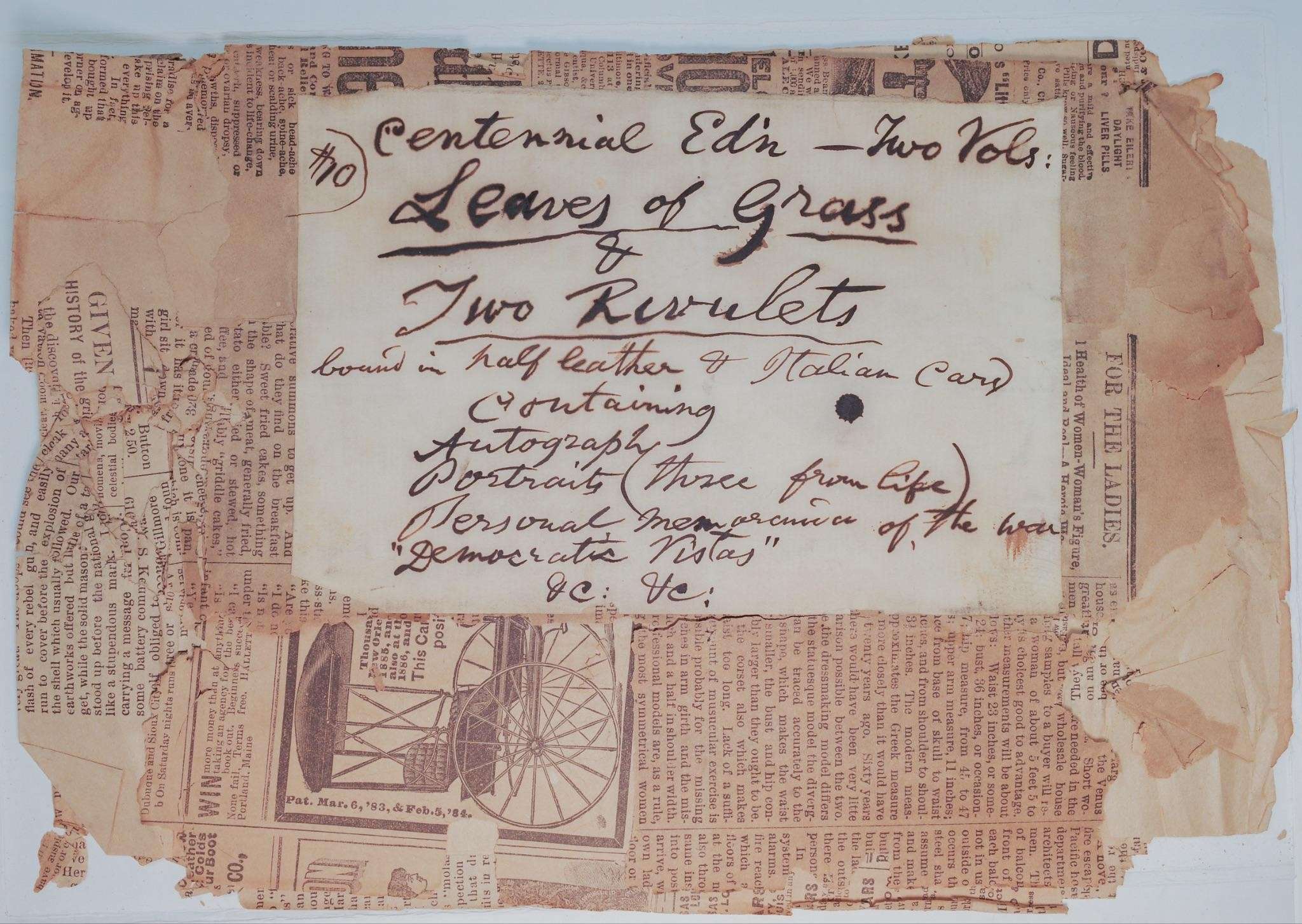
In 1876, Walt Whitman reissued his great work, Leaves of Grass, in a special “Centennial Edition.” The poet prepared copies with his signature scrawled across the title page. One of these copies — now held in Carnegie Mellon University’s Posner Center for Special Collections — was once, if collectors’ notes are to be credited, Whitman’s own, kept in his personal library at his house in Camden, New Jersey. Oddly, this venerable copy is encased in trash, a sort of book jacket made of newsprint and labeled in Whitman’s flourishing hand.
The centennial edition of Leaves of Grass is a work of patriotic propaganda that Whitman, who a decade prior had swaggered into hospital tents to comfort the Union wounded of the Civil War, wanted to herald a new era of the nation’s healing. However, It was not the first printing of Whitman’s “epic of Democracy” to be set self-consciously in the fabric of American history. The third edition (1860) bore in its imprint the awkward phrase, “Year 85 of the States,” situating its publication in a mythic calendar that took the date of the Declaration of Independence as Year One. In both cases, we see Whitman placing himself and his work in the foreordained unfurling of a new American century.
Whitman, who worked as a typesetter and drank with publishers, printers, and binders, is America’s printer-poet. “A font of type,” Whitman wrote in a late poem, is “a latent mine” glittering with “unlaunched voices.” The physical book, as Ed Folsom writes, was for Whitman an extension of his poetic program: “Whitman did not just write his book, he made his book, and he made it over and over again, each time producing a different material object that spoke to its readers in different ways.” Whitman’s work in the print shop — his attention to letter, line, layout, and binding — rhymes with the form and format of the centennial edition, a book for which Whitman oversaw the least detail, much as he had for almost every other edition that appeared during his life. Each of these editions is, in consequence, an object run through with the poet’s intent. The first edition of Leaves of Grass (1855) provides the classic example: having funded its publication, Whitman designed its binding — grass green boards adorned with blind stamped motifs and gilt lettering — dictated the choice and layout of the type, and even set some the type for the edition himself. If, as Whitman hoped, Leaves was to be a lyric gospel for a new and growing nation, nothing could be left to chance or the disinterested labor of printers and binders.
Yet for all of Whitman’s fabled involvement in their making, nothing about his books is straightforward. Each, to borrow Whitman’s phrase, “balks account,” and the printing history of the centennial edition, like the other editions prepared under Whitman’s supervision, is layered. The first issue was made up of unsold sheets of Leaves’s fifth edition (1872), 100 copies in total. Whitman modified these copies with paper slips called “intercalations” pasted onto the pages. These appliqué revisions in some cases fill gaps in the printed text. In others, overlay and correct the poem to fit Whitman’s evolving vision. The intercalations were then incorporated into a second printing to make a seamless whole. It is this later 1876 printing that CMU holds.
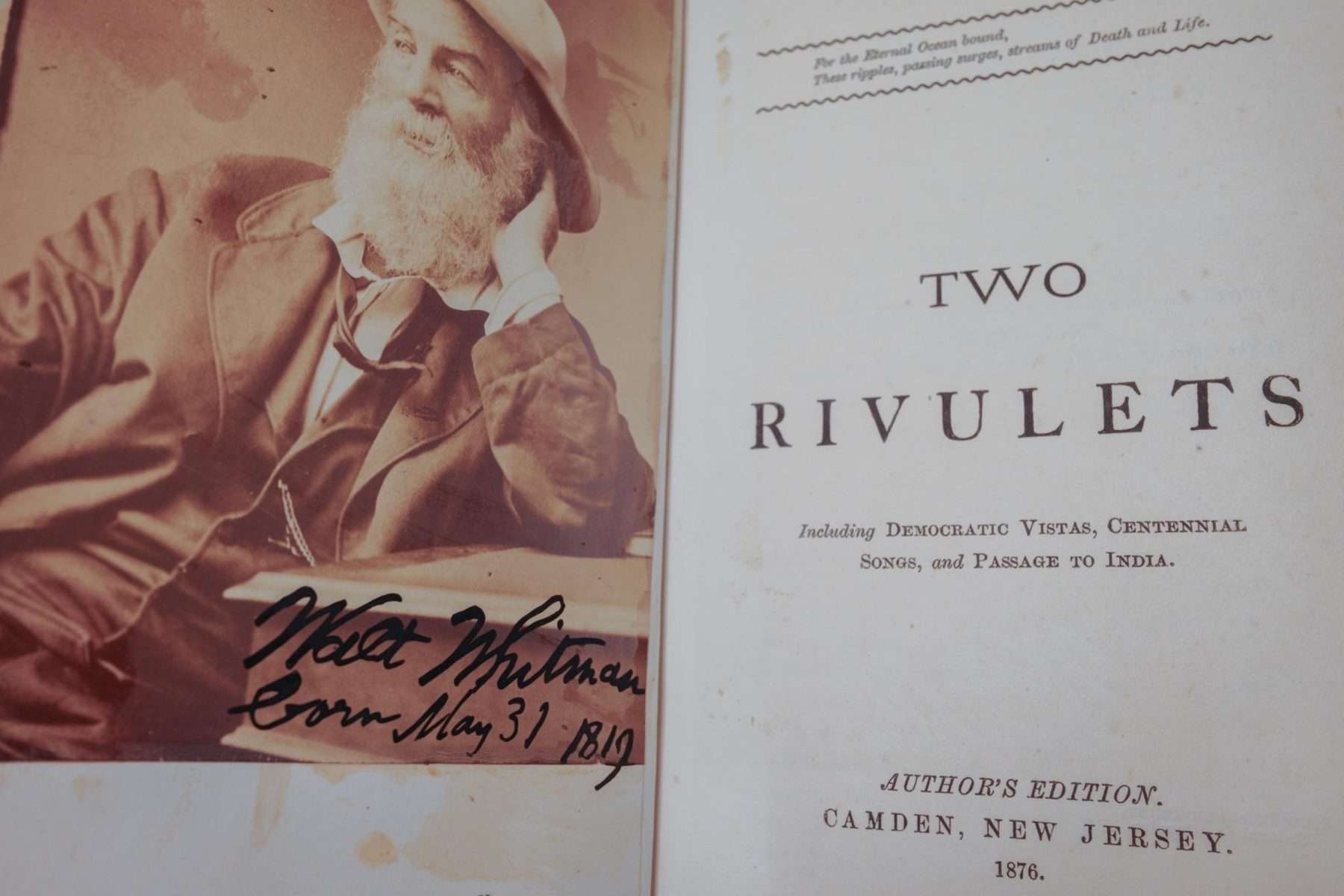
The 1876 edition of Leaves was bound in cream-colored half leather over marbled boards and paired with Whitman’s Two Rivulets, also printed in 1876. While Whitman only signed the title page of the 1876 Leaves, in Two Rivulets he mounted his portrait to the front fly leaf and inscribed it with his name and date of birth: Walt Whitman born May 31 1819. Each volume thus constituted an inscriptional relic from the Camden Sage himself. The two volumes were marketed as a set: an “author’s edition” of Whitman’s works.
That CMU’s copy survives in its newsprint wrapper is a matter of some mystery. The wrapper’s improvised label — a piece of paper pasted directly to the newsprint — bears the price of the two-volume set in its upper left corner: $10 (each volume could be purchased for $5 — the most expensive edition of Leaves published during Whitman’s life by far). Below this, Whitman gives the contents of the two 1876 volumes in a sort of citational shorthand, much like one might find in a bookseller’s catalog or a list of the poet’s effects: “Centennial Ed’n — Two Vols: Leaves of Grass & Two Rivulets bound in half leather & Italian Card Containing Autograph Portraits (three from life), personal memoranda of the war, “Democratic Vistas,” &c.: &c:”
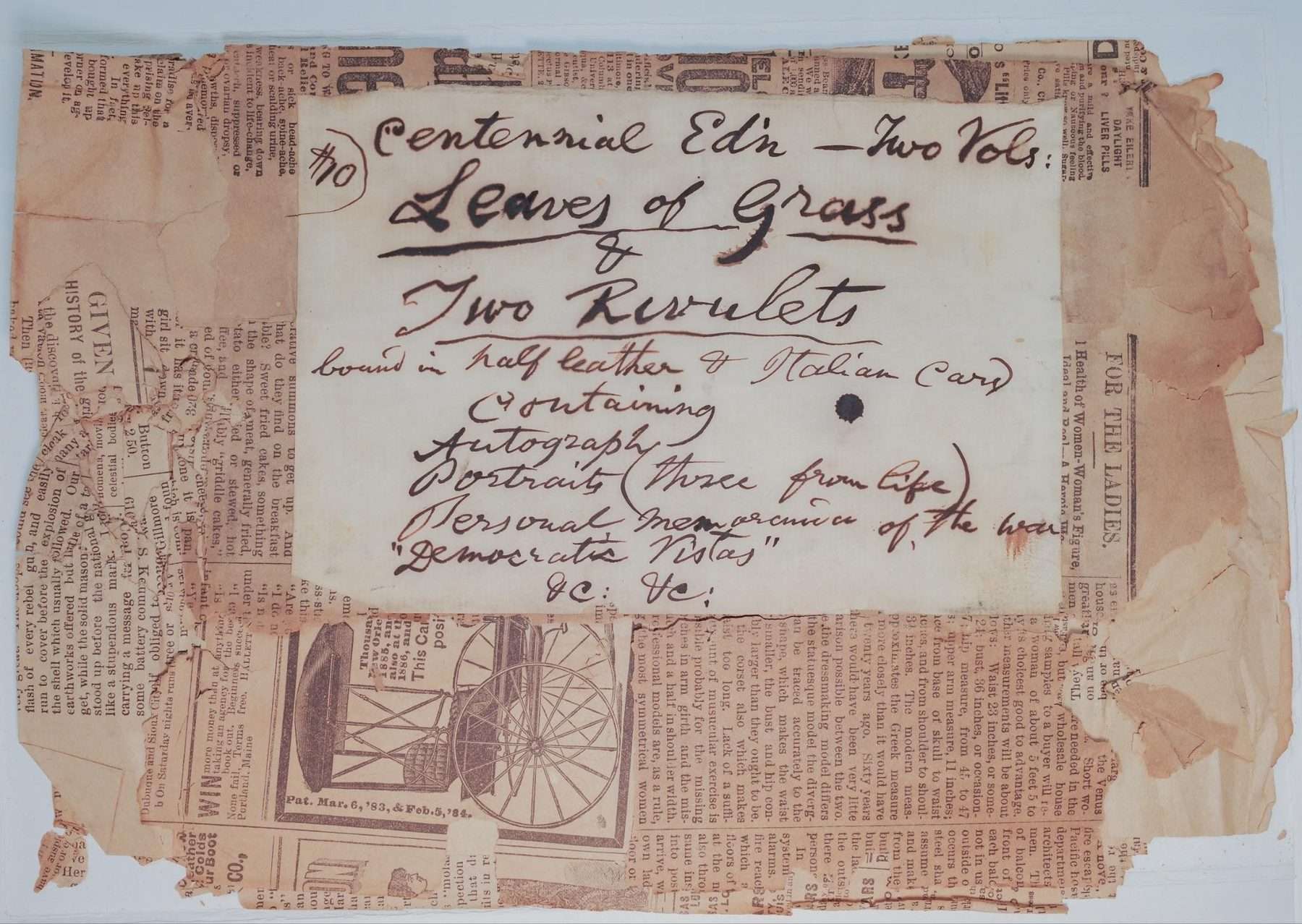
The newspaper that makes up the wrapper is an issue of a Chicago daily, dated August 9, 1888, less than four years before Whitman’s death. It is as though Whitman sought near the end of his life to assemble specimens of his printed output, perhaps wrapped and labeled to assist his executors in the disposition of his estate. Or perhaps it’s Whitman gathering together mementos of his career — an act of retrospective self-archiving done in the shadow of death and declining health?
The wrapper, now crumbling to papery bits, fits with Whitman’s well documented proclivity to retain and repurpose ephemera. Whitman’s biographer Horace Traubel recounts Whitman clipping a paper label and mounting it squarely onto another sheet that he had trimmed for the purpose: “He had cut a piece of heavy wrapping paper the size he wished and pasted a memorandum on it.” Traubel also describes Whitman’s house in Camden as a warren of papery artifacts — newspapers, correspondence, wrapping paper, and books forming a kind of bookmaker’s or bricoleur’s matériel from which Whitman drew when in need — and elsewhere likens Whitman’s rooms to a newspaper office, chock full of the detritus of a life spent in print shops and publishers’ warehouses. Proof sheets, paste, twine, newspaper clippings, ink pots, and old issues of magazines littered Whitman’s cupboards, shelves, tables, and chairs. During a visit, the essayist Agnes Repplier found Whitman’s rooms “littered with old newspapers, so that one lighted match carelessly discarded would send him into another world.”
I find little detail of what came of Whitman’s books — the present volumes presumably among them — after the poet’s death. What records survive provide only hints. Yet there is evidence that Whitman kept a surplus of copies of his own works on hand. In a note dated June 10, 1890, Traubel records finding “probably 10 or a dozen sets” of the centennial edition of Leaves of Grass and Two Rivulets piled on Whitman’s floor. This suggests that several copies of the edition remained in the poet’s possession some fifteen years after publication. More astonishing is an earlier entry in Traubel’s With Whitman in Camden that describes Whitman preparing a set of the centennial volumes for collector and financier Edward Hornor Coates (1846–1921). Having wrapped the volumes, Traubel tells us, Whitman “put [a] label in his hand on the package: ‘$10 Centennial Edn. Two Vols: Leaves of Grass and Two Rivulets bound in half leather & Italian boards containing Autograph, Portraits (three from life) Personal Memoranda in Secession War and Democratic Vistas.’”
There are dissimilarities in the two labels: CMU’s label reads “Italian card” and omits “secession” before “war,” but otherwise agrees with Traubel’s transcription. In any case, Traubel presumably made his transcription from memory, or at least from imperfect notes. Meanwhile, the date of Traubel’s account (Friday, September 21, 1888) fits the chronology of the wrapper itself: a newspaper dated to August 1888. It is almost certain, then, that the copy at CMU is the same copy Whitman hastily wrapped and sent to Coates.
The subsequent history of the copy can be partly reconstructed: it appears listed in the auction catalog for Coates’s library, sold by Stan V. Henkels on 31 March 1922. The copy’s latest private owner, Charles Rosenbloom (1898–1978), was only 24 at the time of sale, so it seems unlikely that he was its buyer. But it is not difficult to imagine the book, its wrapper reverently preserved for decades by Coates, leaving Henkel’s saleroom to take up residence on the shelves of another acolyte-collector before being acquired by Rosenbloom and, finally, donated to CMU. So it descended, improbably, to the present.
To my ear, the exultant and garrulous thrust of Whitman’s poem — Great is liberty! Great is equality! I am their follower, Helmsmen of nations — has always seemed overmuch, offering as it does a paean to a national unity that didn’t then and doesn’t now exist. But this copy, preserved in a proletarian shawl of the day’s news, prompts us to glimpse something of the reason behind Whitman’s optimism — to grant the poem and the poet their place in a distinctly American mythology. There is a fragility and an innocence to it and its brittle paper chemise that Whitman, for all his praise of a muscular manifest destiny, saw in America and its inhabitants. These, at least, were worthy of Whitman’s centenary celebration — and of our own.