During November 2026, volunteer participants will be giving up their cell phones and other distractions to spend an hour in the quiet downtown Radiant Hall P|R|OJECT space at 308 Seventh Avenue. With just a few art materials and a window on the city, they will be free to think, play with ideas, and create, and then reflect on their experience.
A month before I’m due to start my first solo art project, ALONE TIME: A Room of One’s Own, I’m crying into a disposable cup of tea the therapist gave me as I leave a very disappointing facial treatment. I had been eagerly looking forward to this appointment – my first in more than a year – ever since a trustworthy acquaintance had provided me with a glowing review. After her treatment she described feeling so relaxed and other-worldly that she wondered if she was too out of it to drive home. In my appointment things got off to a rough start when – as I lay down under a blanket on the warm treatment table – the therapist and I had a stilted and vaguely hostile interaction, where my indifference to skincare routines and names of ointments seemed to come across as a personal slight for someone whose profession revolves around both of these things.
She left our little curtained-off space to prepare some cleanser or other concoction somewhere else in the building that I hadn’t seen, and my mind started reeling with anxiety over this awkward conversation. I decided I would say something apologetic when she returned, but my eyes were already covered, I didn’t quite know when she was back, and then immediately she was applying something very cold to my face. The moment had passed. Instead, I desperately tried to focus on the music being piped in from somewhere overhead which was intended to be calming but was just loud and quickly I felt overwhelmed. I urged myself to think only of relaxing things, but the exchange of moments ago kept bothering me. And then, with my eyes covered with cotton and the touch of a stranger’s frosty hands on my face, the worst moments from the past year came crashing into my mind and I was utterly at a loss to hold them back. The ensuing sixty minutes turned out to be a very expensive form of mental torture.
Anyone who has experienced some form of loss and grief in their lives can tell you that the oft-repeated phrases, such as, “it comes in waves,” and “it can hit you at any time,” are derived from sad truth. Grief does both of these, and can keep doing so for weeks, months, and years. Sudden tears in the coffee aisle at the grocery store, or a little cry in the car when a place you pass reminds you of your loss. What I’ve been forced to learn over the past year is that traumatic loss is another level of misery, and a strange, often isolating place that no-one wants to visit. It affects your mind and private thoughts in such a devastating way because that person didn’t just die, but the manner of their death was likely characterized by shock, uncertainty, a lack of information, desperation, lots of medical tests, and emergency procedures. It may also be followed by a number of official reports and investigations, and the subsequent pain of having to relive the most devastating moments of your life over and over. In brief, it’s loss, but with added trauma.
My younger sister’s baby was born shortly before Thanksgiving last year. A seemingly completely healthy, 8lb 8oz baby boy, with soft dark hair and chubby legs. They named him Theo, and then somehow, he was dead at 9 days old.
Ten months later, I’m treating myself to an expensive facial and realizing within the first few seconds that I cannot be left alone with only my thoughts for sixty whole minutes. As I lay there with a kaleidoscope of upsetting memories whirling through my head, I wondered why on earth was I planning an art project in which I’m asking other people to do this very thing? To simply sit alone in a room for an hour with just their thoughts, some art materials, and seeing what becomes of it and how it made them feel. During the planning stages I’ve even joked with Radiant Hall staff that participants of ALONE TIME may end up banging on the door to be let out early. Occasionally, I wonder how and why I have convinced myself (and, crucially, other people) that I should be funded to produce this conceptual art piece. I’m usually a printmaker, happily working away at a press creating greeting cards and other small prints.
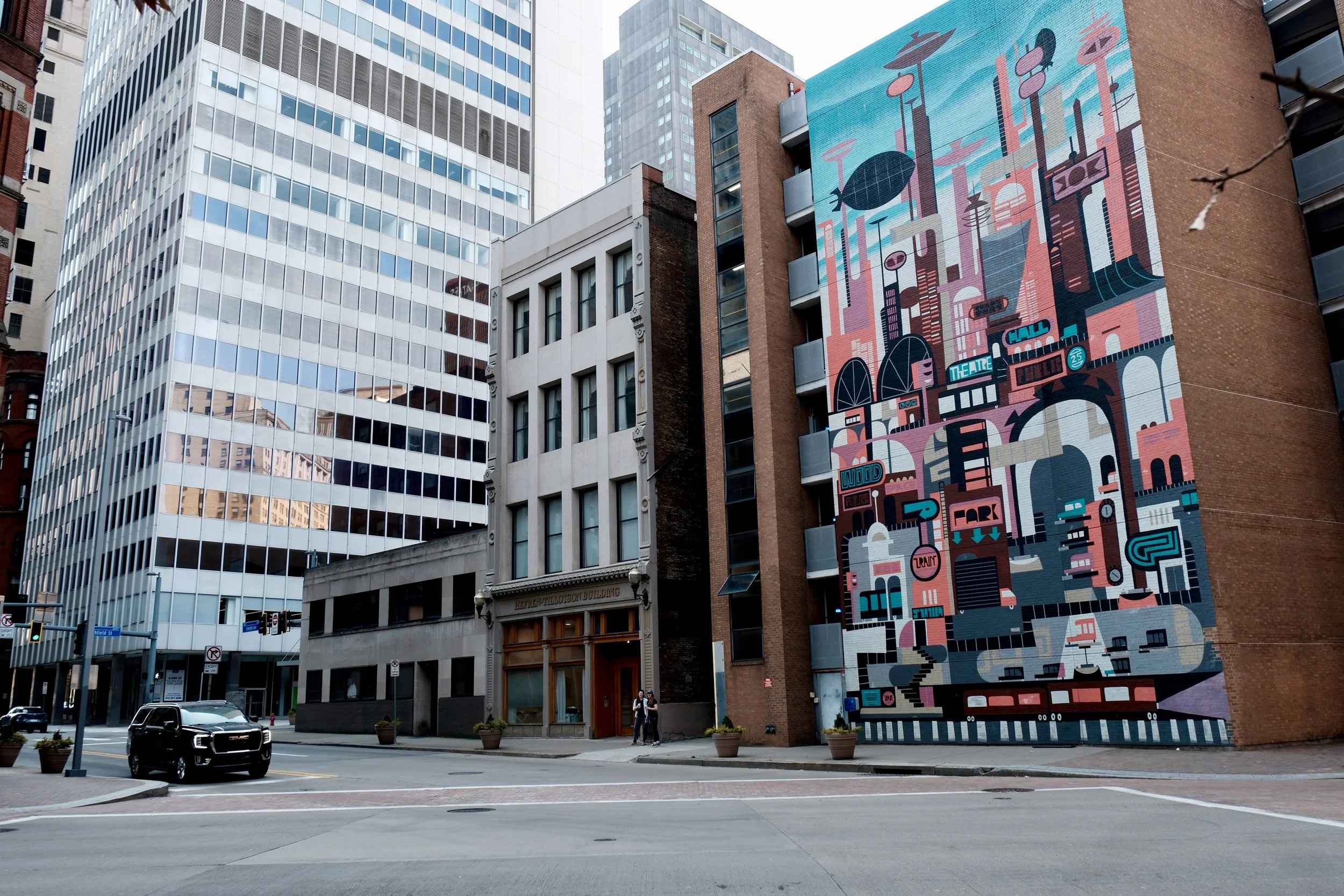
It all began in the Spring of 2026, when I was asked to be a pilot artist in Radiant Hall’s new Downtown Pittsburgh artist studios at 308 Seventh Avenue. The building is large but narrow with an impressive stone front and lots of natural wood trim. Most recently a multi-floor office for a financial company, then empty for several intervening years, the interior of the Hefren-Tillotson building appeared to have been completely untouched since the day the final employee let the large glass entrance door swing closed behind them. A SWOT analysis from a team meeting remained on a whiteboard in what would become my temporary studio. Wallpaper from the last office refresh, probably in the early 1990s, still clung – in most places – to the walls. Office furniture and other discarded items were removed to make way for us to strip the walls, pull up the carpet, and re-paint all the individual offices white.
During this time, I kept my main printmaking studio space in the comparatively bright and airy Radiant Hall’s McKees Rocks building, but during the first two weeks of April I created what developed into a sort of satellite “showroom” studio in this Downtown space. Three other artists joined me, and with the Radiant Hall staff we worked to get the first floor in shape and welcoming for various celebratory events and open studio hours. These evening events would fill the first and third floors with people, music, food, and drinks, but on the days between, despite the central downtown location, and the proximity of Liberty and Seventh Avenues, the building was quiet. Eerily so.
Alone in my converted office, I could feel the weight of this big, empty building above and around me. And so, I always played an audiobook, or a podcast, or called a friend while I worked. I still couldn’t listen to most music, it was too soon since the death of my nephew and everything my sister and family had been through, but I had to have something to distract my mind in these moments of solitude. At the same time, I was growing frustrated with myself that here I was with creative freedom in this fantastic piece of Pittsburgh real estate, in this rather epic version of Virginia Woolf’s A Room of One’s Own, and yet, I felt like I wasn’t really benefiting from it at all. I was the opposite of present.
The first floor of 308 Seventh Ave has a high-ceilinged meeting room that faces the street. It has full-length windows with views of other downtown buildings and the sidewalks of Seventh and Liberty Aves. It seems purpose built to be an art gallery or exhibition room, and that is precisely how Radiant Hall is using it. When alone in the building I would find myself drawn to this room, occasionally taking a chair with me and just sitting, watching Downtown Pittsburgh pass by or looking more closely at the works currently on display. But I would get drawn back into “absence” by a notification on my phone or knowing there was somewhere else I could be. I began to wonder what true, distraction-free time in this space would feel like, and what it might produce.
Radiant Hall was also thinking about this room, what they have named the P|R|OJECT SPACE, and they invited studio members to propose installations or activities for the year ahead. I started sharing some of my ideas for ALONE TIME with a few trusted friends, and the concept began to take shape. I think I was unaware back then how much ongoing grief was shaping my interaction with the space and my desire to create this project. I certainly didn’t frame it in that way to my friends or in my funding proposal. My explanations and reasoning focused more on the space itself and the value of it. How, at its very core, ALONE TIME hits upon the heart of Radiant Hall’s mission and values – to provide affordable access to space for one to freely think and create. Conversations with friends have helped to hone the details. Small details which I think will actually have a big impact on the whole. For example, whether participants would feel more creatively free if their drawings, writings or doodles were later presented to visitors anonymously, rather than with their name attached. Or should they be able to see what other participants in the room before them have created?
The initial idea of asking participants to spend an hour alone in this Downtown space did perhaps stem from a subconscious desire to challenge myself to that task. I don’t know for sure. But as I thought more about the particular “rules” I would need to create the project – to create something from essentially nothing – I was led to the work of conceptual artist Marina Abramovic, known over a number of decades for her performance pieces which often involve the general public. She refers to these “rules” as her artistic conditions. As I researched her practice more, I realized that it’s these restrictive conditions themselves that are essential to her performance or installation. They provide the environment necessary for herself or the public to feel acutely present, and to allow creativity, action, and emotion to flourish. In her work, her conditions of deprivation or assignment of particular tasks are often coupled with long hours, creating pieces of mental and physical endurance.
In ALONE TIME, I’m obviously not planning to put people through an endurance challenge. At least, I sincerely hope it doesn’t feel like my regrettable facial appointment. Rather, through the removal of modern distractions, and the addition of art materials and an unusual view of the city, I aim to create conditions for participants to experience the importance and freedom of dedicated space and solitude. In 2014, in a performance work at the Serpentine Gallery in London called 512 Hours, Abramovic invited the public into empty galleries for up to eight hours, six days a week, for two months. When they arrived, visitors had to leave bags, jackets, electronics, watches and cameras in lockers. The only materials in the gallery were Abramovic herself, the other visitors, and a changing selection of props such as headphones, blindfolds, or even jars of rice for people to count the grains. Each evening, she recorded a video to document how the day had been, how the energy flowed and changed in the galleries throughout the day, and the importance of rituals and rules in establishing a space that felt detached from the rest of the world. Participants also anonymously recorded their reflections on notecards before they left and, wonderfully, they are all still available to read online. It’s impossible to choose any one or two to represent the whole, but one visitor’s comments have provided me with a lofty goal for ALONE TIME : “Calm. Peaceful. Tranquil. No worrying about modern life. No stress. No cares. No wants. No needs. You feel the space, but the space feels you. Thank you.”
In an entirely different way, ALONE TIME carries echoes of the ongoing global initiative, The Sketchbook Project. For the past twenty years, people all over the world have been mailed blank sketchbooks which they then fill and return (for seventeen years physically at least, but now only digitally), creating an enormous online catalog of more than 26,000 artist sketchbooks. The project – started in Atlanta, Georgia – has connected people from 150 different countries and created an incredibly rich visual resource, searchable for free by anyone with access to the internet. Each sketchbook captures a moment in that person’s creative timeline, and insight into their mind and experience. The project has helped inform my decision to present any materials that participants create in their hour anonymously, although who has participated in the project will be known. With the Sketchbook Project there is a vulnerability in making your work, thoughts, and doodles available for literally anyone in the world to view, but participants do have the benefit of unlimited time to fill and return their books, and the choice whether to include something or not. I’m giving people just an hour. By providing a level of anonymity, I hope I’ll be providing as much creative freedom as possible in that short space of time. The pressure to impress or the fear of being judged should be removed. The goal, at its simplest, is just to be, and to see what comes of that.
I don’t have any particular expectations of what people might feel and create, or what the final installation will look like. The enthusiastic support from Radiant Hall staff for the project has kept me hopeful of outcomes – especially when I’ve had moments of doubt – but I honestly don’t know what people will think of being in the space, and whether they will find it conducive to any form of creative output. Perhaps an hour won’t feel like long enough. Perhaps it will feel far too long. I still remain undecided about my own participation: whether I can face an hour completely alone. I want to, and I think I will. During the run of ALONE TIME we will hit the one-year anniversary of Theo’s birth and death. He died because he had an extremely rare and cruel genetic condition called severe nonketotic hyperglycinemia, which has no treatment and no cure. There were no abnormal developments or signs of a problem until he was two days old. The condition is so rare that it took several desperate days for the doctors to determine the cause of his symptoms. Of course, we thought at the time, he was going to be fine. Looking at him there wasn’t a single thing wrong. And then we had to just watch him die. After a few months, most people understandably stop asking you about it. Some people who know what happened have never even mentioned it. Because of this, grief – and especially traumatic loss – can feel isolating, so that you come to rely so much on the emotional support of the family and few friends who experienced it with you. Perhaps by the end of November, I’ll feel able to take part in my project without it being too painful.
You can find out more about ALONE TIME: A Room of One’s Own, including how to volunteer to participate at https://www.winterpicklepress.com/alone-time. The project will be open for public viewing on Friday November 27th, 5-9pm, 308 Seventh Ave, Pittsburgh, PA 15222, and after that by appointment. An artist talk will be held at the same location on Thursday December 3rd at 6PM. The event is free but registration is required.
Photo by Patrick Fisher, courtesy of Greater Pittsburgh Arts Council