I was walking with some friends on January 7th, 2021, through the cobblestoned alleys in downtown Charleston. It had rained earlier, but the sun broke out in the afternoon, and the air was crisp, the old streets shone anew. We were obsessing over last night’s news: the bodies scaling the white marble wall; the horn hat and Star-Spangled-Banner-themed face paint; men and women in full suits ducking behind chairs…
My friends said a lot of things, as people grappling with disbelief often did. But one sentence stuck with me: “I can’t believe it’s happening here — this is something that only happens in third world countries.”
In the days that followed, I would hear the exact same sentiment echoed on the internet and on cable news, over and over again:
This is something that only happens in third world countries.
I am from a third world country, I’d wanted to say. China was seen by most as a third world country when I immigrated in the early 2000s. But I chose to keep quiet that winter afternoon. I knew my friends meant no offense. I didn’t want to make it about me.
We cut across Marion Square, a small park in the center of downtown Charleston, where festivals and farmers market were held in the summer months, and the place bustled with tourists and locals alike. It stood empty in early January. The bronze statue of John C. Calhoun had just been removed in the wake of the BLM movement, a few months ago. The huge marble base stood stark and grim. The antithesis of southern hospitality. In another few months the marble base would, too, be removed, and lush green grass would sprout out to cover the entire park, leaving no trace of the chaos, the rage, the disharmony.
As if nothing had ever happened.
It was a familiar sentiment, this refusal to believe, against all evidence, that massive social turmoil was something that could happen here in America. At the heart of this willful ignorance sits a belief that citizens in a good society are genteel in nature. Anything unpalatable, chaotic or disruptive would be better covered up, tucked away. In this genteel mindset, a political upheaval comes with an innate stigma. So much so that to be caught in one of them, no matter what side you’re on, is something to be ashamed of.
I think of the visual shorthand of the American Dream: a large house on a manicured lawn within a white picket fence. How strange is it that the end goal of upward social mobility in a country that touts freedom and liberty seems to be an escape into the suburbs? There is indeed something dreamlike in this version of American Dream – the quaintness, the nostalgia, the sedation.
When a student protester confronted the Columbia University board of trustees by chanting “Columbia, you can’t hide, you’re committing genocide,” a woman sitting in front of him immediately retorted: “And you’re committing obnoxiousness.”
Regardless of the geopolitical context of their dispute, why did this woman think that the crime of committing obnoxiousness was comparable to the crime of genocide? Did she wish to file away the brutal struggles and sufferings of everyday life as a noise disturbance? Was reality a rude awakening to the Dream she bought into?
As a first-generation immigrant, as someone born and raised in China, I can never buy into this particular version of the American Dream. When I think back on that winter afternoon in 2021, I realized that there was something I intuitively believed in that my friends might not: I see civility as a byproduct, not an end goal. There might come a time when we are swept away by forces much larger than ourselves, when we have to struggle and fight and navigate a chaos we never asked for – it is a human condition, not a third world problem.
And I believe there is no shame in embracing all that chaos and fight, when the time comes.
My given name, Kangkang, is not a common name in Chinese. Even less so for girls. The character, Kang, “抗,” stands for “struggle.” But it shares the same pronunciation with another character, “康,” which means “health,” “wellbeing.” Growing up, I’ve lost count of how many times I had to tell classmates, teachers, parents of my friends, the first time I met them: no, it’s not “Kang” as in health, my character is “Kang” as in struggle.
It wasn’t that my parents did not value health or wellbeing when they chose a name for me. It wasn’t that they wished upon me a life of struggle, as opposed to a life of ease. I knew it because I’d confronted them with this very question, when I was in elementary school, somewhere in between first and second grade. I told them I was tired of the looks some adults gave me when I specified the character of my name: a humorous yet unpleasant surprise. Like you were looking forward to a new flavor of candy but tasted pepper on your tongue instead.
I asked them: how did you decide on my name? Did you make it weird on purpose? Is this some kind of inside joke?
They assured me they had wished for me the same things parents always wished for their children: safety, health, joy, being loved and treasured… They also told me that they were inspired by the pen name of a fiction writer, who happened to be a woman.
But there was more.
According to my father: life is full of struggles. I want you to embrace that fact from the start, to not be afraid or ashamed of having to put up a good fight, when the circumstances arise.
We decided on the name after the gender reveal, my mother added.
More than three decades have passed since that conversation with my folks, and I encountered these lines from Ta-Nehisi Coates’ Between the World and Me. In a letter to his fifteen-year-old son, Coates wrote:
You have been cast into a race in which the wind is always at your face and the hounds are always at your heels. And to varying degrees that is true of all life. The difference is that you do not have the privilege of living in ignorance of this essential fact.
… The struggle is really all I have for you because it is the only portion of this world under your control.
I am sorry that I cannot make it okay. I am sorry that I cannot save you – but not that sorry. Part of me thinks that your very vulnerability brings you closer to the meaning of life…
It dawned on me that this was what my parents had said, when I confronted them about my weird name. They had said so in a different tongue, in a completely different cultural context, but in essence, the message they tried to relay to their daughter was the same as the one Coates relayed to his son:
We don’t wish for you an easy life. We wish for you a meaningful life instead. And a meaningful life is filled with struggle. It is struggle that gives meaning to life.
I could see now, in hindsight, that it was the life experience of my parents and their parents that rendered them this outlook, just as James Baldwin and the Black Panther Party and the streets of west Baltimore and the Mecca and the Trans-Atlantic slave trade all played their parts in shaping Coates’ message to his son. Trauma is passed on throughout generations, and injustice comes under all sorts of high-sounding names. But people who have lived violence and known vulnerability share the same disillusion throughout the world: they’d rather put their faith in struggle than in any kind of dreams.
My maternal grandfather was a fervent Marxist and a fearless revolutionary. He fought throughout the Chinese civil war only to be crushed by the Cultural Revolution. He was a loving father and later, a doting grandpa. But the shrapnel pieces lodged in between his spinal discs, along with the undiagnosed PTSD, plagued him until his death. Having survived the Cultural Revolution, my grandpa became perpetually tipsy, often blackout drunk.
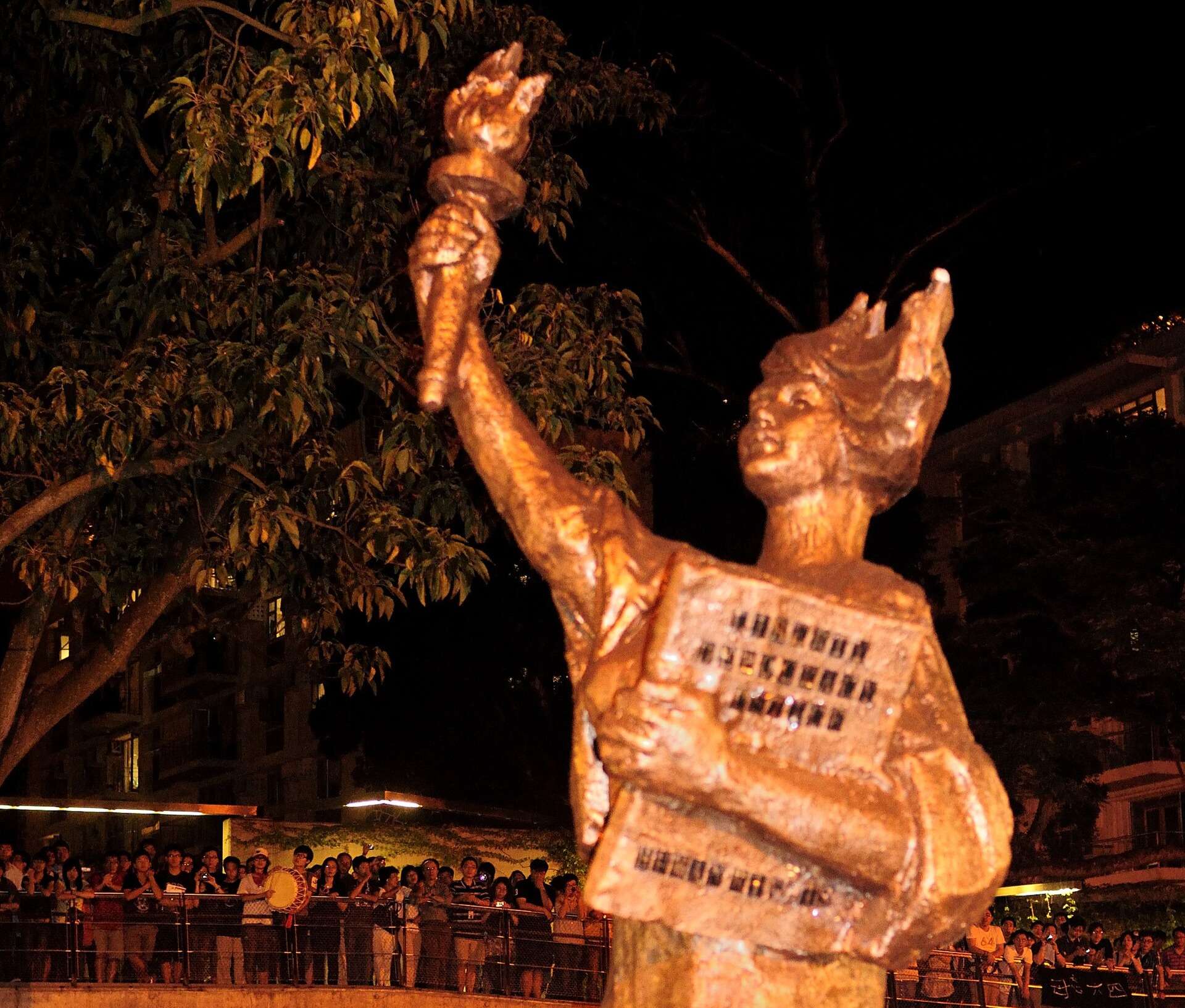
My mother found herself the opposite kind of a man for a husband – my father was a college professor, a soft-spoken intellectual, a man who never smokes, rarely drinks. But he, too, became passionately involved in the months leading up to the Tiananmen Square Massacre, which my mother foresaw as a nightmare on replay. She braced herself for the moment her family life come undone in this next wave of political turmoil, just as the last one did to her childhood.
Growing up, politics had always been personal to me. It was the heated debates accompanied by knee-slapping at the dinner table; it was the late-night news whispering a sense of doom into my childhood dreams. There was never a line I could draw, where what’s personal begins and what’s political ends. In my novel, Nothing to My Name, the stories of three generations of women unfold around three pivotal moments of modern Chinese history – the civil war, the Cultural Revolution and the Tiananmen Square Massacre – I had made that choice not just for impact value, but because these were the moments of great pain and turmoil, as well as deep bonding in my own family history.
It is a deeply political book, it has to do with generational trauma, but it is not a cautionary tale against Communism, as fictions about Chinese modern history tended to be viewed in the past. I do not wish for the readers who dream the American Dream to close my book and say, aren’t you thankful we live under democracy ourselves? As if “democracy” isn’t a vulnerable mess that needs constant defining and defending, but a birthright for the chosen ones. As if “democracy” were a code word that reaffirms superiority and exceptionalism, that distinguishes us against them. As if “democracy” itself were a genteel dream.
When in fact the very opposite is true. More than five years has passed since January 6th, 2021. The same rioters are officially sung as heroes now. We have entered into a reality where peaceful protesters are labeled as “domestic terrorists,” and their public executions without trial have resulted in nothing more than bigger protests. We have entered into a reality where massive war crimes against school children and journalists alike in third world regions, funded by US tax dollars, were written off as technical errors if not flat out normalized.
I feel like I am living the same unpredictability, chaos and confusion of an unfolding history, here in the United States, as my parents did during the lead-up to the Tiananmen Square Massacre, as my grandparents did during Cultural Revolution. I feel just as vulnerable and conflicted as they did. This realization fills me with a sense of cynicism. But it also empowers me, deep down: by sharing the vulnerability of my loved ones in China, I am tapping into their world of strength and resilience, a collective will to keep up the struggle and never give in.
Fast forward to January, 2026. We had recently moved to Portland, Oregon. The day Alex Pretti was murdered, I joined a group of local protesters in front of the ICE building downtown. Marching all around me were nurses, doctors, school teachers, union leaders and parents. My husband, a tele-radiologist who covers ER studies, would have been there by my side, were he not taking a shift that night.
An elderly woman in blue puffer jacket and blue hat brought along her corgi, the most nonchalant dog I’d ever seen, unfazed by the bullhorn right in front of us.
“I know an ANTIFA when I see one,” a middle-aged man pointed to the corgi and laughed.
The sun was setting by the time we arrived in front of the ICE facility, a gray concrete building with a gate in front of it but no sign, nestled among apartment complexes and medical centers downtown. It looked just like any other buildings. I’d driven passed it many times before without a second thought.
The iconic inflatable frog was there, waving the city flag of Portland in front of the gate. Behind the frog stood a group of young men holding an enormous piece of fabric with “Abide No Hatred” printed over rainbow stripes. The street corner bustled with chants and songs. Young people swarmed toward the gate. More than half wore gas masks. A commotion broke out behind my back. “Move, move, move!” A huge street dumpster, pushed by four people, glided past me. These folks, too, were geared up with respirators and scarves and helmets – they carried no weapons but were dressed for all sorts of assaults. One of them even held an open umbrella in front of her face.
I watched them push the graffiti-covered dumpster all the way to the gate. I was bewildered by the surrealness of it all, slow to comprehend an obvious fact: the dumpster was for our own protection. When the agents came charging out of the gate with guns and batons and handcuffs, with the dumpster there to slow them down, we’d have time to retreat.
It dawned on me that I’d come here on a whim, by myself. I didn’t bring a mask or scarf. I thought I was attending a vigil, a peaceful protest, and therefore I’d be safe. I took out my phone and shared my location with my husband in a hurry.
Shortly after that, tear gas cannisters showered down toward us, and the night spiraled into pure chaos. All around me, people were choking and gagging, but there was singing and chanting, louder still. Tear gas filmed my throat, a thousand needles that could neither be swallowed or spat out. Water bottles were handed out by volunteers coughing their own lungs out. I remember searching for the little corgi and old lady, relieved they were nowhere to be seen.
Amidst all the commotion, behind the graffiti-covered dumpster, a poet took off his mask and read out his poems through a bullhorn. The white smoke closed in and swallowed him whole, but his raw voice pierced through. It was a poem about disillusionment and revolution, impassioned words that seeped through me like quick sand, and I felt its grittiness, more real than any readings I’d been to. Meanwhile, thoughts of fear coursed through me: if I were to be beaten and dragged inside the gate tonight, my glasses might be broken. How am I going to read and write without my glasses? How would I even see anything? Would my husband know where to find me? What about my kids, waking up the next morning without a mom? What about our new house, just moved in, still half unpacked? Am I a reckless fool, coming here tonight?
I thought of the few protests I joined back when I was a teenager, on the campus of Peking University: the chaos, the adrenaline, the comradery, the dizzying timelessness of youth. Everything was a Déjà-vu, except for the tear gas. I’d never been tear-gassed in my life. I wondered if this was what the students on the Tiananmen Square had felt, in the early dawn of June 4th, 1989, before they realized it wasn’t rubber bullets. I imagined my grandpa, the hard-core revolutionary till his death, revolting against imperialism, capitalism and communism in turn, shaking his head at me, dismissively, half-approvingly.
I’ve always thought of him as a hero, my loud, drunken, funny wild card of a grandpa. But what appears revolutionary or heroic in hindsight might just be ordinary folks reacting to gross injustice on a whim, confused and helpless and battling against fear, like the young woman wielding an umbrella against tear gas canisters, like the poet reading out loud behind a graffiti-covered dumpster. We are not above being beaten and maimed and arrested, as long as we stare injustice in the eye – we never were, maybe never will. Struggle remains an essential fact of life, in third and first worlds alike.
This realization saddens and emboldens me at once. I had never felt so close to my parents and grandparents as I did in front of the ICE building, that January night. History has failed us, as Min Jin Lee famously put in Pachinko, again and again, across cultures, but it doesn’t matter, because ordinary folks will keep struggling. And it is the struggles that persist. It is the struggles that shine light on history and give meaning to life. I reach into the depth of my family’s struggles and traumas and find courage, both as a fiction writer and as a human being – to stay true, to commit obnoxiousness, to embrace all the vulnerabilities in this beautiful and brutal world.