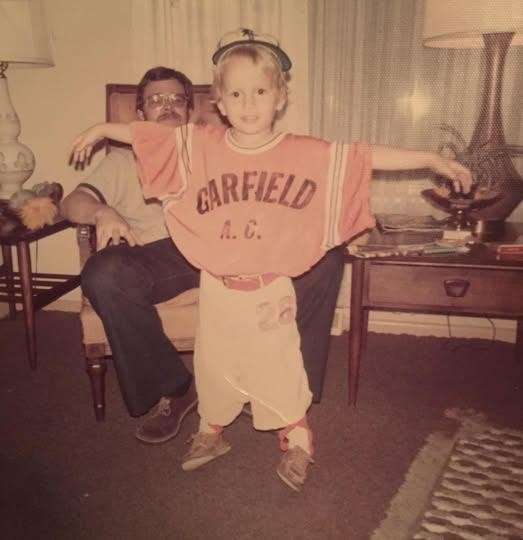
There is a photograph of me as a boy wearing a Garfield A.C. jersey #26.
Uncle Ron is behind me in the chair. Off to the side there may be a pack of cigarettes, probably my grandfather’s, because that was his chair. Uncle Ron’s father had changed his family’s name after coming from Slovakia, making it sound more local, more passable; his mom was Italian. Even the name in the photograph was already doing what the whole country does to people. Arrive. Alter. Belong by translation.
Garfield A.C. was not just a uniform. It was a neighborhood object. It carried Murray Hill, East Cleveland, Italians, Irish, Scots, Slavs, old athletic clubs, family rooms, men in chairs, stories the adults did not explain, songs children could sing before they understood what the words meant.
One of those songs went:
ooh sah sah sah
ooh sah sah sah
hit him in the head
with a big kielbasa
put him in a barrel
roll him down the street
ooh sah sah sah
ooh sah sah sah
I loved the sound of it. The words were comic, brutal, childish, and old. They came from the same place the jersey came from, a world where family, menace, love, laughter, neighborhood, and whatever men did outside the children’s hearing did not present themselves as separate arguments. They were already braided. Nobody sat a child down and explained the sociology of the inner city. The child wore the jersey.
That is where I want to begin, because the photograph contains more truth than any thesis I could place before it. A boy in a borrowed jersey. An uncle in the chair. A name changed to pass. A pack of cigarettes. A song. The old city entering the body before the body has words for it.
I was not from anywhere long enough to truly belong there.
I was conceived in Cleveland, born elsewhere, and moved through enough cities and towns before adulthood that belonging became something I watched other people have. There were southern cities, New England towns, Cleveland, Detroit, Indiana, Ohio, Chicago, and eventually northeast Ohio again. By fourteen I had already learned what the newcomer learns. You enter a room and read it before anyone tells you the rules. You listen for danger. You notice who owns the joke, who owns the corner, who can speak loudly, who speaks only after being spoken to, who is allowed to be strange, and who will pay for being strange.
The moving made me a witness.
But Medina, one of Cleveland’s suburbs, counts. For four years, there was a window of belonging. My mother and father drove me back into the family record. We saw the relatives while they were still alive. Great-grandparents. A great-great-aunt on Rose Avenue in Akron and great aunts in trailer homes. East Cleveland. Garfield Heights. Garfield Park Reservation. The old neighborhoods. The family names spoken by people who remembered them as people, not as entries on a family tree. The transmission came through the living before it became a record.
That may be what made me a keeper instead of only a drifter. A drifter loses the place on purpose to keep moving. A keeper loses the place and begins carrying it.
My father was an inner-city kid by formation, no matter how far he later ran from that fact. He walked to the Carnegie Library in Miles Park, Cleveland, past tough guys on all four corners. His ethnic neighborhood ideas formed there, in the contact zone before anyone used that phrase. He smoked Kool menthol 100s, which to my mind remains one of the most inner-city objects in American life. He had a certain way of seeing people that could sound crude and could also be accurate in the way a kid survives by being accurate.
Once, before I knew enough to understand what he meant, he said of someone that he was basically an inner-city kid, and that all inner-city kids were the same. He would know.
It was a theory of formation, said roughly. He meant that the city taught certain reflexes into people: how to watch a corner, how to carry yourself, how to hear danger before anyone names it. Prejudice and recognition can live close together. A person may see something and still use the wrong frame to hold it. A person may carry injury and misname the source. A person may be both generous and wrong. The record does not simplify because we would like it to.
Later, my own family record made the categories less stable than they had seemed. There was a white slaveholder who fathered children with enslaved women. In that line, an enslaved man had a son with a free white woman. Because the mother was free, the son was born free, even while the father remained enslaved. That free son served the Confederacy. His daughter came north to Cleveland and married into a Scots-Irish family. She is buried in northern soil.
The South was not elsewhere. It moved north in Black families fleeing terror, exclusion, and the closed promise of America. It also moved north in white families seeking work. It moved north in mixed and hidden lines, in legal fictions, in family silences, in names that had been sorted until the sorting looked natural. By the time my grandmother inherited that story, it could appear as a white ethnic Cleveland story on the surface. Beneath it ran the old wound, not as metaphor but as descent. No category survives the record intact.
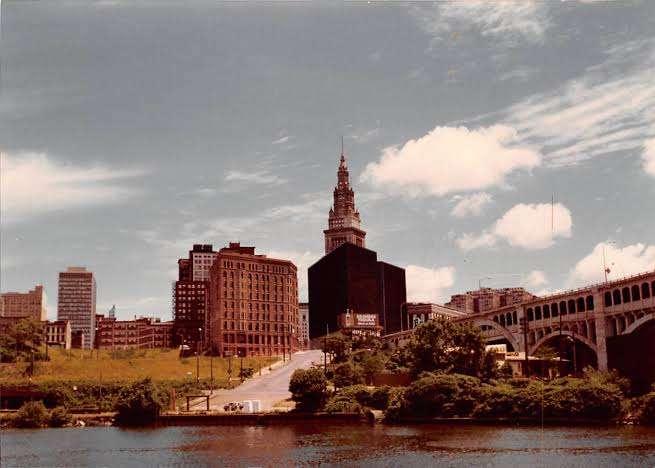
On the Clarke side, there was my great grandfather William Graham Clarke, a carpenter, laborer, Spanish-American War veteran, whose hands helped build the Terminal Tower. That fact came down as family pride. It should have. The city remembers owners more easily than hands. A building can stand for a century and forget the men who helped lift it. Decades later, I came to know a man whose family’s company owned that building. The laborer who helped build it and the keeper who knew the owner met inside me. Labor and capital, the hands and the title, the unkept and the archived. Only the keeper remembers the carpenter.
There was also William “Bill” Melvin Clarke, my grandfather. He went to East Tech on 55th with Jesse Owens. The sharecropper’s grandson up from Alabama in the Great Migration and the County Tyrone carpenter’s son were in the same halls on the East Side of Cleveland. Immigration and migration met in one school. Decades later, through Ohio State, I would work with Jesse Owens’s daughter on the South Side of Chicago. A circle closed across the century without asking me first.
Owens, fastest man alive, died of lung cancer at 66 in Tucson. Bill died in Cleveland of prostate cancer at 61. My father, who ran from Cleveland and carried Kools with him, died far from the Cleveland he fled. Nobody outruns the body. Not even the fastest man alive.
Great-great-grandfather Samuel Clarke, from County Tyrone, died at forty-five from typhoid fever, within a year of arriving on Cleveland’s East Side, killed by the polluted water that carried the disease. Another great-great-grandfather, Alexander Roy, from Scotland, is buried there too, dead at thirty-nine from scarlet fever. Those men, my third-great-grandmother Margaret Thompson, and my great-great-grandmother Margaret Roy, both from Scotland, are buried in unmarked graves at Harvard Grove, too poor for a stone, founders of a line with no marker. But not nameless. Naming names is a keeper’s work. I have the naturalization papers and the Spanish-American War service papers belonging to Samuel’s son. The becoming and the serving. Two documents, just enough to prove they were all here. That is the lucky version of the unlucky side.
I learned the rest in rooms.
I heard a story once at the police station at State and 18th. I was there on other business. A white newcomer had been roughed up on a basketball court by kids from the projects. The cop at the desk did not turn it into innocence and guilt. He said, in effect, what did you expect? You invaded their neighborhood. You’re taking it from them.
The words stayed with me because they were true and not true. The man had not personally taken anything from anyone. He had also entered a place already in motion, already wounded by arrival, disappearance, demolition, speculation, and memory. In that moment, the colors were swapped, but the reflex was the same. Every wave is the newcomer. Every settled wave resents the newcomer. Every newcomer eventually learns to resent the next arrival, unless something interrupts the reflex.
Another time, buying diapers at the Walgreens in Chinatown, with the projects across the way, a woman ran into me. I said, “Pardon me.” She spit at me.
There is no large theory needed for that moment. There is just the body in space. The resister is the Black neighborhood now. The newcomer is me. You cannot know that from the outside. You have to stand there, holding diapers, and receive it.
On the South Side, I once heard a principal refer to a school as “a hundred percent diverse.” She meant it as a virtue. She meant a school that was one hundred percent Black. The vocabulary of integration had been made to name the fact of segregation. Language had not lied exactly. It had collapsed under what it would not say.
At a federal grant meeting on the West Side, I sat in a room where nearly everyone was Black except me and one Mexican man. The meeting opened with a prayer that the wrong people not get the grant. The wrong people meant the Mexican. Scarcity had been sanctified. The stranded were turning on the stranded, asking God to bless the border between them.
William C. Smith was shot in cold blood in an alley near 18th and Michigan by a man with a .45. He was on his way to get coffee. I had met him once. I knew him loosely, knew the group he belonged to. But the alley was not abstract to me. I walked it every day for years. My parking spot was back there. It was part of the ordinary route of my life.
I have no forgiveness for the killing. There is no theory large enough to excuse a man walking through an alley being murdered. But the story that followed the killing became its own injury. The bereaved did what the bereaved sometimes do. They converted an individual horror into a verdict on a race. People broken by grief and wrong in the way grief can make people wrong. The real engine is often grief metabolized badly.
At Safer Foundation, I met a man I will call Luis. He was half-Black, half-Puerto Rican, from the Robert Taylor Homes, too impure to be popular there. He graduated from high school. He tried a pharmacy job. He tried the Army. Every legitimate door closed. So, he bought an eight ball. The first night, he was robbed at gunpoint and made to strip naked. He went back packing. He pulled on undercover police, ran, fired blindly, hit no one, and was beaten senseless in a stairwell. Twenty years for attempted murder. Luis told me this not as a symbol but as his life.
What stayed with me was the order of it. He reached first for the legitimate doors, and the legitimate doors closed. By the time he reached for the illegal one, the ladder had already been pulled up.
Cleveland had its own sequence, which is one reason I cannot read American grievance as a clean moral map. My family did not found the old Scots-Irish Presbyterian world around Miles Park and Newburgh. By the time they arrived, that world had already been there for decades. The church my family attended was already old, part of one of the city’s older Presbyterian lines. The building changed. The congregation changed. The denomination eventually changed. But the memory inside my family was of belonging to that church after they arrived, entering an order already in place.
They were not the first people on the ground. They were another arriving wave entering an older structure, then mistaking belonging for origin because that is what settled people do.
Then later waves came. Slavs arrived, unwelcome at first, then settled, then strong enough to rename the neighborhood after themselves. Slavic Village painted over older roots, just as every name in this essay paints over something and preserves something at the same time. You can see it at Harvard Grove, where many of the older stones carry Celtic origins, followed by a thinner line of Slavic names before the cemetery closed to burials for good. Even the cemetery records the succession. The Great Migration entered a churn already running. Each wave arrived resented. Each wave climbed. Each wave left for the suburbs when it could. Each wave learned to resent from there. That is the ordinary cruelty of succession.
But then the work left.
That is what made the loop tragic instead of merely hard. The ladder had worked, however brutally, for the previous waves. It did not work equally. It did not work innocently. But it existed. Then capital left. Industry left. The last wave arrived, and the ladder was pulled up behind it. Held in place by the displacement.
The churn that had processed everyone froze, and a frozen churn holds everyone in their last position. Resentment fossilizes into geography. The person nearest becomes the cause because the real cause is gone from sight. The migrant did not take the factory job. The factory left.
Anyone who wants proof can go to Cleveland’s East Side and look. The evidence is not hidden in an archive. It stands there to this day in brick, broken windows, empty lots, loading docks, smokestacks, fence lines, and old industrial shells. What remains of the Westinghouse complex is part of that record, one more ruin in a landscape full of them. Cleveland is, in places, a derelict museum of America’s industrial past, except nobody curated it and nobody meant for it to teach. The lesson simply stayed after the work went away.
That is why the grievance so often goes looking for a body. A closed factory is too large to accuse. Capital flight has no face in the grocery line. Deindustrialization does not stand on the corner where the next newcomer stands. So the wound chooses the visible person: the migrant, the Black neighbor, the poor white man, the Mexican at the grant meeting, anyone close enough to receive the blame that belongs to a structure no one can touch.
Later, capital returned not as work but as predation. Subprime lending came back through the same wounds industry had left behind. The houses went underwater. The blocks emptied again. Slavic Village and the surrounding neighborhoods became one of the places where the foreclosure crisis showed its teeth most clearly. The houses that had held succession became debts, then vacancies, then roofs with holes in them.
The same year, my own South Loop home on Michigan went underwater, just like everyone else.[1] We wondered if we’d ever be able to sell. That was not the same injury. It was not the same scale. But the devouring reached both my family’s origin and my own deed. The structure did not care that one story was ancestral and one was personal. It reached where it could.
Chicago is not Cleveland. One city emptied and came back. One city emptied and got killed, or nearly killed, and in some neighborhoods killed again. My father fled Cleveland, the one that was beginning to die, and learned to love Chicago, the living one, after I brought him back into it. He opposed my move downtown. “I worked my ass off to get out,” he said. Then he loved the South Loop.
On Prairie Avenue, the void filled back with life. The gates opened. My daughter spent her first five years at 18th and Michigan, a child beginning her life in the inner city the family had fled. No one orchestrates these circles. They happen, and later the keeper notices.
Between Here and the Sound of a Groaning Interstate & The Groaning Book: A Poetics names this the Law of Moral Recursion. A wound becomes a category. The category becomes an accusation. The accusation creates another wound. Everyone guilty means no one answerable. The verdict is placed before the person arrives.
Here, the law shows itself in place. The stranded peoples become enemies when they should have been natural co-witnesses. The miner, the South Sider, and the East Sider are downstream from the same deindustrialization: capital leaving, work disappearing, wages collapsing, whole neighborhoods stranded after the ladder had been pulled up. Then they are trained to see one another as thieves. “They’re taking your jobs” and “go get a job” are the same disguise. The cause has a name. The work left. The cause has left the room.
The escape clause is proportion. Proportion is not neutrality. It is the discipline to remember without reenacting, to defend without dehumanizing, to hold conviction without purity. It keeps accusation from becoming verdict. It keeps memory from becoming license.
Answerability is proportion made personal. Answerability is individual. It is intentional. It is one person choosing to be responsible to another across a line. You do not bridge a gap by category. You bridge it person to person, on purpose, or you do not bridge it at all.
I know this because I was kept. When I moved to Chicago, Ray Hanley from the Greater Columbus Arts Council handed me off to Joan Small at the Department of Cultural Affairs. Joan was powerful, generous, gracious, pure Chicago. She took the kid from nowhere under her wing. She helped in ways no one can fully see. She carried me all the way to the Cultural Affairs Advisory Board, confirmed before City Council.
I could give her nothing. That is what makes it answerability. She reached down because she could. She has since passed. I keep her name because she kept me.
There is a folded program from the 13th Annual Gwendolyn Brooks Writers’ Conference Kick-off Celebration, a tribute to Ms. Brooks’ In Montgomery. I am listed there as Mr. Kenneth Clarke, one of the readers, in the same column of names as Abena Joan Brown, Sandra Jackson-Opoku, Nora Brooks Blakely, Dr. Elnora D. Daniel, Danny Glover, and Haki Madhubuti.
Quraysh Ali Lansana is on the program too, introducing Madhubuti. Quraysh was Brooks’s last protégé, and on a letter asking me to serve on the Brooks Center advisory board, I had written, in my own hand, I will do this to support Quraysh.
That is the sentence I trust because it is plain. It does not make a theory of crossing. It just crosses. The institution asks, the person answers, and the answer is not category or posture or strategy. It is loyalty enacted in handwriting.
I still have the artifacts: the program, folded and kept; the book signed by the people in that room. The object matters because memory is too easy to inflate after the fact. Paper holds the scale. I was not the center of that room. I was present in it because someone crossed a line toward me, and because I crossed one back.
Mario Smith belongs in this record too. He had done his own work in another part of Chicago’s poetry world, inside another institution, under another set of assumptions about where people belonged. When he came to work with me, it was not symbolic or an argument won. It was simpler than that. There was work to continue, and there was a place to continue it. The institutions did not cross easily. People did. The seam between rooms was crossed by people who chose the work, and one another, over the category they were supposed to remain inside.
The same pattern held elsewhere in poetry, where institutions guarded the door with manners and called it aesthetics. The gate often had little to do with the work. It had to do with lineage, affiliation, comportment, who knew whom, and who could be recognized as already belonging. But even there, the real crossings happened person to person. The institution kept its door. The people went around it.
When I was young, loss meant moving from place to place, a grandparent, a funeral, a house emptied after a death. Only later did I understand that loss is usually larger than the death that announces it.
For years in Chicago, I went to Ivan Ries on Wabash Avenue because the place was historic. It had been there in one form or another since the late nineteenth century, and it occupied an old Louis Sullivan building downtown. I went because it was still possible to enter a structure like that, to look at the outside and then the inside, to feel the city holding one of its own rooms open.
You could take the elevator, but I almost always took the stairs. I wanted to feel the building. As I climbed, the smell of pipe smoke and cigar smoke would reach me, and in an instant I was back in Garfield Heights, in my grandparents’ house, in Cleveland, with the Indians or Browns on at Municipal Stadium, with a whole world I could not have recovered by thinking about it.
The people inside Ivan Ries seemed to have stepped out of some unwritten Chicago story. They were not performing history. They were just there, which is the only way history ever feels alive. The smell did what memory alone could not do. It opened the room.
I live now six miles as the crow flies from where the Prior family built a log cabin in 1802. Harvard Grove Cemetery is thirty minutes up 77. The boy from nowhere came home to Ohio again, though not to a place he was from entirely. He came home to ground old enough to hold someone made of many lines and from none.
On one side are the kept founders, my mother’s side, New England, the Revolutionary settler, the township founders, the record already written in Wolves and Flax: The Prior Family in the Cuyahoga Valley Wilderness. On the other side are the unkept strivers, my father’s side, Ireland, Scotland, the industrial north, the braided South, the unmarked graves. The cabin’s former location and the graves are both reachable in an afternoon.
My father’s own circle closed without permission. He fled Cleveland, the northern origin, and was buried in Hilton Head, the southern one his mother’s people had come up from. He fled one origin and returned to the other.
We think we are building toward something. We are not, not in the way we mean. Samuel Clarke from County Tyrone dies within a year from the water. His line climbs through the whole American ladder, through school, war, work, corporations, GE, Lockheed, British Aerospace, the cottage at Hilton Head, and then the heart stops. The full arc ends in the same ground as the unmarked men. Striving does not save us.
That is different from saying it means nothing. Luis trying mattered. Jesse Owens running mattered. William Graham Clarke’s hands in the Terminal Tower mattered. My father leaving mattered. My books matter, if they matter at all, because the making was real while it was being made. The work matters and it does not beat death. That is the part we keep trying to escape.
Years ago, through the Pritzker Military Museum & Library, I was named Keeper of Military History in an exhibit at the Oriental Institute, now called the Institute for the Study of Ancient Cultures, West Asia & North Africa. There is a tintype of me holding a soldier’s notebook from COP Adam, Baqubah, Iraq, 2007, beside the Sennacherib prism from Iraq, 689 BC. Two records. Two empires. Two men trying to press what happened into something harder than flesh. The same act across 2,700 years. Someone was here. Something happened. Do not let it vanish.
That is all keeping can say. It does not save anyone. The keeper does it anyway, because keeping is the only love that tells the truth about loss. It cannot stop the first death, and it cannot finally stop erasure. It can only stand against it, briefly and faithfully, with whatever record the living can still hold.
And it runs both ways. I keep the unkept: Luis in the stairwell, the carpenter in the tower, the unmarked men and women at Harvard Grove, the woman spit out by her neighborhood’s own wound, the child in the school called diverse because no one could say segregated. I also keep the ones who kept me: Joan Small, Quraysh, the elders in Cleveland, the hands that reached down and across when no category required them to. You were kept, and you keep.
Now I keep the lives of homeless animals. That may sound like an anomaly after the Sennacherib prism, the Brooks stage, and the Terminal Tower. But it is the same vocation stripped of prestige. A dog with no words. A cat with no document. A life that cannot explain itself, preserve itself, or repay the act of keeping. The smallest and most defenseless scale. The purest answerability to the unkept because they can give nothing back.
It is just how it goes. It is what I do.
There is still the photograph of the boy in the Garfield A.C. jersey. He does not know what he is wearing. He does not know the song is funny and terrible. He does not know his father will die far from the city behind him. He does not know that the old neighborhoods will empty, rename themselves, burn, come back, vanish again, or become parks. He does not know that the records will break every category he is handed. He does not know he will spend his life holding things after they fall.
He only wears the jersey. The frame keeps him there.