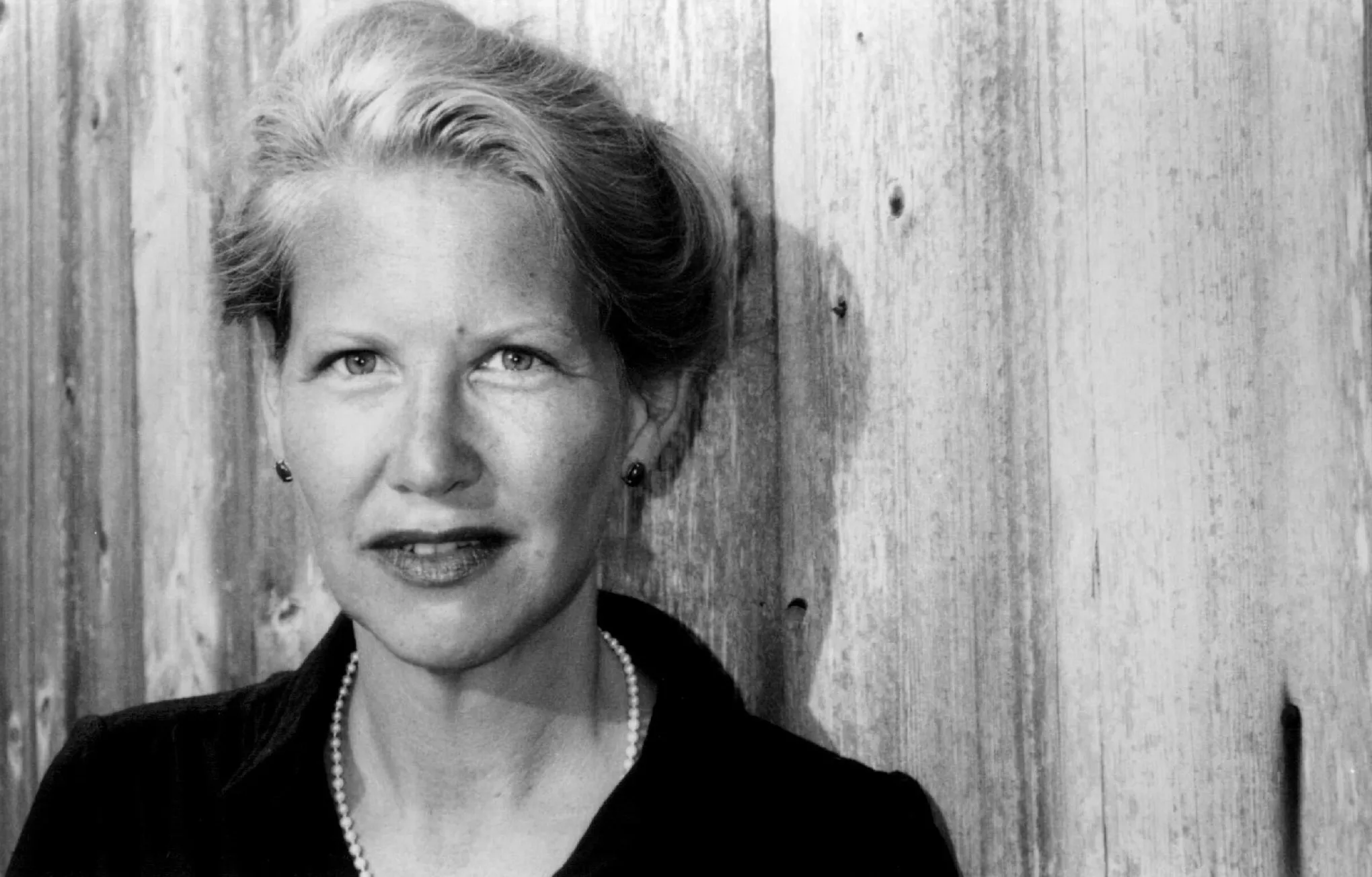
An assignment that Annie Dillard gave us in the class she taught at Wesleyan University was to write a poem titled “My Camel.” Her idea, which runs against all the writing advice I’ve heard since, and which says something about the scale of her aesthetic aspirations, was that we should try to contemplate something that we had never encountered in real life and therefore had to construct in our minds. The example here, clearly, being a camel. The poems that we wrote were bad.
Later in the class–and again, to get us out of ourselves–Annie had us write found poems by stitching phrases together from books we pulled from the library. After a few minutes of flipping through several books desperately searching for good lines you quickly discover that the majority of texts do not lend themselves to this exercise. For poetry, you need a certain novelty of expression, and we found our way naturally to books by mystics, oddballs, and travelers. When Annie passed our poems back to us the next week, she informed us that they were, unfortunately, the best work which we’d produce all semester. It was my first experience in a poetry workshop, and my teacher was pushing me to transcend the parameters of my own life experience.
Annie’s own work is exemplary. In her writing, she is drawn, as if by gravity, to the bleeding edge of understanding, the lip where the wondrous and supernatural mix together. She wanted us to let ourselves be confounded and to write through that. Isn’t that what being alive really is–inuring oneself to the staggering enormity of existence, or trying to see and merge with it? Annie chose the latter. Having us write a poem called “My Camel” was an analogy for writing about God, and she was daring us to try.
She knew it was a reach, and Annie warned us–repeatedly, emphatically, grimly–that writing is hard. She told us that if we really wanted to write, we’d have to do it seven days a week, for four to six hours per day. We’d have to banish our loved ones from our writing spaces. We’d have to give up other interests. Annie had given up painting when she’d recognized that to be good at painting, it would have to be the one and only thing she did. She picked writing instead. You can write, but there will be a cost.
I was 18 years old and did not register a single word she said.
I should tell you how I got into Annie’s class in the first place. When I first arrived at college, in the days before the semester started, I saw that there was a poetry workshop being offered. In the English Department office, on a piece of paper tacked up on the wall, I read that you had to apply to get in, and you could do it by putting some pages of poems in a cardboard box there.
I’d started writing poems a few months before, inspired by a hodgepodge of reading in my local public library’s small poetry section, which included Elizabeth Barrett Browning and Walt Whitman, as well as a beat-up copy of John Ashbery’s The Tennis Court Oath that I’d picked up at a yard sale in Hubbardston, Massachusetts. I filled the unused back pages of a spiral-bound notebook from my high school Biology class with poems. I tore these pages out, stuffed them in a manila envelope, and got in.
It met once a week, in the evening, in an upstairs room in the English Department. Half-way through class, we’d take a break and walk to Annie’s house. In the first half of the first class, when it was time to make that move, I was stuck in the corner behind a table that was too large for the room. I waited until all the others had left, then got a running start and moved across the tabletop as if it were a Slip n’ Slide. Later, Annie said she’d hung back and seen me do it, and she decided then and there that I was all right.
When we got to her house, it was chockablock with heaps of science journals, magazines, and books. She was a hyper-reader, consuming several books and a handful of journal articles daily, then imprinting what she read into her consciousness by talking about it. She liked to blast open chitchat with fresh revelations: marvels and tales of nature, science, invisibilia, journeys, jokes and gags, magic, religiosity. One story I remember her telling was of a mountaineer who’d seen the mountainside racing toward him in an avalanche, and turned to face it, arms open.
I was the only first-year student, and I was beyond intimidated. I was stunned by how articulate the others were, and by the fact that they had the self-confidence and boldness to speak at all. That first semester, I decided to force myself to say something every class. I would go home, do the reading, write out a comment, and edit it until it was coherent. The next meeting, I would put my scribbles under a notebook in front of me, so I could look at them if I lost my thread when I spoke.
As a teacher, Annie was mercurial, and I think she struggled to fill the hours. She would have us submit our assignments triple-spaced and hand them back tattooed with edits in red pen, usually adding punctuation–again, the exact opposite of all poetry workshop advice I’ve heard since then. She was appalled by how much line editing she had to do for me, and for us. In one class, when her queries about the assigned reading were met with silence, she inferred that we hadn’t done the reading and became irritated. I sat in silence: I’d read the text several times without comprehending and did not dare say anything about it. As penance, she had us intone a poem, thudding through the meter like the Our Father, then go home early.
Before we left, Annie informed us–this is one of many lessons of hers that I’ve carried through my entire life–that it’s a misconception that everyday language is prose. People speak in poetry, intuitively inflecting their expression with stresses and metrical feet, and well-written prose had better catch that rhythm, or it will lose the truly intelligent reader. Later, for another assignment, she had us pick a canonical poem, empty it of words, and use the rhythm and meter to write our own poem. She loved metrical virtuosos, like Gerard Manley Hopkins and D.H. Lawrence. Because I was still struggling to comprehend syntax and vocabulary, I especially took to that assignment, enjoying being able to simply bathe in the poem’s sounds.
As part of the class, Annie also invited all of us on a hike to a nearby hill, where she pointed out square-edged basalt, the remnants of a 200-million-year-old lava field. While she smoked a Winston, I looked down on central Connecticut, re-imagining it as a smoldering hellscape. On that hike, she picked up a dirty and wet yellow rag, expressing surprise that somebody could have left behind a perfectly wearable shirt. She put it in the plastic bag she’d brought her lunch in, took it home, washed it, and wore it proudly to our next class with safety pins in place of the missing buttons.
Back then, people didn’t really talk like they do now about setting boundaries, and Annie did not. She hired students for small jobs and loaned out her car to us. A classmate and I used it to take Annie’s pre-teen to the diner one evening for fries and milkshakes. One student of hers moved into the shed behind her house, in exchange for dog walking. At one point she gave out the keys to her house in Key West, where some of us went for Spring Break.
Some became proteges, entered her orbit, and began emulating her. Is it any surprise? We saw she was a writer with a middle-class lifestyle and wanted the recipe. Never mind that she was indifferent to the trappings of bourgeois life and discouraged us from becoming writers.
Although I became close with her, some part of me held out. I decided I wouldn’t read anything more by her than what I’d already read. Her raspy voice was already imprinted in my inner monologue, and I didn’t want her style to drown mine out. I’m not sure if this was the right idea, but it’s made it so that I’ve been able to come to her books at different points in my life. For example, I read An American Childhood, her memoir about growing up in Pittsburgh, after I moved here. In one story from that book, she digs up a cobblestone and puts it on trolley tracks that used to run down Penn Avenue in Point Breeze. The trolley comes to it, stops, strains, and lurches up, “whale-like,” crushing the stone under its wheels. Then it keeps going.
As I approached my graduation, my parents told me they wanted to meet her. Four years before, they had opposed me going to a private liberal arts college because of the price tag, but Annie’s tutelage had helped turn their position around, and they now loved talking about the opportunities the college had created for me. Annie was game to meet my parents, and we made a plan, but she got sick and had to cancel. In a way, it was perfect: without meeting the real Annie, the mythological one and their story could keep growing. Plus, I never had to see my real parents and idealized parent in the same place at once.
Still, my real parents had a point in the first place. I spent decades making monthly payments on the student loans I took on to pay for Wesleyan, all the while trying to find a way to write. Writing is unglamorous and hard, every day. Annie tried to warn me.
Around the time of my graduation, Annie and her husband decided to leave Wesleyan and move to North Carolina, where they had secured jobs at adjacent colleges. I had worked as a mover for years, and Annie hired me to box up the contents of the house. I packed a 24-foot truck and drove to Chapel Hill, where I stayed at their new place.
In the guest room, I tried to write but ended up staring out the window through the trees. Eventually, on the bookshelf, I found a copy of Annie’s only book of poems, Tickets for a Prayer Wheel. Flipping through, I was surprised to come to a poem called “My Camel,” with the subtitle of “A dialogue of self and soul.” Reading it, I realized that Annie had actually written a really good “My Camel.” What a sneak. Also, her poem isn’t about the divine–or it is, but it’s about one portal to it: trying to encounter the quicksilver of one’s own soul. “For years I forget my camel,” she writes. Then, as she takes her poem to its closing, she shifts to direct address: “I write the words of your name.”
I forget my camel, too, Annie. You admonished us not to write. I did anyway–not, in the end, for the trappings, which are flimsy, but because you lit a fire in me to try to really see the bullfrog, Honey Locust, and September morning sunlight, and see them in my soul. You did that through teaching, even more so through your writing, where you left the record of your work illuminating the baffling, boggling, and holy.
When I found out Annie had passed away, I called my friend Jen Mackenzie, a poet who was in the workshop with me. We started piecing our stories together, comparing different perspectives on the same events. I found myself talking about the ways I’d tried to follow Annie’s example, and tried to be a writer, and failed. We laughed, since we’d keep writing anyway.