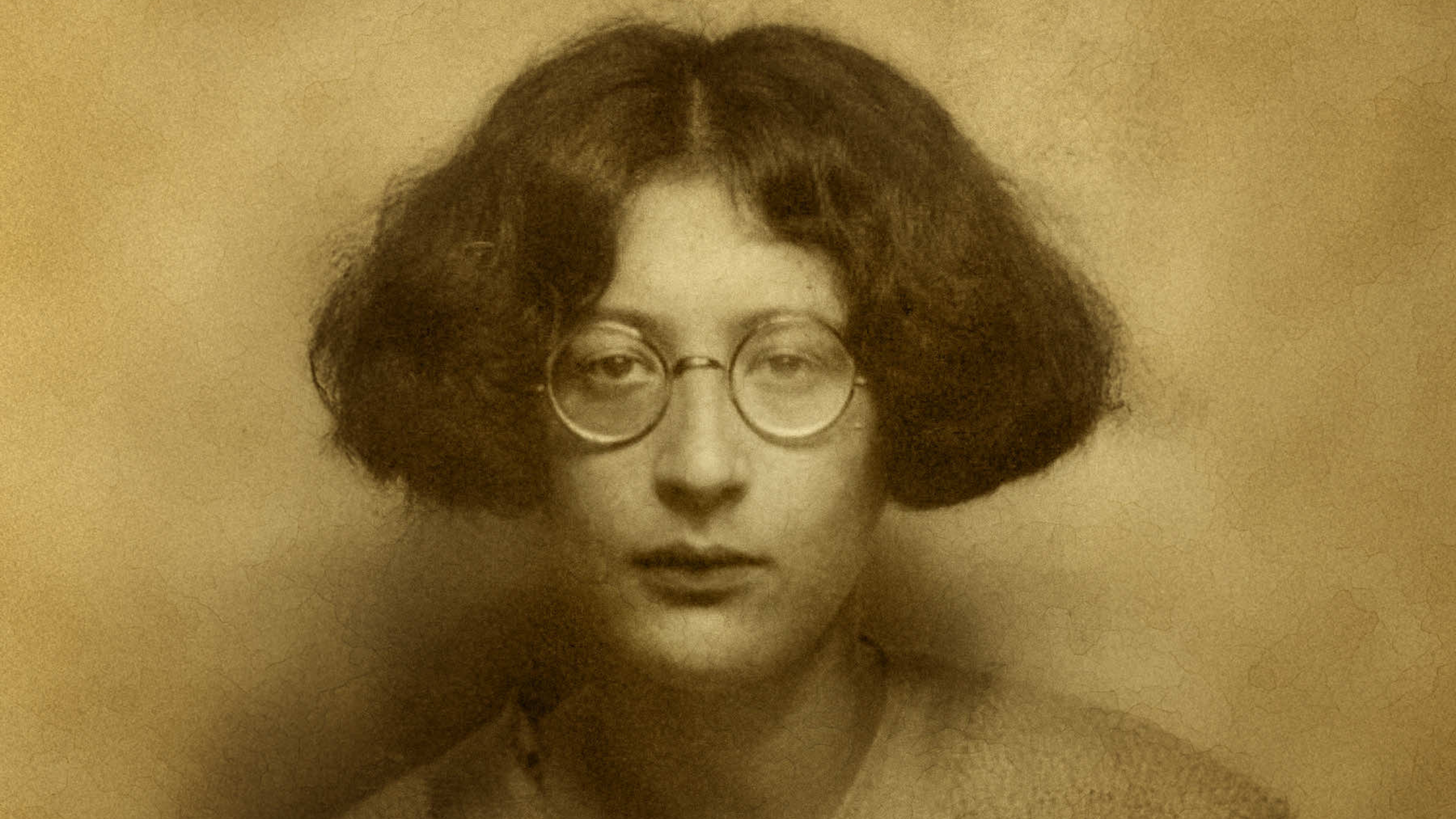
Harvard University Press published Simone Weil’s letters to her family for the first time in English translation in 2024, under the title A Life in Letters, translated by Nicholas Elliott and edited by Robert Chenavier and André A. Devaux. It is a strange kind of literary debut for a woman eighty years dead, and it says something about how much of her still waits to be read. What survives her—the essays, the letters, the notebooks she filled compulsively and told almost no one about—reached readers only because friends salvaged what she left behind and pieced it into books after she was gone. A process that is still, remarkably, underway eight decades later. That a woman so indifferent to her own legacy is now read as one of the most demanding moral philosophers of the twentieth century, cited by novelists, Nobel laureates, popes, and labour organizers alike, says something about how little she cared for the difference between thinking and living.
She died at thirty-four in a sanatorium in Kent, having eaten almost nothing for months because she would not accept more food than the ration given to people living under Nazi occupation. The coroner’s verdict read that her death was the result of cardiac failure due to myocardial degeneration of heart muscle caused by starvation and pulmonary tuberculosis. And then , almost in passing, they added that the deceased had refused to eat while the balance of her mind was disturbed. That phrase tells you more about the coroner than about Simone Weil. She had spent her short life testing whether an idea was worth anything if you weren’t prepared to live inside it, and she died still running the experiment.
Most of what we know of her thinking comes from letters never meant for print, many of them now available in English for the first time thanks to A Life in Letters. She wrote to her parents nearly every week she lived away from them—reporting on her health, her students, her factory wages, her running arguments with priests and Communists—in the ordinary, unguarded voice of a daughter writing home, fretting over care packages, trading family gossip, occasionally scolding her mother right back. She wrote longest and most searchingly to Father Joseph-Marie Perrin, a Dominican who became her closest confidant in her final years. Those letters, wrestling with belief the way a boxer wrestles with an opponent he respects, would become the backbone of Waiting for God, the book Perrin assembled and published in 1950 seven years after her death, and the one through which most readers still meet her for the first time. She also wrote to Gustave Thibon, a self-taught farmer and philosopher who later sifted through her notebooks and shaped them into Gravity and Grace, the aphoristic, unsparing book that made her name in France. She almost never wrote for an audience. Nearly everything she is remembered for she set down for one reader, or for no one, in notebooks she carried the way other people carry cigarettes.
She was born in Paris in 1909, into a family that treated ideas the way other households treat sport: something to be practiced daily and taken seriously. Her father, a doctor, was agnostic and quietly amused by the world. Her mother, Selma, ran the household with a will nobody in it ever fully escaped. Her older brother André would grow into a man who absorbed languages and proofs with equal ease before he could drive a car, become a founder of the Bourbaki group, and eventually be one of the great mathematicians of the twentieth century. Watching her brother’s early brilliance, Simone is said to have decided at six that she would rather die than live without truth. It almost sounds like the kind of story a family invents after the fact to explain why their kid is so eccentric. But everyone who knew her as a child swears she said something close to it, and meant it.
Growing up in the shadow of a prodigy could have flattened a lesser mind into an imitator, but it gave Weil something sharper instead—an early, almost physical understanding that being clever and being right were not the same thing, and that most clever people never notice the difference. At the Lycée Henri IV she studied under Alain, the philosopher born Émile Chartier, whose whole method was to refuse his students the comfort of repeating him. She placed first on the entrance exam for the École Normale Supérieure in 1928, ahead of Simone de Beauvoir, who ranked second, and later admitted that Weil intrigued her more than anyone else at the school. The two met exactly once. Weil was talking about a famine in China, insisting only one thing mattered now: revolution. Beauvoir answered that the point of revolution was to make people happy. Weil looked at her, Beauvoir remembered, with something close to contempt, and said she had obviously never gone hungry.
She was not performing for effect. This was already her method—to hold every idea up against the body of someone actually suffering, and to distrust anything that only survived in comfortable rooms.
After the ENS she took posts in provincial lycées, Le Puy, Auxerre, and then Roanne, teaching philosophy to teenage girls with an intensity that scandalized their parents and thrilled the students who could keep pace. During a bitter strike in Le Puy, she ran soup kitchens for unemployed miners and marched alongside them. This got her transferred, a pattern that would repeat through her entire teaching career. She gave away most of her salary. She kept turning up at picket lines. Ministry officials kept writing anxious letters about her.
The Philosopher in the Real World
Then in 1934, at the height of her promise as a radical young philosopher, she did something almost nobody in her position would consider. She took leave from teaching and went to work in a factory—not to study the workers there, but to become one of them.
She worked the presses at Alstom and then at Renault, doing piecework on an assembly line, standing for hours at machines indifferent to the fact that she had read Spinoza. She grew chronically exhausted, chronically injured, chronically underpaid, and she kept a diary of it unlike anything else in the philosophical writing of the period. Unlike other works during this time, her writing wasn’t observation from a safe distance: it was a testimony from inside a body being consumed by industrial time. The work did not just tire her, she wrote. It also corroded something she had assumed was untouchable—her own sense of her worth as a thinking person. That discovery, that a certain intensity and duration of suffering could reach past the body and damage the soul itself, became the seed for everything she wrote later.
In 1936 she went to Spain to fight for the Republic against Franco. Half blind without her glasses and unable to safely load a rifle, she was an embarrassment to the anarchist column that took her in until she stepped into a pot of boiling oil at camp and had to be sent home to recover. This almost certainly saved her life since most of her unit was wiped out soon after. Even though she did not stay for long, she was there long enough to watch men she had fought beside execute prisoners and civilians without a flicker of hesitation. She understood that no ideology inoculates anyone against cruelty. That force, once loose inside a system, corrupts everyone who touches it and whatever banner they claim to fight under. That became the lesson she carried home and never let go of.
In the exhausted years after Spain, disillusioned with organized politics but not with justice, she had her first mystical experiences: first, in a Portuguese fishing village during a saint’s day procession, where she suddenly understood Christianity as a religion built for slaves; and then more powerfully in 1938, at the Benedictine abbey of Solesmes, where during a Gregorian chant during Holy Week (and through a crippling migraine) something opened in her that never fully closed again.
What kind of philosopher gives up a secure post, a promising career, and her own safety, just to find out whether her ideas could survive contact with a furnace, a rifle, and a factory floor? That question follows her out of this phase of her life and into everything she became afterward.
Life Itself is the Argument
Simone Weil’s ideas cannot be lifted out of the life that produced them. Each one carries the fingerprints of a specific room, a specific machine, a specific year. The temptation with a thinker this demanding is to treat her biography as color and her philosophy as the real substance, a set of abstract claims that happen to be illustrated by an interesting life. That gets her exactly backward. With Weil, the life is the argument. Reading her ideas without the experience behind them is like reading sheet music and assuming you have heard the piece.
Take malheur, the French word usually translated as affliction (though the English is too soft for what she meant by it). Affliction in Weil’s vocabulary is not just ordinary suffering. It is suffering severe and prolonged enough to invade the soul itself, to convince the sufferer at some animal level that they deserve what is happening to them. She did not arrive at this idea by simply reading Aquinas. She arrived at it standing at a machine press for ten hours, watching what the work did to her own sense of herself, and then watching it be done more thoroughly to people who had no philosophy degree to retreat into on the weekends. Affliction, she wrote, is what happens when suffering grows so total it erases even the ability to cry out against it.
Force is the Spain concept, and it found its fullest expression in The Iliad, or the “Poem of Force,” the essay she published in the journal Cahiers du Sud in 1939. It is often read as literary criticism, but it was written by someone who had watched force operate up close two years earlier, in a country where men she knew turned into killers within weeks. Force, in her reading of Homer, is whatever turns a human being into a thing, either a corpse or an object of terror. And the horror of the Iliad is that it does this to victors and victims alike. Achilles is as much a thing by the end as Hector’s body dragged behind the chariot. This might seem like an abstract claim about war, but it is a claim she tested against corpses in Spain.
Attention is the Solesmes concept, though it fully took shape a few years later when she was teaching herself Sanskrit and Greek and struggling badly with geometry problems she used to breeze through as a student. She noticed that forcing a solution through sheer will got her nowhere. But holding her mind still and waiting, being receptive rather than grasping, often produced the answer on its own. Out of this almost trivial classroom observation she built one of her most influential ideas: that real attention, the highest form of it, is not an act of willpower but an act of waiting—a kind of emptying of the self so reality can arrive undistorted. She carried this into prayer, into love of one’s neighbour, and into the proper way to read a text or listen to another person. Attention, taken to its purest, absolutely unmixed state, is prayer, she wrote.
Grace belongs to Assisi, where in 1937, alone in the small chapel of Santa Maria degli Angeli where Francis was said to have prayed, Weil found herself on her knees for the first time in her life, without deciding to kneel. Grace, for her, became the counterweight to gravity, the natural downward pull of self-interest, ego, and force that governs most human behaviour. Grace was whatever interrupted that pull from outside, uncaused by anything the self had done to earn it.
Detachment comes from her sustained engagement with the Bhagavad Gita, which she read in the original Sanskrit and treated with the same rigor she gave Plato. She was struck by Krishna’s instruction to Arjuna that he must act without attachment to the fruits of action, and she found in it a precise parallel to what she was already trying to say about renouncing the self’s demand that reality bend to its wishes. This was not just casual borrowing; she placed the Gita, the Upanishads, Plato, and the Gospels in genuine conversation with one another, each arriving independently at overlapping truths about the self’s need to get out of its own way, without ever flattening what made them distinct. Most English-language profiles of Weil mention this Indian material in a sentence and move on, as if it were an exotic footnote to the real, European philosophy. It was not a footnote. She treated the Gita’s teaching on action and the Upanishadic idea of the atman (the true, innermost essence or of a living being) as philosophical work as serious as anything in the Phaedo. And she read all of it in the original languages to make sure translation was not fooling her.
Plato gave her the Good, understood not as a concept to be defined but as a reality to be approached through exactly the kind of attention she had described. The Republic’s image of the sun, she argued, records Plato’s own mystical experience, badly served by two thousand years of professors who read it as pure epistemology.
The Need for Roots, drafted in London in 1943 for the Free French government in exile as a blueprint for postwar reconstruction, gave her Obligation. Her argument was that rights were secondary and derivative, and that obligations toward the human being must come first. It is a strange, demanding, occasionally infuriating book, closer to a set of moral axioms than a policy document, and it remains one of the more unsettling things ever written about what a society owes the people inside it.
She Broke With Marx Over Something We’re Still Getting Wrong
The most underrated part of her thought is her break with Marxism, and it deserves more than a line. She laid out the case most fully in a long, 1934 essay, “Reflections on the Causes of Liberty and Social Oppression,” which was later gathered with other political writing into the book Oppression and Liberty, published in 1955, twelve years after her death. Weil never stopped being a humanitarian. She spent her adult life on the side of workers against owners, the colonized against empires, the hungry against the well fed. But well before it was fashionable to say so, she concluded that Marx’s analysis had missed something older and more dangerous than class. Marx assumed that once the means of production were collectively owned, oppression would wither, since oppression was a function of property relations. Weil, watching the Soviet Union closely enough to see past its own propaganda, argued that oppression was a function of something Marx underestimated—the bureaucratic apparatus itself. It was the machinery of organization which crushes the individual regardless of who legally owns the factory. Nationalize the plant, abolish private property, and a worker can still end up as powerless before a state planning committee as he ever was before a private owner, sometimes more so, since at least the private owner could occasionally be sued. Power, for Weil, was the deeper corruption.It was older than capitalism, and no change in legal ownership would dissolve it on its own. This is why she reads less like a period piece today than most of her Marxist contemporaries. She was diagnosing bureaucratic domination as a standalone evil decades before anyone had coined the phrase “the banality of evil,” and long before Cold War dissidents began writing about how a planned economy could grow its own totalitarian logic from the inside.
Was Simone Weil a Saint, or Just Very Hard on Herself?
By the last years of her life, Simone Weil had made a philosophy out of refusing to belong. In Marseille, then on a farm in the Ardèche belonging to Gustave Thibon, then in New York, and finally London, she lived something close to a monastic existence while refusing to join any monastery, any church, any party, anything that asked her to sign a card. In Marseille, she fell in with the circle around the journal Cahiers du Sud, still writing, still teaching herself languages, still giving away food she needed herself. At Thibon’s farm she picked grapes alongside seasonal laborers and refused any special treatment, the same instinct that had sent her to the factory floor years before. This refusal to belong to anything, right to the end, is the strangest and most instructive part of her story.
She told Father Perrin plainly that she believed Christianity held the truth, perhaps the fullest expression of it available to the West, and that she loved the sacraments, the liturgy, the person of Christ, with an intensity that unsettled the priests who knew her. And yet she would not be baptized. Years later, in a document published after her death as Letter to a Priest, she itemized her doctrinal objections one by one for a Dominican correspondent. It contained more than thirty of them, and she refused to soften a single one just to ease her own path into the Church. Her reasoning never held any squeamishness or doubt. To her, the Church as an institution claimed sole possession of saving truth, and she could not accept a claim like that once she believed she had found real truth operating plainly elsewhere.
Forays into Eastern Mysticism
That elsewhere deserves its own accounting, since most English-language profiles of Weil treat it as a footnote. She did not sample Indian philosophy the way an interested European reads an anthology. She studied Sanskrit seriously enough to work through the Bhagavad Gita in the original language, and she treated Krishna’s instruction to Arjuna as a claim as rigorous as anything in Plato. She read the Upanishads and found in them the same movement she found in the Gospels and in Plato’s cave, a mind stripping away everything false about the self until only the real remained. She read Krishnamurthi and took him seriously as a thinker rather than a curiosity. What she never did was flatten these traditions into one undifferentiated mysticism, the kind of gesture that treats every religion as saying the same thing in a different accent. She held Hindu philosophy, Buddhism, Platonism, and Christianity in the same hand without pretending they were identical, and used the friction between them to sharpen her thinking rather than to soften it. This is not incidental to her refusal of baptism. It is the same refusal, applied twice. She would not let one tradition claim a monopoly on what she had found scattered generously across several.
Theologians have argued about the baptism question ever since. Some read it as a species of pride, the last stand of an intellectual unwilling to submit to any authority higher than her own judgment. Others read it as the most honest form of faith available to someone who refused to lie even to gain admission to paradise. Both readings hold some truth, which is probably why the argument has never been settled.
Intellectual Afterlife and Criticism
Her afterlife runs through some unlikely rooms. Albert Camus, who helped get her posthumous notebooks published by Gallimard, called her the only great spirit of the age, and L’Homme révolté carries her fingerprints all over its argument about the corrupting logic of revolutionary violence. Iris Murdoch built a good part of her moral philosophy, particularly the idea of moral attention as the discipline of seeing another person clearly rather than through the fog of one’s own ego, directly on Weil’s foundation, and said so often. Czesław Miłosz translated her into Polish and carried her ideas about affliction and force into his own reckoning with totalitarianism. T. S. Eliot wrote the introduction to the English edition of The Need for Roots and found in her a kindred severity about the modern world’s spiritual rootlessness. Thomas Merton read her closely at Gethsemani and found in her confirmation of his own instinct that contemplative attention was a form of justice, not an escape from it.
Was she too demanding of herself, and by implication of everyone around her, by holding humanity to a standard of self-abnegation that most people reasonably cannot and should not meet? A friend can admire the rigor of her thought while still wishing someone had made her eat. Did her deep suspicion of institutions, the same suspicion that kept her out of the Church, also leave her with no real politics she could build on? The evidence cuts both ways. The Need for Roots reads more like a moral indictment than a working plan, brilliant in diagnosis and thin on mechanism. But in that same period she also wrote On the Abolition of All Political Parties, a short, furious pamphlet arguing that parties by their nature corrupt the individual conscience they claim to represent, an argument still quoted today by people exhausted with partisan politics on every point of the compass. She was capable of practical proposals. She just simply distrusted every existing vehicle built to carry them out.
These are not questions with tidy answers, and Weil herself would probably have distrusted anyone who claimed to have settled them. She spent her whole life insisting the point was not to arrive at comfortable conclusions. It was to keep looking, without flinching, at whatever was actually there.