“We are scientists of sound / mathematically puttin’ it down.”
- Kool & the Gang, “Heaven at Once”
My feet moved.
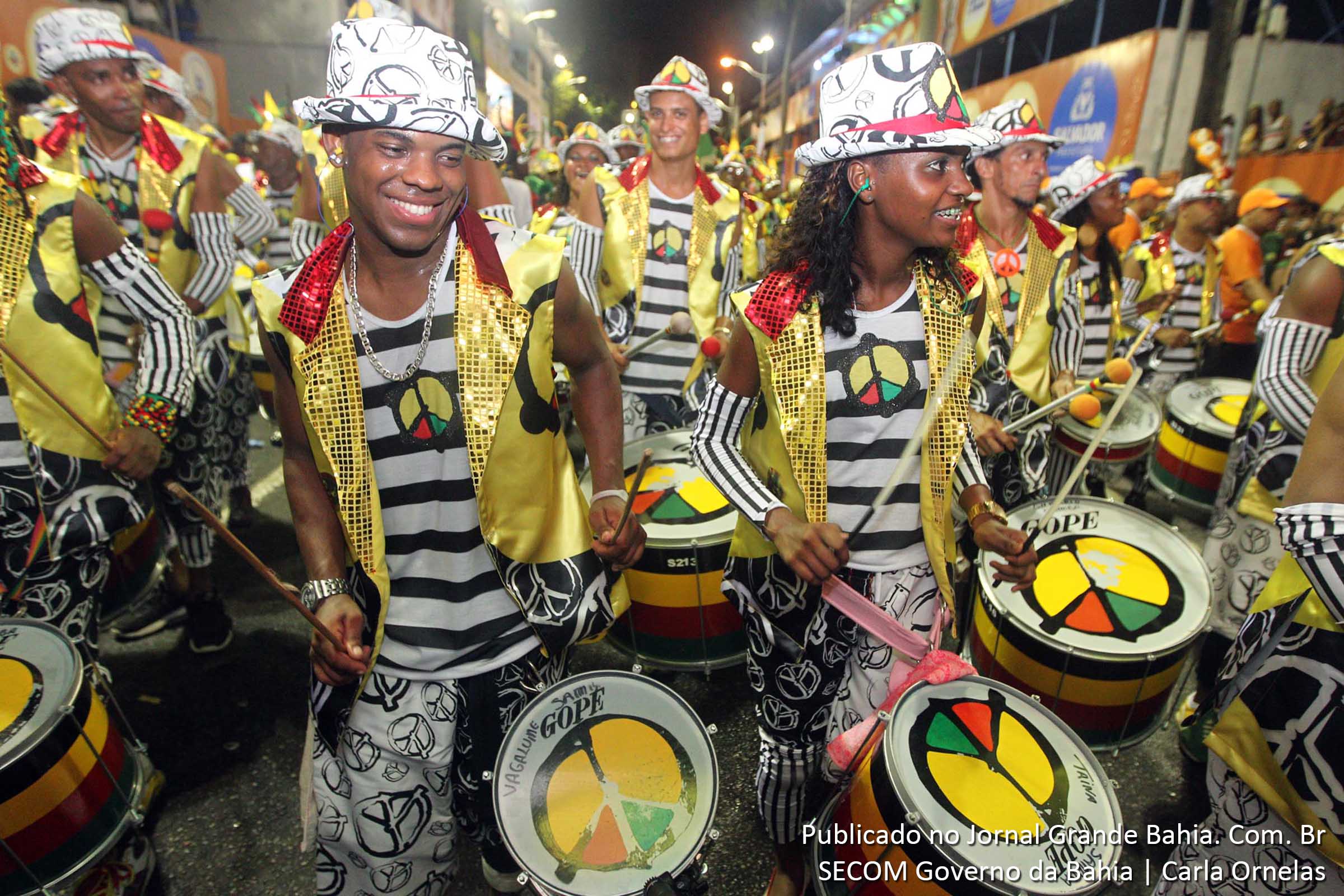
I’d been invited to play with Banda Olodum by Neguinho do Samba, the group’s leader. I was stepping in concert with a contingent of 120 drummers. As I moved, the drumstick I held in my right hand hit the anchoring beats of their rhythm on the fundo—a bass drum—that was strapped to my waist.
Olodum’s sound spread out in the night, echoing off the buildings and sidewalks. That sound enveloped a crowd of revelers the size of an entire city, lining the streets of Salvador da Bahia, as the group paraded by. One set of drums called people to the bacchanal with a cutting metallic crack.
Another repeated its rhythm in a raspy sustained voice. Three separate sets of the largest drums rang out on the bottom, delivering the ringing notes that were, and are, the group’s signature sound.
Each drummer’s body moved according to the drum they played.
The snare drum is the raspy-sounding drum. Olodum’s snare drummers play while holding their sticks straight, making them into prosthetic forearm extensions. Those extended forearms are in constant motion, like wings on a dragonfly. Their upper arms barely move, but the intense side-to-side undulations of the drummers’ torsos illustrate and emphasize the swing of the groove for the people.
The cutting crack comes from the repique, a cylindrical metal drum. Drummers who play it dance down the street doing a four-step: left for-ward, left step in place, right forward, right step in place. To deliver the crack, drummers open their arms wide, then close them quickly in a flap-ping movement.
The fundo is the largest drum. It delivers the bottom. In Olodum, as in so much of African and Afro diasporic music, the low notes provide both the motive force and the melodic foundation. Three different sets of drums combine to deliver the low-end melody, each set playing one note of the pattern. Fundo drummers are the most flamboyant dancers in the group. The best was named Legal. He danced and played while holding his instrument up in the air like a flag, beating the fundo using his right arm while his left arm, fully extended, held the drum over his head in tribute to the drum nation.
As I played, my left side moved in opposing motion to my right in a bodily dance of mirror symmetry. I was playing, but I was not consciously doing so. I was in that state where things “just are,” where the automatic rises to consciousness and the conscious becomes automatic. Some make a big deal out of that state. I guess it may be for them. For me, it just is, like breathing.
The band stopped moving, and I shifted mentally. We had reached an impasse in front of a steel wall that blocked our path. At this point, I had been playing with the band for more than six hours without a break, but then, while still holding with the band, I keyed in on the sound of the drums in front of the wall.
The sound of a set of fundos being played in their element, outdoors in the street or a large stone structure, is utterly unique and beautiful. Moving drums become symphonic. Revelers in the streets during Carnival hear the sound of fundos subtly but noticeably change. They ring with overtones that change according to the ear’s proximity to the drums and the drum’s distance from buildings and walls.
Those subtle changes work in concert with repetition. Music is organized sonic repetition. On one scale of repetition, we hear organized sound as notes, chords, and melodies. On another, we recognize it as rhythm.
Ingenious repetition, clever manipulation of the sounds human beings hear as rhythmic, is a defining feature of music built on an African base.
Individual rhythms that work well become the building blocks for rhythmic structures. The core elements of rhythms, like the core elements of physical structures, are simple. Groups of sonic events countable on one hand are bundled, then welded and intertwined to create rhythms. These rhythms are then themselves intertwined and welded into structures. These structures are multiplicities that unfold in time and permeate the frequencies within human awareness. The best, developed and tweaked, become grooves.
A well-organized set of rhythms, a great groove, always feels fresh. When you’re moving your body, rhythmic repetition creates a sense of newness. Each repetition of the groove gives you a new opportunity to experience it, to engage with your body and the joy of movement. Dancers ride the rhythm, access this sense of constantly unique experience, and use it to open the door to losing themselves in the groove.
Low-pitched frequencies are the foundation of movement. Bass is the base. When there is no low-end musical instrument providing rhythmic repetition, the movement of people’s feet provides the bass. Grooving is mutualistic; dancers can’t exist without bass, and bass is sterile, unable to give birth, without dancers. The intertwined rhythms of a great groove provide multiple ways to enter the music, multiple means to focus, and multiple vectors for movement. This multiplicity melded to songs coming from Olodum’s singers is what moves the crowd.
In front of the wall, the reverberations of the drums became oceanic. The sound of the fundos blurred and multiplied. It was as if the fundos were being played two blocks away, directly next to me, and in front of me at the same time. The repique’s crack echoed off the walls, repeating in rhythm, then falling out of time like a dancer slowly stum-bling. The snare drum sound blurred, the crisp rhythm of the drummers morphed into a sound evocative of a swarm of prehistoric hornets. The sound of the singer iterated and spread, the sonic illustration of fractal multiplication.
And then, the wall moved. Two steel slabs swung apart, and as they parted, bright lights and television cameras emerged from the darkness between them. As the slabs were cleared, I was pulled along by the energy of 120 musicians unleashing something they had been carefully guarding all night.
Olodum’s singers and dancers were riding above us on a large truck that carried a sound system, the only thing that enabled them to be heard over the drum battery. Centered in the mass of us drummers, they dug in just as deeply as we did. Together we kicked our performance up to its highest level. Seven hours in, we had reached a pinnacle. I could see hills of revelers on both sides of the street and television cameras marked with the logos of all the major Brazilian television networks. The drummers and singers and dancers played as if all of Brazil was watching them. Because they were.
At that moment, playing with Olodum under the glare of the television lights that made 4 a.m. as bright as sunrise, I stood at the peak of musical joy.
Excerpted from How Black Music Took Over the World by Melvin Gibbs. Copyright © 2026 by Melvin Gibbs. Available from Basic Books, an imprint of Hachette Book Group, Inc.