Editor’s Introduction – Noah Ashley Blooms
It can be difficult to see Appalachia clearly through all the stories told about it. Some make the region into a villain, a place defined by poverty, ignorance, and cruelty, as though these things were born in the mountains rather than shaped by history. Others go too far in the opposite direction, insisting on a place of extraordinary generosity and resilience, where hardship becomes a virtue and suffering is something to admire rather than address. And then there’s nostalgia, perhaps the distortion that troubles me most of all. It imagines an Appalachia forever disappearing, a place whose best days are behind it, whose people and traditions are valuable because they belong to another time.
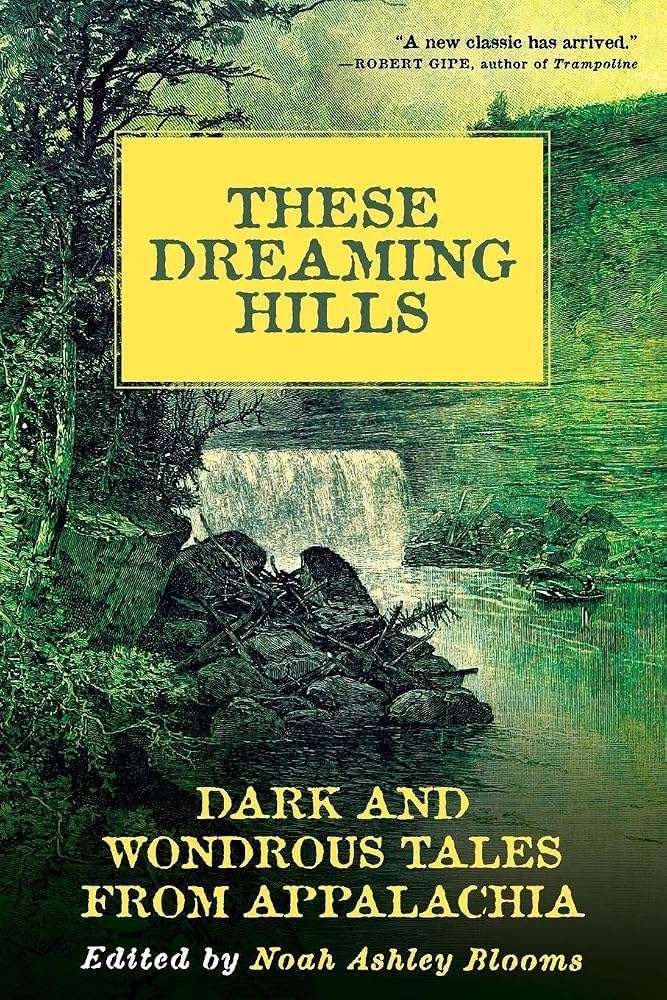
When I began reading submissions for These Dreaming Hills: Dark and Wondrous Tales from Appalachia, I wanted to find stories that refused to make Appalachia innocent in order to make it worthy of love, or helpless in order to make it deserving of care. I wanted stories that could hold the complexity of the region and its people without reducing either to what they had been or what we wished them to be.
Elizabeth Kilcoyne’s “Damburst” was one of those stories.
As a child, Misty and her friends discovered magic in a river, a place that offered them endless wonder until a devastating flood took her brother’s life. Unable to reconcile her grief with her love for the river, Misty left it behind. But when another environmental disaster threatens the life within its waters, she returns, hoping the magic of her childhood might help her save it.
What moves me most about “Damburst” is that Misty doesn’t return because she’s made peace with the river, but because even after all the pain it’s caused, she still loves it. She doesn’t need to make the river noble and flawless to justify returning, or monstrous to justify having left. Instead, she chooses to care for it without pretending their history is anything other than what it is.
But she cannot save the river alone. To help, Misty must also reconnect with the childhood friends she’s grown apart from. Much like with the river, their shared history contains both affection and resentment. Coming together doesn’t undo what happened between them, and it cannot restore everything they’ve lost. But it offers something nostalgia, idealization, and villainization never can: the possibility of a different future. I think about that possibility when I think about Appalachia, and about the communities we hope to build. There is so much here worth loving, and so much that needs to change. We need stories that can make room for both, stories that help us see the place as it is without losing sight of what it might become.
Noah Ashley Blooms (they/them) is a queer, nonbinary, Appalachian author of Where I Can’t Follow and Every Bone a Prayer. Their work has been nominated for the Crook’s Corner Book Prize, Weatherford Award, and Judy Gaines Young Book Award, and they’ve been named a South Arts State Literary Fellow for Kentucky. Their writing has appeared in The Year’s Best Dark Fantasy & Horror, Fantasy & Science Fiction, Strange Horizons, The Oxford American, and Reactor. They received their MFA at the University of Mississippi and are a graduate of the Clarion Writers’ Workshop.
“Damburst” by Elizabeth Kilcoyne
Misty didn’t come back to the river to forgive it. She came back to save the mussels in Sugar Creek, after January rain spilled the quarry retention pond into its mouth and drowned them in acidic silence beneath the clay yellow water. Twelve years ago she’d picked a college in the closest largest city, far enough away from its watershed that she couldn’t hear its singing invitation when she turned on her taps. She was still close enough to hear the rainstorm half an hour before it hit back home, melting rivulets through the lingering drifts of snow.
She dreamed the wallbreak, the overflow, the caustic leak down the hillside and the flooding creek rushing up to meet it. She woke with the sinus pressure of limestone sludge in milky tendrils reaching downstream towards the deep pockets of slow cold water where the fish lay dormant. She gasped awake, mouth gritty.
The mine had been abandoned since they’d reached the settlement, closed as part of the inadequate reparations the owners had made to the county they’d ruined. When she first woke up, she thought it was a memory. Then she checked her phone and saw her hometown in a Google alert again, national news reporting on a place where nothing ever happened. 8 inches of rain overnight, the river hit 41 feet at the Cave Run Dam. 2 fatalities, 2 still missing.
It was Deer Creek all over again.
When she dreamed about the river it was only memory, never possibility, old images conjured from prerecorded film reel playing on loop. Like a broken branch caught in an eddy, the image dragged back to start all over with every inch of ground it gained.
When she was young the river only ever seemed to spill over with promise, the sort kids who were used to the broken variety could actually believe. To the friends she’d lost when she left, it offered up glacial pebbles in fistfuls, polished coal worry stones and Adena spearheads. It never would hold on long to a front door key or a father’s borrowed pocketknife if ever a hand should drop one, washing it back towards the toes of their mud-stained school sneakers like a cat offering up a dead snake.
She never dreamed about its generosity, either. She only remembered its love in waking life, jarring as a migraine aura when she caught the glint of mother of pearl in a plastic button. Each step down the rainbow path of split mussel shells gleaming in the shallows might startle a crawfish to scoot backward beneath another easy limestone foothold. Here there’d be a tire, there a silver maple split in half lying just beneath the surface. Their feet trusted these improvised paths as much as they’d trust a city sidewalk not to give way beneath them. They’d hurry along it just in time to catch another proffered gift; a deer drinking in the sunset, the wing of a bald eagle lifted just before flight, the first drops falling in a curtain of rain.
Until the river swelled so there was no footpath through at all, only ripping current insisting forward, forward.
They’d find the bodies soon enough. It had only ever held onto the one, tucked shamefully in the tangled rootball of a tree like crumpled paper hiding a failing grade. They’d find the spill without her, too, but not before the damage had been done. The mussels were a passive species, silent as trees. Their breath underwater was the same one God breathed to bring the world to life. They could filter poison from the water if it came in small, trickling doses from neighboring farms and businesses, but an onslaught like this would strangle them, snuffing out the light and lifebreath from the river altogether. Its song would fall silent. Without the mussels of Sugar Creek, the river would be unrecognizable.
That propelling tug had her buckling her seatbelt before she could talk herself out of it. She’d have a look at the damage, that was all. Maybe be the first one to call the authorities and report it. It wasn’t like she could run poison backwards up a riverbank on her own.
Even if once the promise its banks offered her made her think anything was possible.
#
The new bypass shaved twelve minutes off her drive home. It ran straight through what it had once curved around, the cow-flattened foothills that rose up like waves when she left the city behind. Jagged holds of limestone, staggering skyward around the flat road, streamed with muddy rivulets of water. They drained off into swollen ditches on either side.
Misty missed the turn-off to the Arby’s and the Shell and found herself, stomach grumbling on a quarter of a tank right outside the place she promised herself she wouldn’t go.
Alma Castillo stood with her arms crossed over her chest and a frown on her face that made Misty immediately want to surrender the swingset, nevermind how long it had been since their playground days.
“Pay inside before you pump,” she told Misty.
“I’ve got my card.”
“Card reader won’t work for you,” Alma explained, “Because this is a hostage situation. You come pay before you pump. Tell me why that ugly Jeep of yours just pulled up in my parking lot.”
The restaurant inside the gas station was packed already. Alma’s mother and sister topped up styrofoam cups of coffee for those the flood had displaced. The strong smell of onions on the grill held them safe, the way their walls hadn’t.
“You already know,” Misty accused as her coat was stripped from her shoulders and she weakly resisted being manhandled into a seat at a formica table. Like they’d been waiting for her, she was served two pork tamales that tasted like the only thing in the fridge when her mom was working doubles. Behind the grill, Carolina Castillo’s hair was streaked through with white now and her eyes crinkled more at the edges than they used to when they sized Misty up, satisfied, at least, that she’d been eating well in the thirteen years since she’d last been sent home with three styrofoam to-go containers and three Big Gulp cups of orange pop.
“Of course we know.” Alma no longer called her stupid, but Misty could hear it in the pause. “We watched it rain. I can feel it now in my lungs, like a night spent smoking. Difference between you and me is about sixty miles from the problem. Why are you back?”
To fix it.
But she’d imagined herself doing it alone. They were already down one, maybe two. The three of them could probably get the river to sing, but they couldn’t get it to change. They’d only ever done it before with five. It was just as embarrassing to fail alone, to tell herself she’d tried with no one else the wiser. But the river wanted a high school reunion.
“How many fatalities?” She asked.
“Governor said two on his most recent count. They found one who’d been reported missing earlier still alive, but the water’s so cold there’s not much hope for the other. We had warning enough to evacuate, but a lot of people can’t miss a shift or they get fired. Some of the new guys think their lifted trucks are tougher than a couple of inches of water…”
The Castillos knew as well as she did how fast the water rose. How hard it was to find your way out once it pulled you in.
“The gas station part’s new.” She said, aware they were waiting for her to explain her presence in it.
“Settlement check came through. More money in gas than tortas and tacos. We’re oil barons now,” Alicia agreed. She was taller than her older sister with long fingers that Misty saw in her memories scooping up fistfuls of muddy water, tossing it up in the air to suspend like raindrops, spelling out her name. In her dreams they only ever reached for something to cling to, found a moment’s rest on a tree branch and held on tight until another passing branch knocked her forward, forward.
“What’d you spend yours on? Not a Benz, clearly.” Alma flicked her gaze like a cigarette towards Misty’s beaten up Jeep.
Misty hadn’t spent the settlement check on anything yet. It sat in her checking account for three years, an abstract string of numbers that meant she’d probably never go hungry again as long as she kept answering the phone at the extension office. Numbers that softened the world around her, muffled its groaning. She liked to look at them whenever she printed a balance receipt from her bank.
“You can’t do it with one.” Alicia told her out of nowhere, voice low and urgent. Not nowhere, now, because her mother had walked into the back office and could no longer overhear them. “Or two, if you thought we hadn’t already tried. We couldn’t get it to sing, but it hummed.”
“Haven’t tried three yet?”
“Good luck finding him.” Alma said, rolling her eyes. “Call me if you do.”
#
Misty found Logan picking scabs on an overturned sycamore above the riverbank in the second place she went to look. She’d tried the boat ramp at the local park first, but they’d closed it off above the floodline and search and rescue had set up their point of operations where it was easy in, easy out. Forty eight hours in and they were packing up the red inflatable rafts the firefighters in the next town had loaned them. The missing were no longer missing.
Misty’s vision doubled across a decade, memory overlaying sight like rainwater pouring into her eyes. She could taste mud at the back of her mouth. There was some talk through the window she couldn’t remember cracking, some guy she recognized from high school saying, “Misty, honey, do you need some help?” She shook her head, waved as friendly as she could remember how to do, and pulled back out of the lot.
She ended up at the Deer Creek bus stop where it first began. It had been a waste of time, looking anywhere else first. Cowardly to avoid it. There were no rescue boats here. No one to rescue. No one had lived here since she lived here.
The road she and the others had been picked up on by a yellow school bus every day since the start of kindergarten had washed away in the flood before this one. A fossil record of asphalt, the only lingering sign of life. Water still covered the slope of the bank beneath the gap tooth smile where there’d once been a bridge. The mine above them had been closed before she was born and the jobs it had promised evaporated alongside it, but the impact of its fast and loose drainage practices crashed down on them one night when Misty was seventeen years old.
The trailers they’d once lived in were crushed tin cans by the time the clean up crews eventually discovered them, miles downstream from where they’d started. The spot where the Castillo’s home once sat was still submerged in floodwater, but Misty’s own yard was clear of it now, the ridge torn like angry claws had shredded into it. The swollen gash of water that was Deer Creek swirled clay brown just beneath the one lane bridge.
She was five miles upstream from the Sugar Creek spill. Logan should have been there, where the current damage was, not sitting in the wreckage of the past. But he was here at the edge of Mr. Day’s longtime-fallow corn field, and so was she.
The ground beneath Misty was muddy as a rice paddy and littered with the river’s backwash. She was trespassing on property Mr. Day still owned and sometimes used, but she wasn’t worried about bird shot in her behind. He wouldn’t see much besides catfish on the trail cam he’d originally installed to keep the kids away, at least not for the next four days. By then she’d be gone.
Her muck boots, the sturdy sort she’d bought in lieu of a Benz, squelched through the mud but did not succumb to it. Logan’s jeans were soaked brown nearly to the knee, and he shivered beneath two layers of hoodies. He raised his hand as if to conduct a symphony above the churning water but jumped like he’d been caught doing something evil when he heard her halting approach, cramming his hand into his pocket instead of wiggling it into the position that would pull a stream of water up into his cupped palm. His face was sprinkled with sores.
“You ain’t supposed to be here,” he drawled at her, cracking a smile she’d once thought of as handsome. “Trespasser.”
“If Mr. Day wants to come down from his house and make good on that promise to shoot us, he’ll need a boat to do it. I think he’s got bigger problems, and so do I.”
“You can’t breathe either.” Logan had a way of telling her what she thought instead of asking her, but he’d known her long enough that he was rarely wrong. “I told myself I was getting sick there for a minute. But that dream… that’s the realest thing there is anymore.” He reached out a hand to her, but Misty hesitated, kept back. He smiled, unsurprised.
“Alma and Alicia already tried with two,” she said, apologetically.
“You talk to them girls already?” There was a note of jealousy there, or maybe awe. He’d always wanted to be closer to Alicia than he ever got. They both had.
“Talking to you now,” she said, “Maybe even listening, if you think you got an idea worth trying.”
He stared at her, long and hard with an edge to his eyes she didn’t remember. She swallowed spit, anticipating something cruel. He’d always had that way about him. He’d needed it.
But instead he lifted his hand, ticking off his fingers as he went, “Alicia was always best at stirring up the water, moving the current where she wanted it to go. Alma could get it to sing, whenever we had three, but she could make it hum all on her own. It would give you anything you asked for even when you were alone and when Jared tried to run, it would carry him like the wind.” He stopped, shaking his head, so she finished the next part for him.
“You used to clear it out in patches as clear as glass. We could see the bottom like looking through a window.”
“For seconds. In patches.” He demurred, smacking at his temple as though he could dispel something crawling across the scalded shave of his head. He was near tears, she realized, had been all this time. “I thought they might ask me if we could do it with three. But they don’t ask me much anymore.”
He quirked a watery smile at her, like it was a joke they were both in on. Misty wasn’t sure she could muster a laugh. “What happens when you try to do it with one?”
“About as much as ever happened when I was alone. I’m not much magic as it stands, alone.”
Neither was Misty, but they were both here.
“Hey,” laughing again, “remember how fast he could go, even if it was just two? He’d take your hand and just run like we were at a track meet. Once it was three, me and him and Alma, and we got to going so fast the wake of us rocked waves up onto the shore.”
Misty tried not to remember running. Every time she did she remembered slipping, the solid path beneath her feet giving way to unrelenting, battering current. When she and Jared had been yanked apart by the current, she sought a gift from the water that had turned unrecognizable around her. And it had offered one to her; a tree trunk she could cling to until the boats came.
It hadn’t offered up Jared’s body. She’d asked kindly. She’d pleaded and cursed. She’d tangled her fingers up in knots trying to get the magical gesturing right to force a miracle.
In the end, the divers found him. Direct cremation was all their parents could afford. Her last glimpse of her brother was lit with panic and framed in river water.
“We can try it with two,” she told Logan, not really meaning it.
“They say they’d try it?”
“If I found you.”
He spread his hands out, like, well. Go on then. When she didn’t reach for her phone, he let his hands fall back at his sides again. “You don’t think we can do it with four, either.”
Why lie? Misty didn’t. “Four wasn’t enough to dredge up a body. Four won’t move slurry from a creek mouth.”
“Maybe we were young and stupid and asking the wrong questions.”
There was nothing Logan could say to her that she hadn’t already broken down in her head over years of bad sleep and worse dreams. Misty hadn’t asked the river for a body. She’d asked it for Jared. Out of a thousand kindnesses, magic tricks and moments of awe, the river had never offered her a miracle.
When she didn’t answer, Logan picked a dried bit of turkey tail from the trunk of the tree he was sitting on and tossed it into the open creek mouth. “Well, you won’t listen to me. Maybe you should talk to the river about it.”
The river didn’t talk. It hummed an unending song of changing currents and would even sing in a language far beyond their understanding, if they offered it a large enough captive audience. It gave and it took. It moved for them and around them and sometimes carried them away with it. If she sat down to talk with it she’d only interrogate it, and for her troubles she might find a blue glass bottle or a wheat penny, but she’d never find out why.
“Let’s try it with four,” she said instead.
If it didn’t work, she’d walk away. She’d done it before, when her family settled out of court for less than her brother’s life was worth and she walked away thinking she’d never come back to the waters that held him under and held his ashes when it was done. She could love the mussels of Sugar Creek for breathing the river clean and leave them dead beneath the water for someone else to pull out when the sediment strangled them. She could learn to live with the feeling of her lungs collapsing. She’d done it before.
#
The river was still at 35 feet by the dam in Cave Run which meant there were two places they could meet and get to the Sugar Creek spill. Fish and Wildlife wouldn’t be there yet. Fish and Wildlife probably didn’t know yet. Fish and Wildlife didn’t breathe against a river spilling into their lungs when they lay down at night to sleep. The easement onto the Carson place had a stalled pickup truck jammed sideways across its entrance. Fewer eyes there. Maybe a day to try, if they were lucky, before someone else saw the spill.
When Misty parked the Jeep, Alma’s Highlander was already there, idling. Logan jammed the wrapper of the granola bar Misty’d been saving into her cup holder and jumped out of the seat like it’d been burning him to sit there the whole drive up. He hadn’t asked her what she’d spent the settlement money on. He told her he’d bought himself a private jet. It was parked up in a hangar in Cincinnati waiting for him, but his car was too broke down to make it up there. Alma had already told her that his fosters had gotten ahold of the money before he could, that he’d never seen a dime. It seemed about as generous to let him lie.
“Girls,” he said, nodding to them without looking directly at them. A tight, polite smile flashed across Alicia’s face. Alma looked past the scabs on his face to make sure Misty was fine. Hurt in Logan’s eyes blinked away before Misty could be sure she’d actually seen it.
She hadn’t been there to know, so she had to ask. “Do you do this anymore?”
“Not in years.” Alicia shook her head. “I don’t play with dolls or cake my eyes with black eye shadow either. Kid shit, you know.”
Alma added, “Sometimes in the summer we’ll spend a day on the bank. Float below the riffle. But I don’t ask it for anything. I’ve got enough already.”
Misty looked at Logan, who shrugged. “I don’t want it to answer anymore.”
Four instead of five. Whenever they’d tried it before it had been Logan missing, not Jared. Logan who was missing half the time they played anyways, truant in his court records, ran away from home most summers, spent a fall in J-county juvie and came back with worse habits than he’d gone in to fix. Logan who they’d always assumed one day would fade or leave or disappear the way his dad had. But Misty’d found him again almost right where she left him.
Jared’s ashes had dispersed into the Ohio, the Mississippi, the Gulf of Mexico. Even if the five of them had linked hands and run with him as fast as they could with minds fixed on believing in life beyond the next bend in the river, they’d never have gotten that far.
“I haven’t got forever,” Logan said, “so let’s get going.”
When the river was low they could walk to Sugar Creek from the banks below their trailers. They’d done it often when they were seven, eight. Those stifling summer days where everything smelled like catfish foam and still, leafy mud, all mineral, a cousin to blood. On days when a box fan couldn’t stir the air in their homes into some semblance of cool Alma could stir up a breezy song from the sluggish central current and they would breathe through July by its song, moving only when another proffered delight from the banks inspired them onwards. When the new limestone mine opened twelve years after the old one closed, the dust it threw was too heavy for the summer breeze to beat back so they’d stopped coming as close.
The river had accepted quarry dust the way it accepted cowshit and fertilizer, old cans of paint, compacted soil that dumped buckets of rain down into its creeks and collapsed stretches of bank near the honeysuckle thickets alike all wove a discordant harmony through its steady song.
But it was never silent, even now, with an entire retention pond choking its voice, caustic flow sawing away at its cords. Its swan song didn’t sound that much different than the way it sang throughout their summers. Just quieter.
Alma tensed and flexed her hand like she was shaking out pins and needles, tapping a slow beat as she shuffled down the muddy banks towards the spill site. They all felt, like gooseflesh, the moment their ears tuned radio-clear to its hum.
A tree floated by like a car in slow traffic, steered by the same current that had nearly killed them the last time they’d been together. At its edges though, the river was as still and placid as it had been in their school days, minnows freckling the surface in patches here and there, water spiders zagging out of the range of ripples left by their boots toeing nervously at the edge of the receding water. Misty took a breath like she was about to submerge herself as she reached down to touch the frigid edge.
It was only water.
It didn’t greet her or jump to life at the touch of her hand like a dog just happy to see her home, the way it had sometimes when she was very young and believed it would. Nor did the mud beneath her boots grip onto her ankle and tug her down with invisible hands, the way it had the last time she’d touched it. She could stand there all day and talk about it like it wasn’t there and it wouldn’t take offense or interrupt or tell her that it loved her or say sorry for anything it had done.
But there, just a step closer to the water from where she was standing, a piece of smooth green glass gleamed like a jewel in the sludge. Like it had been waiting for her to ask for a sign. Like it had spent decades smoothing a jagged beer bottle beneath its murky water just to say hello again.
“Misty…” Alicia warned her as she spotted the glass. “be careful. There’s no telling how eroded the bank is past where we’re standing.”
When once in a lifetime flooding began to happen every five years it rendered home unrecognizable. Misty would sooner trust magic than memory at this point; she could only pray for the insight her instinct could offer. Once they’d never questioned where their feet would fall. Now knowing its fail point kept them at arms length from trying. The dirty sand they’d built castles from in childhood was so far beneath the flood water they might never see it again.
“I’m just saying hi,” Misty murmured, and pinched the glass between her fingers, bringing it up to her face. She closed one eye and through the other the world glowed a blurry veridian. The sort of cheap delight that would have kept a child who’d never seen an impressive thing in this world entranced long enough to learn to trust something she never should have believed in. Greener grass through warped glass.
It felt like waking into a dream to believe in magic again, like the blur of her life in the city was faded memory and this was the only thing that had ever been real. They moved like an orchestra tuning up its instruments. The water cleared beneath Logan’s fingertips so sharply it brought into focus a whole gnarled rootball at the bottom, smallmouth bass sleeping in its tangle. A clear, rainbow arc bounced to the beat of Alma’s song as they walked along the edge towards the spill. Not school yard jovial anymore, but like an echo of joy past.
Logan’s smile hadn’t looked like that since it was gap toothed. Alma’s face had been pinched and worried since her first grade pictures except for rare moments like this when her fingers fanned out like they could pluck notes of music from the air. Alicia’s eyes landed on Misty’s, wide with wonder, free from fear.
They could do magic together, even if there was no promise they’d be able to work a miracle.
They couldn’t stand too close to the mine spill. Acid seeping from the retention pond could burn through their skin the way it had dissolved the green above the waterline into sludge. No one should be near it. It was a blight that never should have touched the water at all, and someone, someone who would never have to live by the water they’d poisoned, should pay for it. But the payout would take years coming, if lightning struck twice and another payout ever came at all. And cash revenge meant nothing to the mussels of Sugar Creek, or the blue darters in the shallows, or the muskies in the deep with flashing fairytale mouths of bright, sharp teeth.
So there would be no payout and no court justice. No slap on the wrist from the sheriff or hell rained down by the EPA. There’d be no evidence a crime had occurred at all but a few dead fish and the lingering memory of four people who didn’t matter at all to the people who’d nearly ended a tiny world in pursuit of a dollar.
They hesitated, awkward, for a moment at the creek mouth. They were united in purpose but afraid to begin. It was one thing to play. It was another to try to change the river entirely.
The last time they’d done this, they’d been friends. Now their friendship was just another piece of unrecovered wreckage, remains of something drowned years ago. The music in Alma’s steps had dried up and Alicia swore off any childish thing that might remind her how her childhood ended. Logan had lost himself completely and Misty had washed up miles from shore, heart shattered and barely beating. The river might offer up the broken pottery pieces of what their lives had once been to them, but surely they couldn’t fit those pieces back together. So how could they stand there now and try to make a miracle happen, while missing the bright, guiding point of their star because a miracle hadn’t worked?
And yet when Alma took Misty’s hand, Misty took Alicia’s. Alicia didn’t hesitate to thread her other through Logan’s and he closed the circle with a gentle squeeze to Alma’s fingers. This was how it worked with four, a neat quadrilateral, all four angles, their separate corners and at their feet, a rushing river that was so much bigger than any shape they could ever try to make.
Cold fear thrilled through Misty as she remembered their hands separated by ceaseless current as water rushed down from the hillside, falling upon their homes like an invading army, climbing up past their ankles just to knock them off their feet and drag them down into the roiling stream they’d played in just the day before. The river that had loved her for as long as she’d known it beat her senseless against tree trunks and branches and only offered her shelter from the storm when she could take no more.
After she’d been rescued her body held onto the hurt for weeks, bruised ribs aching with each wracking sob as she sat in a borrowed pickup truck outside the coroner’s office and still months later as she turned the key for the first time in the lock of her new dorm room at a school a sympathy scholarship had earned her. The last time she’d felt this unable to breathe it had been a current holding her under. This time it was a cry for help.
There weren’t words for what her heart whispered to save it, anymore than there had been when she thrust her hands again and again searchingly into the muddy water that had nearly taken her life and begged it for something it couldn’t— or wouldn’t— give.
Jared hadn’t drowned like the other fatalities of the flood. He’d gone down a second before the rest of them, slipped and fallen atop a rushing current, and some piece of detritus had snapped his neck. Painless, instantaneous. Momentum carried the rest of them a second longer and then dropped them like snapped puppet strings into the flood.
They’d almost drowned, but just a moment before that, they’d been walking on water. Many would have called it a miracle.
A small mercy too, to cradle his body beneath muddy water so none of them would see it. A kindness not to give them what it was they thought they wanted. A kindness to scream for them in their dreams, to bring them back together, to figure out saving it when it could not save itself and could offer them nothing in return but a chance to thread their fingers together one last time and make magic. It held some whispered trace of Jared now, of the body they’d surrendered back to it. She could hear his voice, woven now into the unending harmony of the water he’d been given to. They weren’t just four, after all.
She didn’t have to forgive the water to save it. She just had to love the things within it, the salt licks and hidden springs, the hollowing limestone, the shallow creeks. The Sugar Creek mussels taking last, rattling gasps as the river’s living lungs, the bass and turtle and otters on the banks and deer drinking from the creek who would either starve trying to stay or surrender the banks to the poison lapping at the shore. Her friends who’d do the same. Her brother who lived on in every raindrop, even the ones that came crashing down and took whole houses with them on their winding path to the endless ocean.
The way it happened was this: the song that had hummed beneath the current all this time raised like a bell ringing through the river valley, so loud that the gas station and the cars on the highway and the FEMA tent Logan had been living in since the last flood all buzzed with the clear resonance of its sound.
The story it told lasted longer than the last ice age, of glaciers receding and fingers of water remaining, cutting through the land and peeling back layers of fossilized sea, crumbling it to nothing and pressing it down into shape again, a lump of potters clay, notching cave holes into cliff faces deep and warm enough to hold fires and furs, washing fish into nets and crawdads into baskets, fertilizing gardens across valleys and sometimes flooding them, too, drawing people through its veins when their legs became too tired to walk and sometimes holding them beneath its waters until they slept forever. Bearing their moonshine and their poison and their ashes in wordless love, and rage, and hurt, and dignity, lapping at the bellies of babies in the shallows, stilling long enough in places to show children the wordless wonder of a turtle swimming just beneath the surface, begging them not to forget when the shovels in their hands went from digging sandcastles to building industry, forgiving them when they inevitably did.
It fell silent after an age, and when it was over, they held a slab of limestone between them. The splatter of Ordovician sediment embedded on its surface was worn nearly incoherent, a memory of coral here, a whisper of brachiopod ridge there.
It was too heavy for any of them to bear alone. They struggled with its weight together back up the banks, leaving the river laden with its gifts the way that had since they were small. Beneath them, the mussels of Sugar Creek took a deep breath with clear gills before they resumed their song once more.
“Excerpted from ‘Damburst’ by Elizabeth Kilcoyne, in These Dreaming Hills: Dark and Wondrous Tales from Appalachia, edited by Noah Ashley Blooms and published by Appalachia Book Company (2026). Reprinted by permission of Appalachia Book Company.”