Three months later, on a Sunday in March, Viperine came into the lab while I was logging water samples. I hadn’t seen her since December.
— I thought you were in Moulins, I said.
— I have something to show you.
She searched in an aluminum briefcase.
Suddenly I imagined walking all the way around the desk and kissing her. She’d stand up while we were kissing, and I would reach over and lock the door.
Then I reminded myself that I wasn’t actually attracted to her, and that my mind was in an especially disorganized state.
After we kissed she’d give me a look, and I’d run my hand up underneath her shirt, feeling the warm cotton on the back of my hand. And that would be the beginning of our weird relationship.
She was still searching in the briefcase—or was that a bit of acting like everything else? What sort of student carries an aluminum briefcase?
At last she found what she was looking for. She pulled her chair forward and handed me a tourist brochure, advertising MULU, THE AMAZING BAT CAVE. She leaned in, elbows close together on the table, hands clasped.
— It’s a park in Borneo. One of the caves there has over four million bats. Thirty different species.
She turned a page for me. Her delicate finger, the nail carefully manicured and painted with translucent gloss, pointed to a picture of a cliff face, with an enormous cave opening in it. Out of it came helical streams of bats, so far up in the air they looked like twirls of smoke.
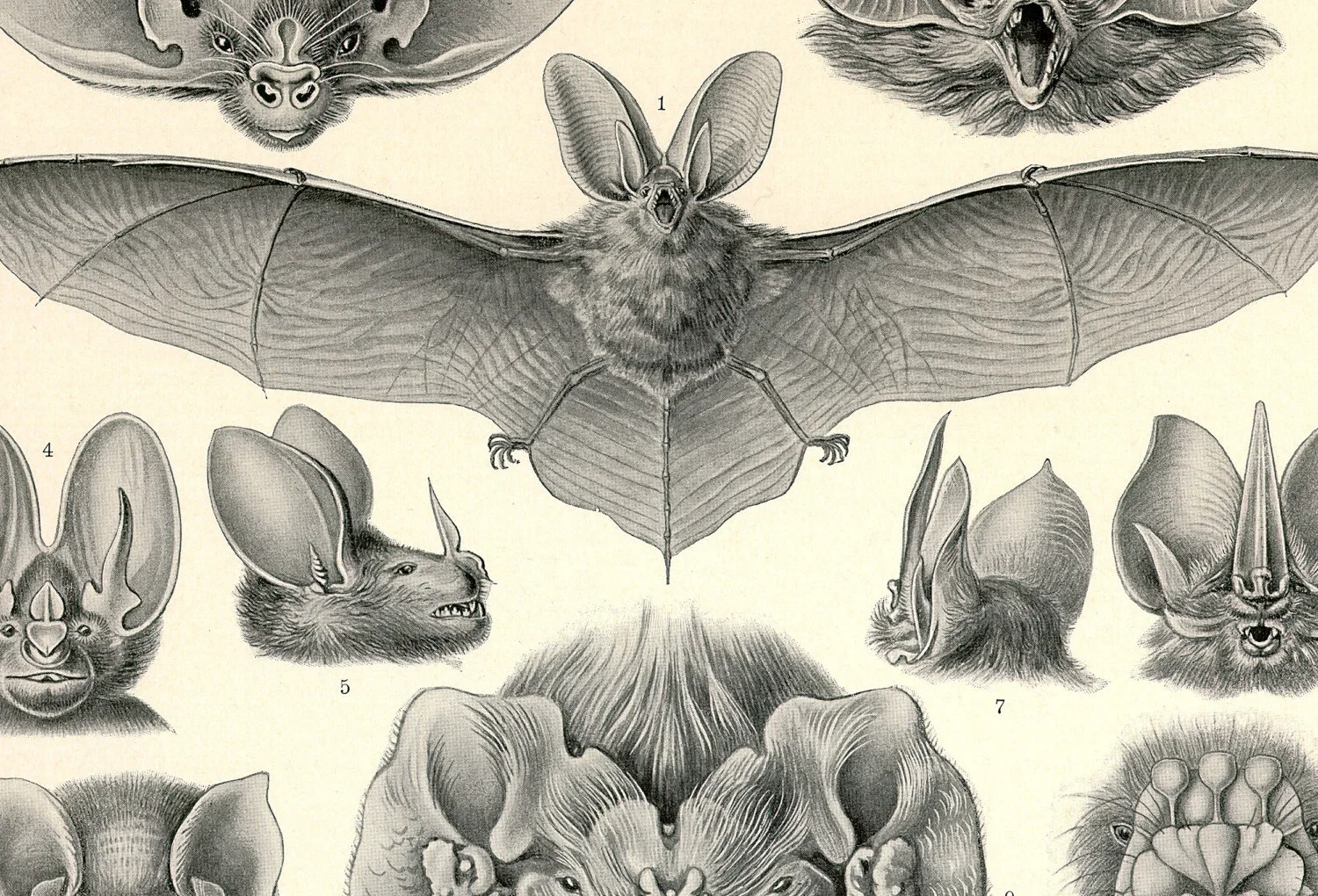
— One of the species is Cheiromeles torquatus, the naked bulldog bat, often called the “naked bat” because it has almost no hair.
— Must be lovely.
She pulled out a photo.
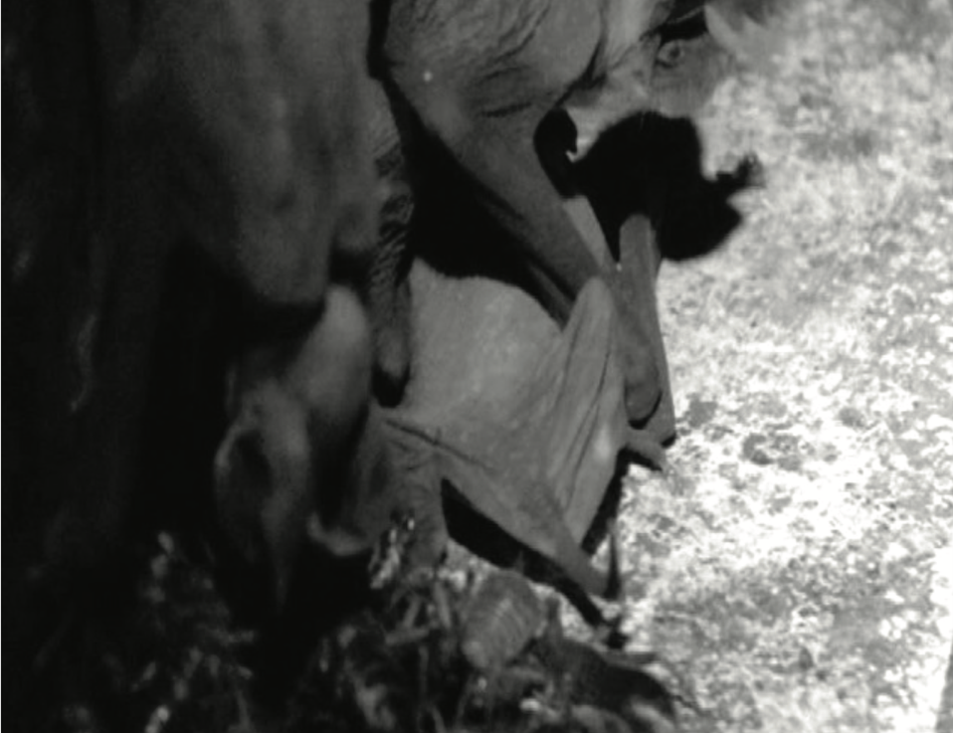
— Bats at the top, earwigs on the bottom.
Her gestures were graceful, as if she was indicating points of beauty in a painting.
— Earwigs?
— These naked bats have parasites. The bats secrete a skin oil. It is assumed the oil performs the same function as fur, protecting their skin. But it also attracts very large orange parasites: a kind of earwig, Arixenia esau. It means “hairy guest.” Esau was supposedly hairy and ruddy. They grab onto the bats and ride them piggy-back, and eat their skin oil and shed skin. The English research group sent me these pictures. They were taken inside the cave, on a concrete platform built for tourists.
Viperine’s strangeness, lovely and endless.
In the photo one of the bats was climbing into, or stuck under, a pile of other bats. It had a rat’s tail that probably wagged as it struggled.
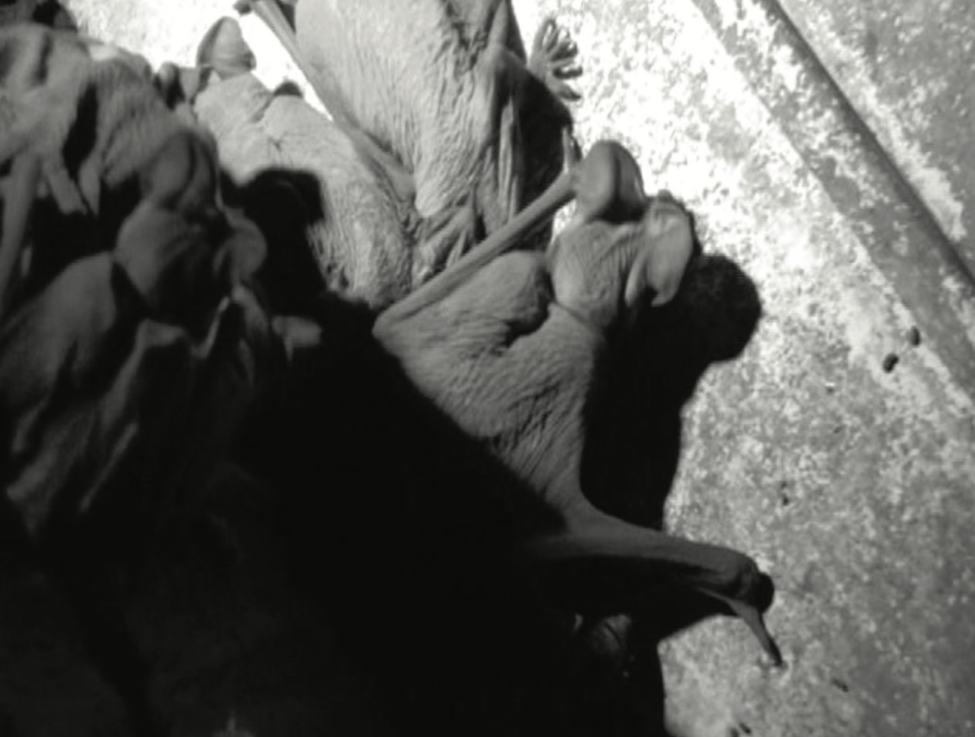
In the second photo a bat’s head was turned away. I pondered its small round skull and Mickey Mouse ears. What face could go with that body? Its wings were folded. It hung on with a single claw. Above it was a foot or hand with five fingers uselessly splayed.
The bats were awful-looking creatures, like starved mice that had been shaved. Like crippled old men.
— This is your research project?
She beamed at me.
— I got into it because of my mother.
— Your mother is a scientist?
— No. She doesn’t know about these things. I mean, she knows about the caves.
— She’s been to Borneo?
— No.
— So she is interested in bats.
— Caves. Well, not really. I mean, just one cave. See, I have this unusual family. My father had to go on reduced contract last year, because my mother has been in poor health. My sister can’t help, because she has a family in Scotland, and they have their own issues.
— I’m sorry.
— Don’t be. She has her own life. My father still makes a good salary. He is a Vice President of Remuneration Policy at the Bond AU Insurance Company, at their office in Moulins. He can support us. Also, my mother’s health problems aren’t physical, they’re mental.
— I see, sorry.
— Don’t. My mother’s delusional.
She raised one eyebrow, and then the other.
— It started two years ago. She began complaining that her food tasted bad. She did all the cooking, but sometimes we sat down and the salad was missing, or the main dish, the meat or the stew. She would say it turned out badly and she had to throw it out. She tasted licorice in our beef stew, or malt vinegar in our fish. At first I didn’t know what to think. When she wasn’t in the room my father said she was getting old. The sense of taste changes, he said. Sometimes she tasted a spoonful of the dinner she had made and pursed up her lips and stuck her tongue in and out like this. Some days she hardly ate anything. Once she made a roast chicken with lemon slices and garlic, and she ate only the lemon slices. Then one day she cooked us a soupe de cœur de bœuf au basilic, tomato and basil soup. When she tasted it her mouth stayed open as if she were going to vomit. She stared at the soup a moment, and then reached over to my bowl and took a spoonful. She said, “That’s odd, why is yours fine and mine isn’t?” My father and I tasted her soup, and my soup, and his soup, and we couldn’t tell the difference. She kept dipping her spoon into her soup, and mine, and his. She said her bowl was off, that it tasted like trompettes de la mort, that’s a species of black curly mushroom. She has always said they are poisonous, even though people eat them all the time, they are delicious. “This is wrong,” she said, “it tastes like poison.” We went back into the kitchen and tasted from the pot. I couldn’t tell any difference, except that the soup in the pot was a bit saltier. But she said, “That’s not funny,” and she stared at both of us one after the other. My father said, “What’s wrong, dear?” And she said, “What did you do?” And he said, “What do you mean?” And she said, “Zacharie, you poisoned me?” And then she just looked at him with a fixed stare, not so much angry as confused. He hugged her, and said of course not, and she hugged him. But she looked very unhappy, and she wouldn’t sit down at the table again. My father and I took the dishes and helped her clean up.
Viperine gestured delicately over the desktop, as if she was adjusting marionettes of her mother and father.
— Nothing happened for a week or two. My mother tasted everything, over and over. Then one evening we were having poule au pot. She had been eating bread, which we got from our boulangerie, and drinking wine, but she had hardly taken a half soup spoon of the poule au pot that she had been making all day long. All of a sudden she put her spoon down and said, “I just cannot go on like this. My god, why are you trying to poison me?” My father said, “Why would I poison you?” But she looked at him with a vacant horrified stare, the way a captured soldier might look when he knows he needs to run away immediately in order to save his life, but he is too weak to move. My father said, “I am not poisoning you.” Over and over, “I am not poisoning you. I love you. I would never do such a thing.” After that, things got worse. First mother said we had to have all our meals bought and brought in, and we did that, but she began to wonder about the cans and jars of food. She said, “Where did you get this tinned asparagus? I have never seen it before.” And I said, “I bought it at the Monoprix, you can go see.” She wouldn’t answer. One morning when father was at work she took me aside in the hallway, even though no one else was in the house, and whispered, “I know he is having an affair. He wants me out of the way. That is why he is trying to poison me.” And then she broke down, sobbing and shaking, and went off to her room.
Viperine had that open-eyed look little children can get just before they cry.
— That’s awful, I said. I’m so sorry.
— Stop. We developed a routine. My mother cooked for us, but not for herself. She bought in bulk from Picard, they sell frozen food, and we brought in the frozen food in two large shopping carts and put it in freezers in the basement. But one day she said, “Zacharie, I can’t eat this.” And he said, “Why?” and she said, “Because you are trying to poison me.” “How could I poison you,” he said, “with food that is sealed in a factory?” And I said, “Mama, remember you bought the food yourself, you chose it yourself.” But she wouldn’t argue. After that she would only eat bread she had bought herself from our boulangerie. My father and I knew we had to prove he wasn’t trying to murder her. I told her I could take the Picard packages to a laboratory and have them certified. She trusted me, so she said yes.
— You tested her food?
— Every week, when I’m home, I take one box of each kind of food we’ve bought from Picard, and bring the boxes to the medical laboratory at the IUT Montluçon-Moulins-Vichy, in Montluçon, or at least I tell her that’s where I’m going, but really I drive to Cosne d’Allier, which is closer, and I go to a café there, and I sit all day long and read my books, and wait until 4PM, and then I drive back home. I tell her the scientists at the IUT have certified her food samples and that they are safe for human consumption. Last summer I did that a dozen times, and then in September or October she started asking me, “What did they say, exactly? What tests did they run?” And of course it wasn’t easy to answer. It is hard to lie to your mother, isn’t it?
When she sat at the table she seemed lost in thought. She combed her right eyebrow with the fingernail of her index finger, or she sat with her hands gently clasped, the fingers moving slowly.
At that moment it was difficult to imagine what Viperine could possibly say that I might believe. The emotion was real, but the rest sounded like a script. Maybe if she admitted she was just a farm boy from Quebec. Or maybe it was all true, and she was about to ask me to fabricate documents proving her mother’s drinking water was free of poisons.
She brushed the front of her shirt down, very lightly, revealing nothing.
— Sorry, I said.
— Don’t say that. That’s my life. Maybe yours is better.
She put her left hand on the table, steadying herself. It was a practiced move, an invitation for me to put my hand on hers to comfort her. Yet she looked genuinely upset. She was complicated. We would make such an interesting couple.
I reached for her hand.
— Now I come to the bats, she said, retracting her hand.
She took out another folder and spilled dozens of photos across the desk. Bats and earwigs struggled everywhere.
I had an odd sensation, as if my chair was softening, sinking into the floor. She exhausted me. I pretended to look at my watch. That feeble gesture was enough. I was saved.
She stood up, and so did I. She put a letter on my desk. It was addressed to me. I reached for it, but she took both my hands in hers. We stood a moment, looking at each other.
— And of course you are very welcome to come with us to Borneo. Perhaps…
Then, abruptly, she left.
————
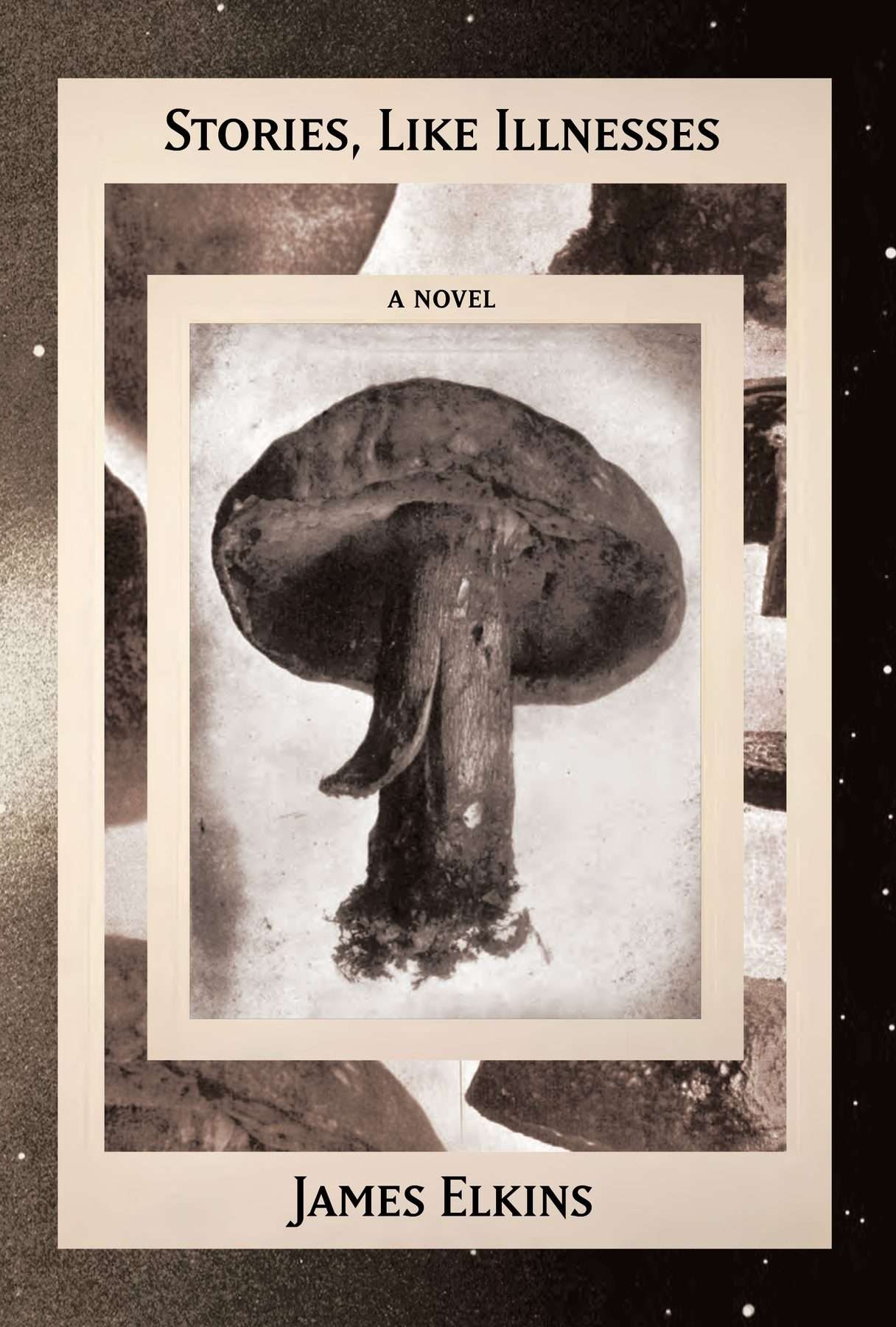
This is an excerpt from the novel Stories, Like Illnesses, just out from Unnamed Press in LA. It’s the first book in a five-volume novel called Five Strange Languages. Much, much more information about the five books and their companion nonfiction volume are on www.jameselkins.com.