The day of Cousin Bucky’s wake, I woke up early to comb and braid my siblings’ hair. They were both able to do it them-selves, but for special occasions like powwows and funerals, the job fell to me to make their plaits perfect.
Bobo was easily frustrated when doing his hair. It was the only thing he wasn’t happy-go-lucky about. He wanted perfec-tion. I liked that about him, liked that he understood the impor-tance of hair and honored it.
His hair was naturally wavy. With the Minnesota humidity, it was often a frizzy mess. He would tear out his braids if even a single strand escaped them, so I spent a long time on them that morning. I oiled his hair first and then I separated it into per-fectly even sections and carefully weaved them together, hum-ming under my breath. When I was sure not even one strand was loose, I showered it with hairspray.
Prim’s hair was easier to control. It was sleek and straight all the way down to her little-girl hips. Like me, she almost always wore her hair in two braids, and most days she braided it herself. She liked the independence of it. She always took a photo with her hand-me-down iPhone when she finished so she could track her braiding progress. I only braided it on days when she wanted to look her best.
I had just finished putting the last end band on Prim’s hairwhen Mother stuck her head into the bedroom and said, “We’re leaving in five.”
Prim’s head whipped around to look at Mother. “But, Nimaa-maa, Middle Sister hasn’t even had a chance to start getting ready.”
“Five minutes,” Mother said.
“Haven’t you ever heard oflndian Time, Mama?” Prim called as Mother shut their bedroom door.
I smiled at my sister and stood up from where I had been sit-ting on the bed. “It’s okay. I’m just gonna change and brush my hair and then I’ll be good to go.”
“Aren’t you going to put on any makeup, Middle Sister?” “No,” I said, and walked out of their room.
“Don’t you care what people think? You need some concealer and mascara at least!” she called. “You would look even better with a bit of blush! Bring some life to your skin.”
Mother used to say this to me, but she had long since given up. I pretended not to hear Prim.
My siblings went downstairs to wait. I ran a brush through my hair, looking in the mirror as I did so. The reflection of her side of the room stared at me, watched me. Exactly as she had left it.
I set down the brush and crossed the invisible line, opening her desk drawers, looking-not for the first time-for some-thing, anything: photos or notes or a diary. But as always, the drawers were filled with nothing but makeup, yarn, crochet hooks, and nail polish. I went to her nightstand and opened the drawer there. The only thing of note was a photo of her sit-ting at a cafe, holding a cup of coffee. Most of the setting was obscured by a sunspot. Staring at it again, though, I realized I didn’t recognize it as anywhere on our reservation.
My mother yelled my name. I put the photo back in the drawer and went downstairs, leaving my hair loose.
We were the first ones there, even beating Cousin Bucky’smom, Great-Auntie Clarence. The funeral director let us in, and we sat down in the metal chairs, all in a row: Bobo, Mother, me, and then Prim. We didn’t talk. Bobo grew bored and pulled out his phone, but us girls just sat there, waiting. I looked to the chair on the other side of Bobo, the one my father should have been sitting in.
When Great-Auntie Clarence and her other kids arrived, Mother went to help them set up. My siblings and I stayed seated, Bobo scooting over to sit in Mother’s abandoned chair, though he didn’t look away from his phone. I watched Mother tape baby photos and school photos to colorful cardboard, and I remembered another wake, her knocking over pieces of blue and purple cardboard, crying, ripping the photos off and demanding of everyone in the room why they would do such a thing, how they could be so cruel.
When the rest of the family showed up, Bobo joined his favorite group of cousins-two boys and a girl all around his age. I couldn’t remember any of their names. I knew they had been to our house before, and I knew that I had babysat each of them at some point, but I couldn’t find any of those memories. Looking around that room, at my relatives come to mourn another cousin gone too soon, everyone looked foreign to me. A room of half-familiar faces. All that circled in my brain were memories of a brown-haired girl with kind eyes and a single dimple.
Prim got up next, pulling me with her over to Mother, who now stood by herself in a corner with a can of Pepsi. Prim wrapped her arms around Mother’s waist and squeezed. Bobo came over and joined us. We stared out at the sea of black that was our family.
I spotted him then, as I stood next to my mother and sister. After the Indian boarding school era, most of my family converted and became Catholic or Presbyterian or something else Christian, so we had European funerals now-one day as opposed to four days, gravestones instead of spirit homes, prayers aboutJesus. Traditionally, it’s thought that the only color spirits can see is red, that they’re even drawn to it. Some people said that meant we were supposed to wear it to funerals, for one final goodbye. Others said it meant we should avoid red at all costs at funerals so the spirits of our dead could move on. No one in my family could agree on what was the proper procedure, but everyone defaulted to black so as not to make any massive blunder.
So it was hard to miss John’s red cowboy boots. It was strange to think that he was the only one Bucky’s spirit could see, even if John didn’t know it.
My leg began to shake. I didn’t know why he was there. I didn’t think Bucky and he had been friends. What would my family do when they noticed him? Would a fight erupt? Would someone tell him to get the fuck out?
John took off his jean jacket and tossed it on a chair near the door. I watched the whispers spread through the cousins as someone beside me noticed him, a chain reaction. The uncles crossed their arms and glared, and the aunties furrowed their brows and leaned in close to the auntie nearest them to gos-sip. There were more voices speaking now, but the volume had decreased to a hum as everyone’s conversations turned to the man in the red cowboy boots.
When John first moved onto our stolen allotment twenty-three years ago, some of my uncles on my father’s side went fish-ing on a pond on his land. John came out in his red cowboy boots with a hunting rifle and told them to get the fuck off his property. That was the one and only known notable interaction between him and any member of my family, and that was all it took. From that point on, everyone in the family refused to talk with him or refer to him as anything other than “the man in the red cowboy boots.” It would become John’s given nickname. They didn’t think he deserved any more respect than that.
Most of the NDNs on the reservation took our side in it. After all,John was the invader,John was the one trespassing. Butthe reservation’s white folks took John’s side and cited private-property laws. They said he paid for the land and us Indians had no real right to it anymore.
No one was surprised by the split in public opinion.
Now he made his way through the crowd, not seeming to notice how people purposefully stepped into his space or stuck their elbows out to hit him. He snaked his way over to Great-Auntie Clarence. Her face was all scrunched up and annoyed as he approached. I watched his mouth begin to move, and the lon-ger he spoke, the softer and warmer her expression got. When he stopped talking, she reached up and patted his cheek, smiling widely enough you could see her gums, yellowed from chewing too much tobacco.
“Hey, your boyfriend is here!” Bobo said, and pointed. Sev-eral people nearby turned and looked at us. I gave them a closed-lip smile. Mother pressed her lips into a thin line and walked away from us, toward a nearby huddle of middle-aged aunties, pulling Prim with her.
I pushed Bobo’s hand down and whispered, “He’s not my boyfriend. Don’t say that ever again.”
He raised his eyebrows at me and smirked.
Before I could convince him I was telling the truth, he ran off, saying he had to use the bathroom. I stood there by myself for a few minutes more, my eyes scanning the room for someone friendly I could talk to, someone who wouldn’t ask me how I was holding up or where my father was. Someone who knew better than to ask questions I couldn’t possibly answer.
My eyes landed on Nookomis.
I hesitated a moment before approaching her, remembering our last interaction. Remembering the way she looked at me, the mysterious knowledge in her eyes. But she had no way of know-ing my secret, no reason to guess my guilt. I was overreacting, being paranoid. Whatever she knew, it wasn’t what I thought-what I feared.
I walked over and kissed her wrinkled cheek. She waved me away.
“Stop doing that,” she said. “I’m not that old bitch, the queen of England.”
Even though her words had her usual sass and bite, her voice lacked conviction, like she was saying them because they were expected of her and not because she really meant them. Her brown eyes looked tired, sagging down into the hollows of her once-full cheeks. There was no glinting knowledge, no accusa-tion in those eyes, just sadness.
“Are you okay, Nookomis?” I asked, and squatted down next to her chair. I wrapped her cold hand in mine. My fingers rubbed circles across her weathered skin.
She shook her head. “Gaawiin.”
“What’s wrong?”
“He told me it would be me. He promised. Your grandfather promised. But here I am, attending another funeral. So many young people dying. First Oldest Granddaughter and now Bucky. And this one, this one was supposed to be mine, Noozhi-shenh. It was supposed to be me in that casket.”
I looked away from her as I blinked back my tears. It was selfish to want her to stay alive, to want her not to leave me. All she wanted was to see her husband again, to start her journey to whatever came after, and there I was secretly happy it wasn’t her funeral I was attending, happy that it was a cousin I barely knew in the casket instead of my grandmother.
I tried to soothe Nookomis, but I wasn’t sure what you say to someone who was upset they were still alive. I mumbled some-thing about her time coming soon, about how maybe she still had sometl1ing left to finish, but none of it helped. None of it worked to ease her disappointment and sadness. She pulled her hand out of mine.
“Awas,” she said. “Leave me alone.”
I hesitated, but she wouldn’t look at me. She was curled inon herself like a dying plant. She looked like Mother. Her guilt was so strong I could almost taste it in the air. Guilt at still being alive. Guilt for outliving another young Native. That was some-thing I understood well.
As I was walking away from Nookomis, Oldest Friend and I spotted each other. She smiled and waved me over.
“Sorry about your cousin,” she said, and held out her plate. Doritos. I shook my head. She popped one in her mouth. “How are you?”
“Fine,” I said. She licked the Dorito dust off her acrylics. “You?”
“I’m good,” she said. “Good.”
I watched her eat two more chips and sneaked a peek at my phone screen.
“I noticed your bloke’s here,” she said. “What are you doing here?” I asked. “Do you not want me here?”
“No, it’s just you weren’t related to Bucky or friends with him, so I’m not sure why you’d come.”
She shrugged. “Dad was a good mate of Bucky’s dad. I came to keep him company.”
“Ah,” I said, and looked around for her father. I didn’t see him anywhere. “I’m gonna go get food.”
“Good idea,” she said. “Food is important.” “Sure is,” I said, and waved goodbye.
“Cheerio,” she said around the chips in her mouth, and I swore I heard her exhale a sigh of relief. Not that I could blame her; I was relieved to be free of talking to her too.
On the way to tl1e buffet, I talked to a cousin I wasn’t sure I’d met before. She was maybe three or four years younger than me. She told me I could call her Tommy, said she had been a tomboy growing up and the name had just stuck and she liked it better than her birth name anyway. She waited for me to give her myname, or at least a nickname, but I was afraid of the shift when she realized which cousin I was, so I pretended not to know what she was waiting for. She probably thought I was a bit dumb, but that was better than watching that change happen, better than the friendliness turning to concern. It was nice to talk to some-one who didn’t know I was broken.
She glanced around and leaned in closer. “My mom, she told me that Cousin Bucky died of an overdose.”
“Accidental or … ?”
“Mom doesn’t know, or she just won’t tell me,” Tommy said. “I think she doesn’t know. That woman can’t keep a secret. Good thing she ain’t a priest, otherwise there would be nothing private about confessions, eeey.”
Tommy took a sip from her soda and dropped her voice. “Either way, it’s no surprise, considering who he hung out with.”
“What do you mean?”
“Shit, cousin! You really don’t know? Are you one of my city cousins?”
I shook my head. “No, I’m not.”
“No shame if you are. City NDNs are just as Indian as us rez NDNs. Just would explain how you don’t know these things.”
“Nah, I grew up here. Me and all three of my siblings,” I said. She studied me long and hard, her eyebrows scrunched together. Then her eyes widened. “Say, you’re not … oh damn, I’m so sorry I didn’t recognize you. You just look… so different from the last time I saw you … you know, um, at the last … funeral … her memorial thing.”
I looked at the drink clenched in her hands, avoiding her eyes. “How you doing, couzoon, you know, considering . . .
everything?”
“You know, I should probably go pay my respects to Bucky or whatever. It was nice talking with you, Tommy,” I said, and walked over to the body before she could respond.
Bucky’s casket was small, too small for his body. His limbsweren’t laid out straight, they were curved and bent like tree branches. I imagined the four-eleven mortician standing on a stool and trying to get Bucky to fit in this tiny little box. Limbs popping out and the little mortician swearing and sweating and sitting on the bottom of the box until he could finally get it to close. The thought made me smile.
The size of the casket was made worse by Great-Auntie Clar-ence’s request that Bucky be buried with his knife collection. Sixty-three knives. He had displayed them all in one of his mom’s china cabinets-he still lived with her-and Great-Auntie Clar-ence’s china had been shoved into boxes to make room for them. When I was maybe seven years old, Bucky had caught a chip-munk at a family gathering by the lake, and he had used one of his least favorite knives-one that he wasn’t concerned with preserving-to peel the fur off the chipmunk while it was still alive. He was in his twenties at the time and had laughed as he’d done it. I can still hear that laughter, mixed with the chipmunk’s screams. I didn’t know it at the time, but that was during the height of his meth addiction-or what we all thought was the height of his meth addiction, considering he now lay in a casket two sizes too small, having died from an overdose.
His hands were folded across his chest, clutching a buck knife with an antler handle. The knife had been my great-grandfather’s, Bucky’s grandfather’s, tl1e antler from the first deer Great-Grand had ever killed. It was a shame for something so beautiful to be sacrificed to the dirt and worms. Would it decompose? Or would it just sit in the dirt all shiny as the maggots and worms took care of Bucky?
“Sorry about your cousin,” John said from beside me, putting a hand on the small of my back. “He was a good man.”
My body went stiff as I felt John’s fingers spread and rub the polyester fabric of my dress. It was worse than if he’d touched my butt. The butt claims desire and physical connection, while the small of your back claims a link of intimacy, of deeper connection.
His fingers tangled in the ends of my unbraided hair. I felt sick.
I stepped away from him, and his hand fell to his side. The room felt too small, like my body had suddenly been shoved into that tiny little box with Bucky and his knives, and someone was closing the lid. The air that was left smelled like John, that awful cologne. Stronger than usual. It became its own being, taking up the space in that box, cramming me into one corner. The smell licked at my skin, preparing to consume me, to take ownership ofme.
“You look beautiful,” John told me. “More than usual, any-ways. Do you wear makeup or are you naturally this pretty?”
He smiled as he said it, the skin next to his eyes crinkling, and I could almost pretend the look in his eyes was harmless. His tone was soft and kind and sincere. No one other than him had ever called me beautiful. Not my parents, not my ex-boyfriend, not even the men at work who wanted me as their in-law. I had never been the beautiful one among my siblings. Yet here was a man who seemed like he meant the words he spoke, and for a brief moment, I liked them, wanted to hear more compliments. My body leaned toward him, toward that smile.
He leaned toward me too. “Your lips, especially. I love them. So nice and round. So full. My father would have called them French lips. We’re French, and he and I both love French lips. I know all about them. So plump and juicy.”
He reached a hand toward me, as if to touch my mouth, but his finger stayed an inch or two away from me. In the air between his hand and my lips, he traced their outline so delicately, as if he were actually caressing them. “Indian women don’t have lips like that.” His words were so soft, so gentle, I could barely hear them. “You must have some French blood in you. French Canadian, I would guess. And you know what French women are meant to be great at? Well, it makes sense when they have mouths like yours.”
He grinned and winked at me.
My body jerked away from him, stumbled backward, and knocked into Bucky’s casket. My fingertips brushed against the cold skin of Bucky’s hands and the family knife cupped between them. I yanked my hand away and looked down at the hollow-ness of Bucky’s face, at his hands wrapped around that knife.
“Please leave,” I said, not looking at John, still staring down at my dead cousin. “I’m trying to say goodbye.”
I focused on the cavities in Bucky’s face. Had it always looked like that, or had death brought about this change in him? I couldn’t remember what he had looked like in life. It’s strange how quickly you forget people’s faces.
“Of course. I didn’t mean to intrude,” John said, and walked away. He grabbed his jean jacket from where he’d tossed it on a metal chair and left the room without saying goodbye to anyone.
In the wake of John’s departure, no one was looking at me-a relief. I was back to being someone people avoided because of the haunted look in my eyes. They could feel the weight of my grief trying to suck them in and swallow them whole, destroy them too. Maybe they even believed I was beyond help, was too far down this path of hurt to turn back.
I bent down, kissed Bucky’s cheek, and whispered, “Sorry, Buck, but you really don’t need this anymore.”
I pulled the antler-handled buck knife from Bucky’s fingers. They were as cold as a fish’s belly. I folded the knife and slipped it into the beaded black purse draped across my body. I stepped back, lingered a moment, and then went to get food.
I loaded a paper plate with wild rice and cantaloupe. I sat down next to an uncle of mine we called Uncle Starving Artist. The plate of food sat untouched as I asked him about his current project. He launched into a passionate description of the large beaded and quilled installation he was creating in his backyard.
“How’s Ajijaak?” Uncle Starving Artist asked when he had finished. “I haven’t seen him around in a while.”
I looked down at the peeling faux leather of my funeral heels. “Don’t know. Haven’t talked to him in like a year.” My voice was soft and sad, and my body felt drained, exhausted, like how you feel after you spend the whole day crying.
My uncle cleared his throat and shifted in his seat. His eyes flitted around, as he tried to think of some other topic. “Well, uh, what have you been working on?”
“Nothing,” I said, and popped a piece of cantaloupe into my mouth.
“Nothing?” he said, surprised. “But you’re like me, always have some project happening.”
He was right. I’d always been an artist, always been crafty. Growing up, I had been a big painter, but when I was in high school, the Cultural Revitalization Program was just starting to get going, and my preferred medium shifted. The community center offered one-off classes in traditional artforms like beadwork, quillwork, birchbark biting, birchbark baskets, rib-bon skirt and shirt making, moccasin making. I took every one I could, and my free time became consumed with jewelry and moccasins. When I had first started working at the hardware store, it was mostly to fund my bead addiction. Now all my sup-plies sat unused in boxes shoved under my bed.
I lied to Uncle Starving Artist and said work kept me too busy. Said I had little free time for such things. Said that’s what happens when you grow up. I could tell he didn’t buy a word of it, but he left the lies alone. He asked if there was anyone new in my life, and I said no, no one new. That there just wasn’t any time. Romance was overrated.
I saw him hesitate, his eyes flit one way. Then Uncle Starving Artist excused himself and walked over to Great-Auntie Clar-ence, giving her a big hug. I stayed seated at the table alone and picked at the food in front of me.
A group of cousins sat down at the next table over, and my ears tuned in to their conversation.
“I understand that she’s going through a hard time, but it’s a bit much,” one said, and took a sip of his wine. We called him Favre because he had always claimed he was going to be the next big quarterback for the Vikings.
“Like are they friends? She really must have issues if that’s the case,” Tommy said.
“Can you blame her? With her dad being a shut-in and her sister dead? I would make bad decisions too,” Favre said.
“Shhh,” a woman about my age who I couldn’t place said, and motioned in my direction. “She’s sitting right there.”
Even my family was talking about me behind my back. They had noticed the way John had come up to me, even though I hadn’t wanted to talk to him. But no one had bothered to ask me, because no one ever asked me anything beyond “How are you holding up?” I had become nothing more than the broken sister left behind.
I stood up and left the wake, not bothering to tell my mother or my siblings I was going home.
The funeral home was on the opposite side of town from my house. About a mile into the trek, I took off my funeral heels and walked along the sidewalk barefoot. I winced as something on the ground cut into the soles of my feet, but it hurt less than the blisters on my toes. I should have kept the heels on, made myself walk all the way home in them.
I was on the edge of Main Street when I came across her. A skinny little rez dog with mammoth nipples, clearly having nursed several litters in her lifetime and maybe having just finished nursing another. She froze and stared at me with big brown eyes. There was a glassiness to them that I often saw in my own. As if it were too painful to actually be present.
I bent down about five feet from her, kneeling on the crack-ing sidewalk, and held out my arms. “Come here,” I said in a soft, sweet voice. “I won’t hurt you.”
She took a few steps toward me and sniffed the air around me. Maybe she smelled Bucky’s dead body on me or maybe she smelled John’s cologne clinging to me like a spiderweb or maybe she smelled something else entirely, like my own brokenness and bad luck. Instead of coming into my arms like a dog from a Disney movie, she ran in the opposite direction, long spotted tail tucked between her legs. I knelt there, watching her run until I could no longer see her. Then I got up and walked the rest of the way home, forgetting my funeral heels on the sidewalk.
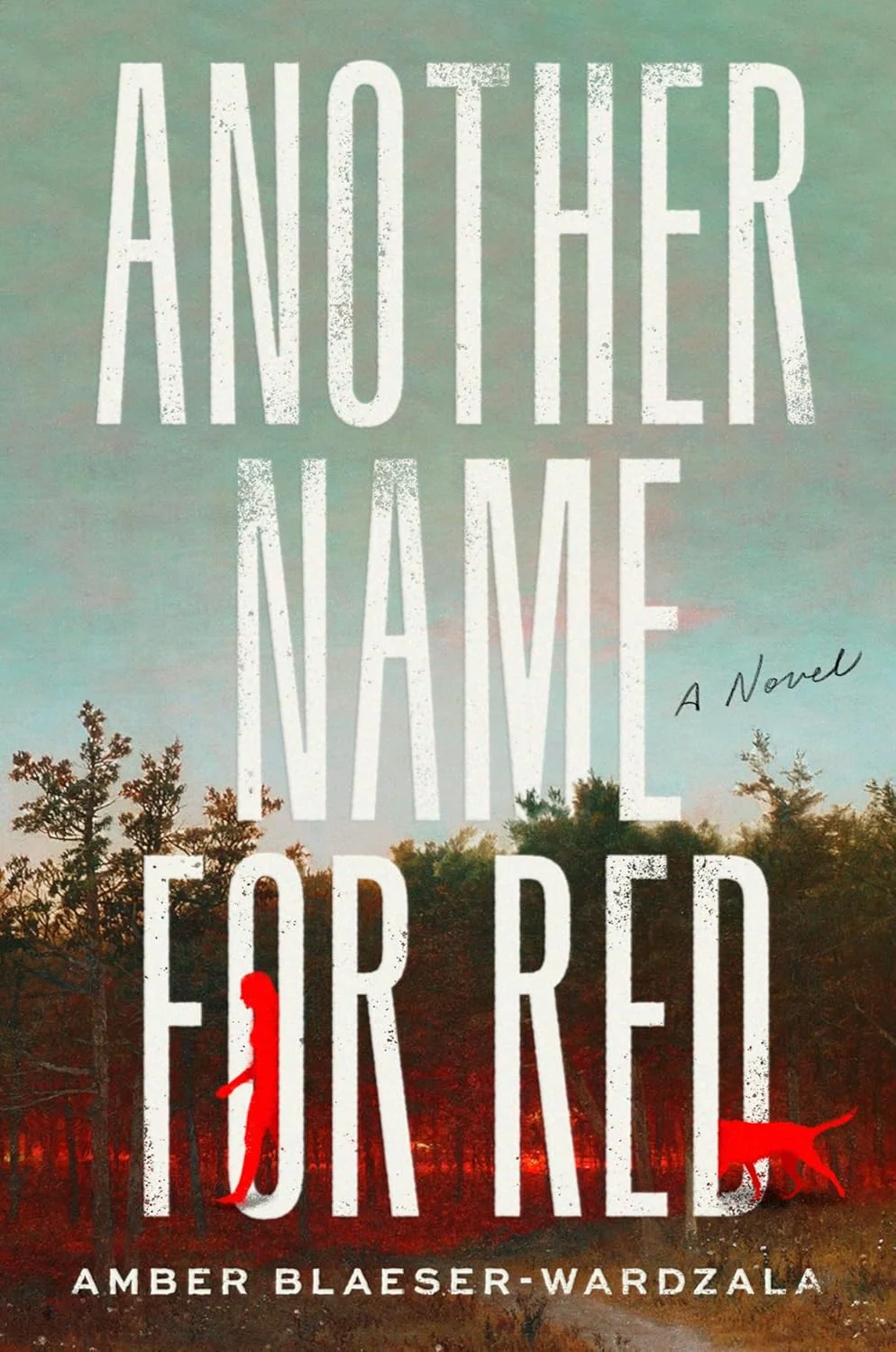
Excerpted from Another Name for Red: A Novel. Copyright (c) 2026 by Amber Blaeser-Wardzala. Used with permission of the publisher, Penguin Random House. All rights reserved.