Tick—tick—tick—tick, too slow. Tick-tick-tick-tick, aargh! too fast.
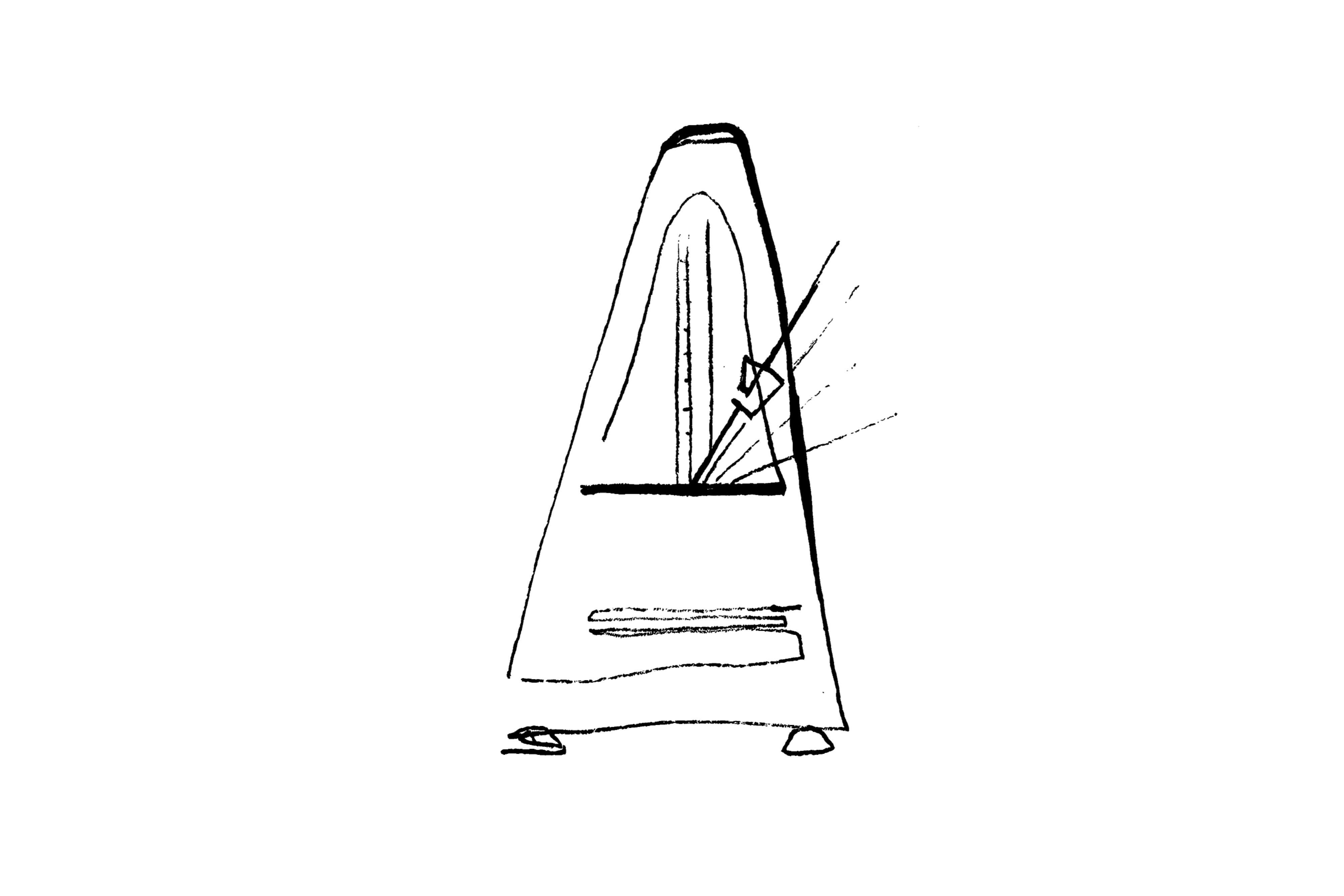
I had tempo issues as a young musician learning the piano—I still do. The metronome was supposed to help. We had one of those classic, old-fashioned metronomes, a pyramidal tower of dark brown wood, about eight inches high, with a thin metal arm that rocked mesmerizingly back and forth, registering its signature tick at the end of each arc. You adjusted the tempo by sliding a small weight up and down the arm.
I loved playing with the metronome, as if it were a toy, seeing how fast it could go if I dropped the weight to the bottom. I hated playing along with the metronome, its unforgiving regularity casting a spotlight on every place I was rushing or falling behind. This was, of course, the point.
Later I joined band, and the mechanical metal arm of the metronome was replaced by a human arm waving a baton. This seemed less annoying somehow; after all, ensembles have to play together to make music. Anyone who has suffered through a middle school band concert might question whether “making music” is the apt phrase. But everyone should stand slightly in awe at the small miracle of a band director getting young adolescents to play together at more or less the same time.
My university symphony orchestra, by contrast, was semi-professional. I was amazed at the ability of a good conductor to keep eighty people playing in time with the merest twitch of the baton. As a French horn player, I often had long sections of rest, where I kept a metronome in my head, tediously counting off the measures until I could play again: ONE-two-three, TWO-two-three, THREE-two-three … The second movement of Brahms’s fourth symphony starts with the French horns by themselves.
At rehearsal, I watched our guest conductor from Julliard like a hawk, making sure I moved notes precisely in time with his beat. “Again,” he bellowed after a few measures. Again, I followed his rhythm precisely. “Man, I nailed that,” I thought. “Again!” the conductor demanded, crashing my proud high. “This time,” he said, “play just a fraction of a second behind the beat. That,” he explained, “is where the music is made.”
Today, I occasionally record songs on my home computer. A digital metronomic click in the headphones has replaced the sway of the mechanical device of my youth. Digital recording makes it possible to achieve perfect rhythm. Line up the notes on the computer screen, and the electronic instruments play precisely on the beat. It sounds terrible.
We all have our inner metronomes that keep us on task. They can be annoying, and sometimes we want to shut them off. But we risk wallowing in selfish mediocrity. Follow too closely, and we produce robotic inanity. The trick is finding the spots just off the beat, where the metronome’s tick casts an almost imperceptible echo. It’s not always easy, but that is where the music is made.
Want to read more about metronomes? Bloomsbury’s Object Lessons series has you covered!
—
Art by Lara Schaberg.