Diana Nelson Jones worked as a journalist for most of her life. She was a reporter in Huntington, West Virginia and then in Tulsa, Oklahoma, before landing at the Pittsburgh Post-Gazette, where she worked for 31 years.
The Page is Nelson Jones’ first novel and tells the story of veteran journalist Myra Thorne who is downsized out of her newspaper job in Pittsburgh and returns to her hometown of LePage, West Virginia. Though entirely fictional, Nelson Jones draws on her many years of working as a print reporter and also her childhood in Shinnston, West Virginia.
Myra lands back in LePage, broken and depressed. She has known only one job and it lit her up like nothing else–she fears she will never again feel the thrill of breaking a story, the collaboration of a buzzing newsroom, the joy of writing a great feature, or the feeling of being of service to your town and community. Down on her luck, she returns to town which is down on its heels and which she never wanted to return to. She has to find a way to move forward.
She also wants to find a way to repair a difficult and unhappy relationship with her mother.
Myra starts to heal when she has the idea to cover the news in this little news desert. Bad actors love news deserts since they can thrive when hidden from reporters, which is the same reason why a populace can love reporters who bring maleficence to light. So, she starts a local weekly paper. What makes it unusual is the format–it is posted in a large layout in an empty storefront window on the main street of town. She calls it The Page. Quickly, people gather. Turns out, they were hungry for local news.
She reports on the LePage Planning Committee Meetings. She does some investigative reporting which reveals some financial malfeasance in the government. She reports a heart-breaking story and reminds herself that she can cry later. She takes on some newspaper neophytes and mentors them.
The Page heals her and, in some ways, heals the town, too. Harley, in particular, is a man she meets on her first night back in town and she doesn’t think much of him, but he becomes a loyal and stalwart reader of the paper. He checks on it frequently to see if she’s posted any updates.
Myra, through her own investigative instincts, finds a way to make peace with her mother, as she uncovers some unknown family history that leads them to one another in an authentic and empathic way.
I sat down with Jones to talk to her about journalism, West Virginia, writing fiction and the importance of the news and news readers. These questions and answers have been lightly edited for length.
* * *
Jody DiPerna: This book does some really interesting things. One of the things you do is you tell the story of journalism right now–you are giving people a little window into what reporters do.
Nelson Jones: I suppose subconsciously I was. Mainly, it was what I knew. It’s what I know, and it’s what Myra knows.
JD: We need more Myra’s all over the place. I think one of the problems we face is so many small outlets dying.
NJ: When you had your daily paper, your little hometown paper, everybody knows the people who work there. The further you get away from local journalism, the less it affects you for one thing, because you know the people on CNN don’t care about me. They don’t know you. But the people who worked at the Post-Gazette, at least before it became Venetoulis, they cared.
JD: I think journalism has to be personal and local. You wrote so many stories about Pittsburgh life and I feel like that part of the newsroom is disappearing. There’s so little of that.
NJ: There’s no neighborhood reporter at the Post-Gazette. I was the only one then, which is crazy because there’s ninetyneighborhoods. I covered boroughs, too. When Sharpsburg and Etna and Millvale teamed up to do some environmental stuff, water retention–that was a fabulous story–because they had floods all the time.
JD: Did you start writing this book with Myra?
NJ: The short background is in the fall of 2019, the Post-Gazette basically played a Hunger Games kind of game with two of my favorite editors and forced them out. They told a third editor your services are no longer required. I went home. I’m lying in bed thinking, this is awful. This is fucking awful. I was thinking, what would I do if they said that to me? Well, I guess I could work at Dollar General, but I couldn’t pay my mortgage. So I just started thinking about what if what if I went back to Shinnston? What if they didn’t have a paper? A story started to evolve in my head. There are a lot of vacant storefronts. I always loved storefronts. I did the storefront project for the paper. So my imagination was going. What if she used a storefront?
JD: I love storefronts.
NJ: Plus, Myra has no money and no tech savvy. She goes back to her hometown. She doesn’t know what to do. She’s in grief. She’s in despair. The basic idea–she starts a newspaper in a storefront and that opens the possibilities for people to gather–the fact that she could give the news in a very economical way and bring people together.
JD: I love that. First, she’s filling this massive gap in what people know about what’s happening in their hometown, which is really valuable. But the way that she does it with The Page on the storefront. People gathering to read it feels like this physical manifestation of what we lost with local newspapers. They inhabit this space together.
NJ: I knew there had to be something besides getting the news.
JD: I grew up in a family news stand and people read the paper together, like parallel play, and this reminded me of that. There’s a great scene in the movie The Post where they’re waiting for the New York Times to drop and four characters are standing there reading together.
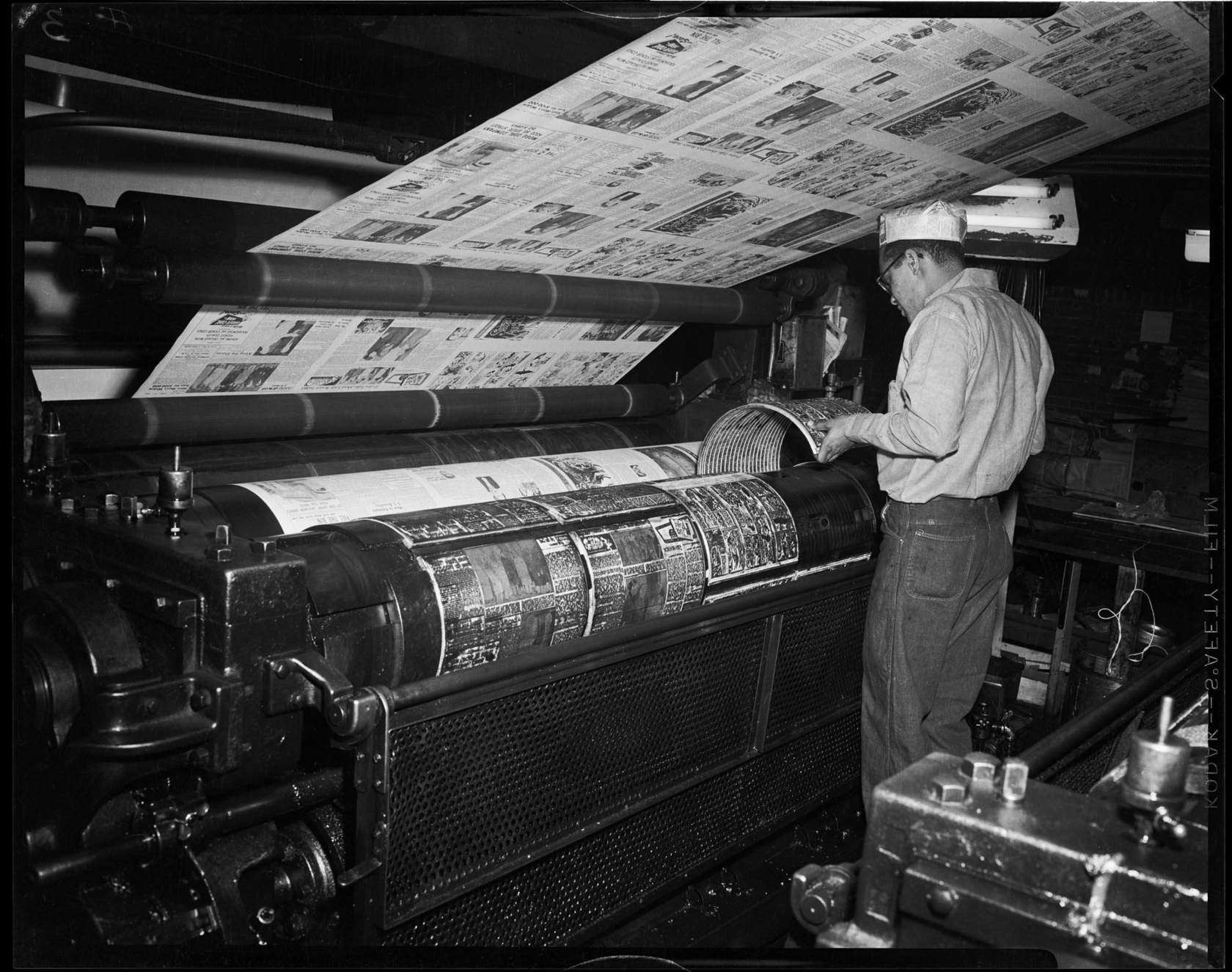
NJ: That movie really hit me on several levels. Just seeing the papers come down. The way the machines move them–it’s like poetry. It is beautiful. I love the presses. I love that whole magic of the news.
JD: There’s something about it being this physical thing you can hold. There’s something about standing next to somebody. It’s such a good idea. It makes me want to start a storefront newspaper.
NJ: I wanted to have a vehicle for dialogue so the reader gets to know how people respond to the paper and you also just get this kind of active sense of community happening right now.
JD: One of the things that I love is the feature that Myra and her team does on the anniversary of the mine explosion, interviewing the survivors.
NJ: I wanted to do that because that was based on the Farmington Number 9 Mine disaster in 1968. That memorial service brought every single person together. Everybody’s there. I think the mine explosion was so important to Shinnston. I thought it had to be important to Le Page and then The Page. Farmington was 78 killed, as I recall.
JD: That’s a huge number of people and that number affects so many towns all around the mine.
NJ: Le Page was kind of the place where people came in to get to do their commerce. That was true of Shinnston too. All those little towns, Farmington, Worthington, Monongah, Mannington, and Enterprise, they all came to Shinnston. So all the people standing around huddled with grief, that was true. That happened in Shinnston. I remember so viscerally the pain that seared that town.
JD: I wonder what it was like after forty plus years of journalism to then start writing fiction, where literally anything can happen, anything at all.
NJ: My god, the learning curve. A whole different animal. You know, newspaper story and a book are both the same basic species. I think no, they aren’t. They’re the same genus. One’s a cat and one’s a tiger, maybe. First, I was trying to edit myself as I went. Because that’s what I did in the newsroom. You’re writing today for tomorrow, so you’re always rewriting. I think I limited myself when I was writing that first draft.
JD: I think journalists have an advantage, which is that journalists know how to write. They can write elegant, clear sentences, but when you think about writing 800 or 1,000 words and then writing 85,000 or 90,000 words–that’s a different thing.
NJ: You have to have faith in your reader to stay with you. I actually found the revisions and revising a lot of fun.
JD: When you’re doing journalism, you’re not writing dialogue because you are quoting people.
NJ: That is kind of how you learn to write dialogue–is to listen.
JD: I assume that Le Page (pronounced “Lee Page”) is a fictional place, but it is based on your own sense memory of growing up in West Virginia.
NJ: Yeah, it is modeled after my hometown of Shinnston. I made a map. So I’d know how many blocks Myra lived from Gino, how many blocks Myra lived from the store and the park and how many blocks from Billy’s. I wanted to be able to refer to the map so I’d always get it right. It has to make sense. I looked up all the baseball games I referred to, and I made sure that they really did play the Dodgers on that day.
JD: That’s kind of your sweet spot, Diana–the baseball, the Pirates.
NJ:The Pirates losing again. It’s so sad.
JD: I was just at a conference where one of the panelists asked, why aren’t more stories set in West Virginia? I was delighted to read a book about a journalist set in West Virginia. We don’t get many books where a reporter is the protagonist.
NJ: I was trying to find comps and there aren’t many. I found one book that was a little bit similar, but not much at all.
JD: My small town where I grew up was never fancy. It was a steel town, but it was vibrant, and it isn’t now. There are empty storefronts everywhere. There used to be a drug store, there were two small grocery stores, butcher shops.
NJ: We had all that, too. Bakery. Barber shop. There was a Murphy.
JD: We had a small little clothing store, but it was local. It was just this Jewish family that owned it.
NJ: Ours was Italian–my town was Italian. But you could buy stuff you needed.
JD: I love how many Italian-Americans are in this book, because I cannot tell you how many people I talk to from outside of this region and outside of West Virginia specifically, who don’t think there are any Italian people in West Virginia.
NJ: Or any ethnic people, really. Just (air quotes) Scots-Irish
JD: Myra goes back not willingly. She, like many of us, wanted to leave the small town where she grew up. I think it’s a fine line to walk. You get this sense that some people feel like Myra felt like she was too good for them, but I really think she wanted something else.
NJ: It’s always hard to describe that because I had that same feeling–I can’t stay in this little town.
JD: I am a city mouse at heart.
NJ: I am too and I didn’t know that until I lived in Columbus right after college. I liked it and it wasn’t even as big as it is now. I love cities. I like small towns too, but you know, I could not imagine myself staying there. What would I have done? I didn’t want to get married. There’s nowhere to work. I could have worked for the Shinnston News, which might have been cool. There’s a lot of value in being a small town reporter. It’s really important, but I did not like Shinnston. I do now, but at the time I didn’t. I knew there was no future for what I really wanted to do.
JD: After coming home to LePage, Myra finds a way to report the news and does this thing where she is helping to build community–she’s part of the town because The Page becomes a big part of the town.
NJ: Oh shit! I did this so well, like damn it. Yeah.
JD: I wanted to talk about her personal story. When we meet Myra and we meet her mom, I wondered if they could ever find a way to really connect. And how are they going to do that? Because they are spinning in this pattern that neither one can break.
NJ: They were both like that. They both wanted something else, but they couldn’t quite figure out how to yeah how to do it. I thought about what would melt Sue (Myra’s mom). What would break through?
JD: Myra discovers this locked room and she has to know–because that is the kind of shit that would drive a reporter crazy–what is in that room?
NJ: She has to know, right? I was thinking something has to happen to Sue that is absolutely destructive–like tearing down the old model and rebuilding what’s inside, the thing that’s trapped in there. I thought it had to be something about her past. It had to be something she hasn’t dealt with, doesn’t know about. And I just thought, oh, maybe Myra discovers something. It had to be something that creates such a shift.
JD: The reader really has to ride with Myra.
NJ: It’s hard to explain to people that some of my characters were talking to me when I was swimming.
JD: That’s not uncommon for fiction writers.
NJ: It happened to me and it was kind of shocking. I couldn’t sleep sometimes, and I’d just be dozing, and Gino was saying, I need to have more of a role. And Harley. Harley was like going like this (waving her arms around.)
JD: Harley becomes a sort of avatar for the reader all journalists are writing for. I love Harley.
NJ: Harley’s that guy. I wanted to make it really clear that Harley is that guy. J.D. Salinger talked about the fat lady swatting flies on the porch as just your every person. He’s your regular person, your unassuming glue–somebody who holds the world together. I wanted Myra to have that realization about Harley that he was this country guy, never traveled, never been anywhere, but he was hungry for the news, and that’s who we need all over all over the place. That guy.
JD: I think this is a really optimistic book. Do you think you’re an optimist? Do you think of yourself that way?
NJ: Yeah, I’m glass half full. I think I’m an optimist. I’m not optimistic about what used to be: I don’t think you will have the coal mines thriving again or get the steel mills back. But I do believe that people–I just have faith in my family. I think people adapt. I think the better angels of nature eventually take back over. I just do. And I think you can usually depend on somebody. You can usually trust somebody, except scammers. It’s optimistic–as long as there are Harleys in the world.