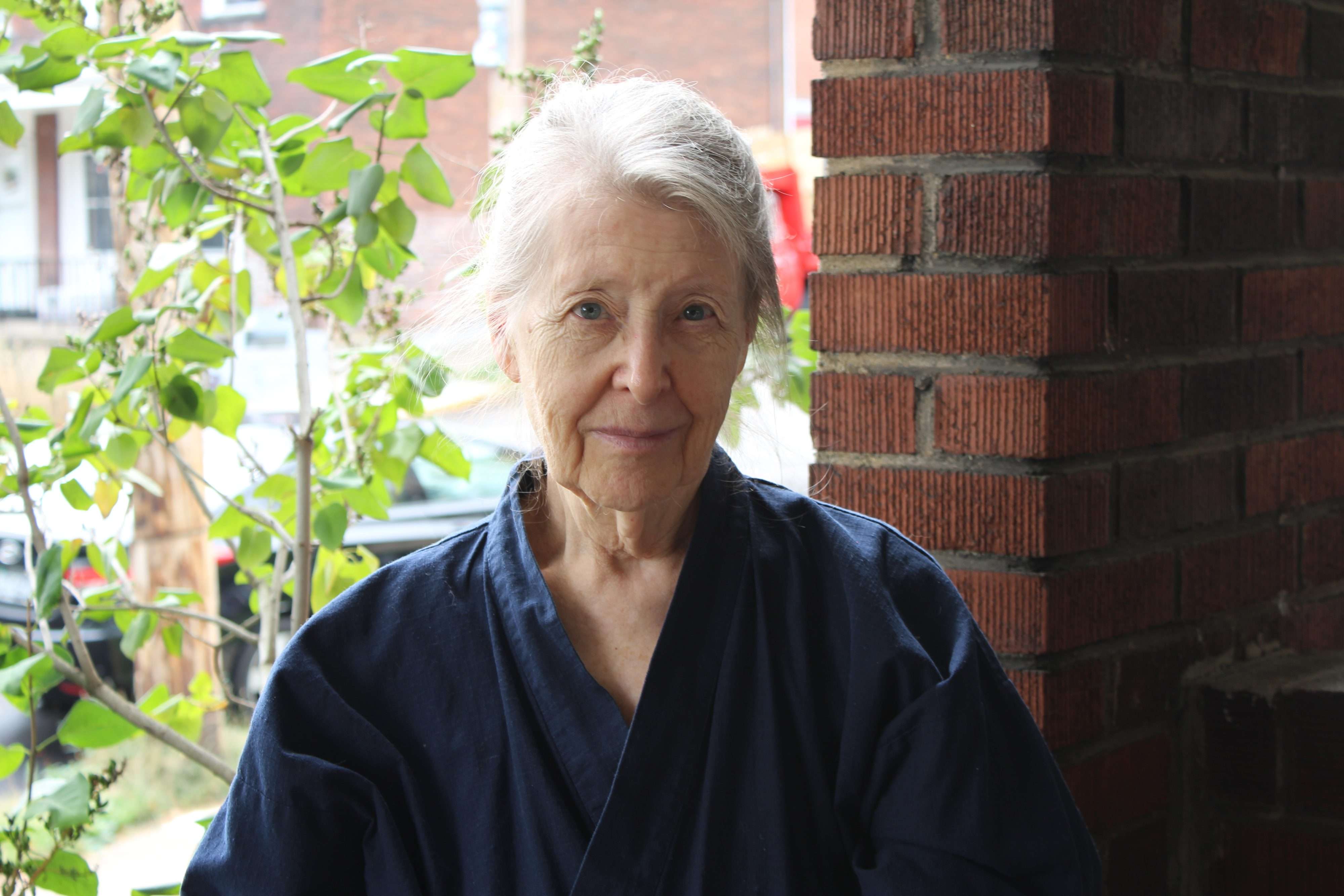
Catherine Gammon is celebrating the relaunch of The Martyrs, The Lovers on November 14 at 7 pm at Bottom Feeder Books.
I first met author Catherine Gammon at a weekly vigil in protest of ICE outside the agency’s Pittsburgh offices on the South Side of the city. Later, at one of Gammon’s readings, I happened to pick up a first edition of copy The Martyrs, The Lovers which was released by a publisher which later folded. Recently I learned that Gammon’s novel, among my favorites that I read this year, would be rereleased by Baobab Press. Fortunate for all of us, since Gammon’s work is transcendent in its driving rhythms, streams of consciousness and surprising jumps, even while experimental form never supersedes storytelling.
Loosely based on the life and 1992 suspicious death of German activist and Green Party leader Petra Kelly and her partner Gert Bastian, The Martyrs, the Lovers is a fictional reflection both on their lives and the 20th century crises with which they engaged—crises we still face today.
Gammon is author most recently of the novel The Martyrs, The Lovers, the chapbook What Is Your Work? and the story collection The Gunman and the Carnival, also from Baobab Press. In 2027, Baobab will publish the first volume of her novel Nightbirds in an Age of Light, to be followed in 2028 by volume two. Her previous novels are China Blue, Sorrow, and Isabel Out of the Rain. Catherine taught in the University of Pittsburgh’s MFA program throughout the 1990s before leaving academia for Zen training; she lives in Greenfield with a garden and a cat.
Gammon and I had a conversation looking at how the novel is relevant to political and social forces at work in the world today.
Jennifer Bannan: I’m sure, as this novel is loosely based on the life of Petra Kelly, that you have some thoughts about the recent AfD wins in Germany, given how much of The Martyrs, the Lovers deals with German politics and the threat of neo-Nazis. My immediate reaction to those electoral wins was that Nazism and fascism and oppression and violence will not go away. But I imagine you have something more complex to share.
Catherine Gammon: There’s certainly a connection between what was going on in the early 1990s—in the world and in the book—and what’s going on in Germany now, and here, and in so many other places. The thing to bear in mind is that this rise of what for a while we called the alt-right was visible in the 1990s—everything we face in 2026, climate change, environmental degradation, loss of biodiversity and habitat, nuclear proliferation, the proliferation of weapons of mass destruction, extreme wealth inequality, even the dangers of what we call artificial intelligence, and clearly human rights abuses and racial and gender and political harassment with the rise and return of the violent right—all this was visible in the ’90s, both here and in Germany, and both there and here people were working against it, for a better present and a better future. The world we’re living in 2026 is very much the world that the central characters in the novel, and the historical individuals who inform them, were living in too. There is a throughline.
Something that might be interesting for people to see, especially for those who don’t know Petra Kelly, would be the recent documentary Petra Kelly—Act Now!, which is available through the library on Hoopla. The film is hagiographic, unlike The Martyrs, The Lovers, but it demonstrates what Petra meant to people and movements in her day, and inspires an awareness of this throughline from the late 20th century to where we are now. So many people younger than I am see the great differences of recent decades because of the enormous effects of technological change, and the great cataclysmic divides, such as 9/11 and Covid, but they may miss seeing at the same time the fundamental similarities, the many ways things haven’t so much changed as intensified.
JB: I find it amazing how you work with multiple scenarios that could have led up to the characters’ death and yet it never feels like a whodunit. Was it just your commitment to imagination and a literary standard that made that possible? Or is there more to the story there? Did you think much about the genres of mystery or historical novel when you were writing the book?
CG: I didn’t come to this at all as a whodunit, so I’m glad it doesn’t feel like one, even though it does depend in part on the mystery and uncertainty of a whodunit. I did aim for a bit of whodunit voice in the long Lukas chapter that opens part three, which is why I made him a compulsive reader of cheap mysteries, but the “who” of these deaths is really a deeper question, and one that isn’t easily answerable.
The background to how I came to this in the first place really informs these multiple scenarios. How the book came to be is hinted at in the opening of the novel and addressed more fully in the note on origins after it ends. I had met Petra and her partner Gert Bastian just a year and a half or so before they died, and they left an intense impression on me. I had no intention of writing about those encounters, but when I learned of their deaths—and the way they died—I felt I had to go back to them and their work as a subject for fiction.
And this feeling was strengthened as I began to see articles and very soon books, supposedly works of nonfiction (often providing contradictory “facts” of the case), that went all the way, for example, to dramatizing the inner workings of Gert Bastian’s mind as he goes up the stairs to kill Petra—giving a confident account of some utterly subjective reality in an unconfirmable scenario that is probable at best. In other words, they wrote what no one could know or prove, what could only be written as fiction. Those books were all asserted as if with certainty. And yet there were so many unanswered questions, so many political possibilities surrounding the case, and whatever was or is the truth, those questions without answers were what made exploring the story of their deaths important.
So, I thought if nonfiction was going to offer certainty, I had to do the opposite, render uncertainty. Which, you know, if you’re looking for a nice whodunit, you’re expecting to get an answer at the end. But the narrator here warns you up front you won’t get one.
As for the question of the novel as historical, at the time of its composition, the events of its present action were contemporary to the writing, so the question of historical fiction as a genre didn’t arise. The background of course was historical—the period of Jutta’s childhood in post-war West Germany, for example, but even the period of the sixties, and certainly her work in the eighties, wouldn’t have been considered the stuff of historical fiction. (And as an aside, even if I had first approached this material for the first time now, so many decades later, I think—like a great many novels set in periods of the past—it would not fit into historical fiction as a genre.)
JB: The relationship between [the main characters based on Kelly and Bastian] Jutta and Lukas is fraught. The most notable aspect seems to be her “daddy issues” from having an abusive father. But the relationship has a lot more going on — his former military career, her superstar leadership with him as a support. The relationship’s contradictory nature seems like it could be a driving force of the storytelling – is that true?
CG: Yes, absolutely. It was clearly a driving force. I think my feelings about the two people I met in Germany, Petra and Gert—who were by then no longer at the height of their fame or political influence; who were in some kind of struggle with one another perhaps, and certainly in struggle with their situation after Petra lost her place in the Bundestag; and both of whom suffered from her emotional vulnerabilities to harassment and from her dependence on him—all this had affected me deeply at the time I met them, and informed my response to their deaths. If I had known the two of them in the decade before, as so many of Petra’s close friends and allies did, I would probably have imagined very different fictional characters. Or I might not have been moved to write them as fictional characters at all.
That said, it is important to say again that Jutta and Lukas are fictions. Even though Jutta’s background is built on the basis of Petra’s—her physical frailty, her early education by nuns in the shadows of Germany after the end of World War II, her teenage life in a military family in the US after her mother marries an American, her presence in the US through the 1960s, the inspiration she took from the civil rights movement and the anti-war movement, the grief over the assassinations of King and the Kennedys—Petra was here for all of this—and even though these facts of her life feed into the fictional Jutta, so does my own experience of those years. And I think the same can be said of what you call her “daddy issues.”
Jutta’s abusive father is loosely based on comments Petra made in interviews or stories told in her German biography, and my own father was not violent or abusive in the ways of Jutta’s father, but the daughter’s feeling of being both attracted to and imprisoned by the power of that father—his charisma and domination and his failure to honor her independent reality—all this draws from my own complicated feelings for the very different father who was mine. If the sequence of Jutta’s affairs with various men is loosely based on Petra’s, and they bear more resemblance to her life than to mine, my portrayal of them is completely fictional, which means the writing arrives from that alchemy of imagination and memory and truth and projection and wish that remains finally mysterious, no matter how clearly we might be able to parse its elements.
And in telling this story in particular, I was more interested in dramatizing the great and visible contradictions than in landing on a particular view of their origins—so once again, many possibilities remain—and dramatizing contradiction was a product of imagination taking on every possible part and point of view.
JB: I found the sections dealing with Jutta’s loss of her young American sister Emma to be the most profound, most beautiful parts of the book. Can you talk about the importance of that loss to Jutta’s later commitment to working against nuclear power and nuclear weapons?
CG: In many ways this was one of the most challenging aspects of this fictional life for me to write because the relationship between Jutta and Emma is so intimate and their story depends on intimate elements that aren’t in my own experience. I have no sister and I’ve never known a dying child. Other than myself, the one child I knew well enough to draw from (my daughter) was already a young adult and healthy and alive. I had a few things in common with Petra’s background—we were close in age and both in high school and college in the US during the sixties, so to some extent we shared the experience of the big public events of those years, the assassinations, the demonstrations (if on opposite sides of the country), the shock of the Chicago convention—and I was able to draw from that common experience to imagine Jutta’s life during those times. Difficult relations with a father and unhappy or complicated love relationships with men were in my experience too. But never a dying child.
This painful loss of early death, however, was an essential element of Petra Kelly’s story as she told it, so it had to be essential to Jutta’s story too. In the novel, Emma and her illness and death are entirely imagined, but their centrality to Jutta’s life is based on Petra Kelly’s frequent invocation of her little sister’s death from cancer as the inspiration for her work against nuclear power and nuclear weapons.
The dramatization of that inspiration coming fully to Jutta’s consciousness is also completely fictional, a scene created to bring the many personal elements explored in Part One of the novel to a confluence and a turning point, after which her drive to find her own heroic mission has found its target. In reality, of course, I doubt this coming to consciousness was quite so neat.
JB: The way the doctors talk to Jutta and her mother — much more dismissively than how they talk to Emma’s father. This is the first time Jutta seems to truly feel the patriarchy’s disdain for her. Was this based on an actual experience and can you speak to Jutta’s rise in patriarchal systems and what you learned about those systems in writing about her?
CG: There’s a moment when one of those doctors directly speaks (in the way of fiction) words a Pittsburgh surgeon spoke to me in 1993 when I asked him for an explanation of the arthroscopic surgery he was scheduled to perform on my frozen shoulder. (And I was so shocked and angry that I had my shoulder surgery done by the famous knee specialist instead.)
But in answer to the question about patriarchy, I can’t say I learned anything about the patriarchy from writing about Jutta or studying Petra that I hadn’t already learned. I was drawn to her story in the first place—for the book that didn’t come together when she was still alive—because I recognized and to some extent shared the political analysis she offered. What I didn’t share was the activism—I admired it, but the activist path has never been sustainable for me. (I’m one of those people Jutta doesn’t understand, as she says early in the book—they show up for demonstrations and then one day suddenly they’ve had enough, they just go home.) What made Petra’s story compelling was the way it embodied the entanglement of the political and the personal (to use a catchphrase from that era)—and she was fully conscious of this—when at the same time there was a depth of personal history, an underlayer or shadow that didn’t get spoken, which was either not known to her at all, or if known, was turned away from, and this refusal became apparent during the short time I spent with her and Gert Bastian.
And of course, it was that unknowable or unsayable that I wanted to draw out from her for the biography that after all wouldn’t be written and finally could only be written as fiction.
As for Jutta’s, or Petra’s, rise through patriarchal systems—Petra was a very capable, very smart, very hardworking, very attractive young woman, and she was fluent in English as well as German. She had all these advantages and the drive to use them in seats of power. Sometimes it was rumored that she accomplished this or that because of her romantic and sexual relationship with this or that man with power to advance her, but it wasn’t my sense of Petra that this was true—and it’s certainly not true of my Jutta. While it is true that many of Petra’s relationships were with older married men, I think this was distinct from any ambition for advancement. I read her ambition as based entirely on her vision of an almost holy campaign. And this is how she reads sexuality too—as spiritual, as holy, as not to be contained or confined, imprisoned by conventional rules. I’m sure she saw her affairs, if anything, as antipatriarchal. This is probably one of the many ways those years, the 1970s, ’80s, ’90s, have been overwritten in recent decades. Women like Petra and Jutta embraced their sexual agency over any sense of being or having been victims, even when there was a background of abuse.