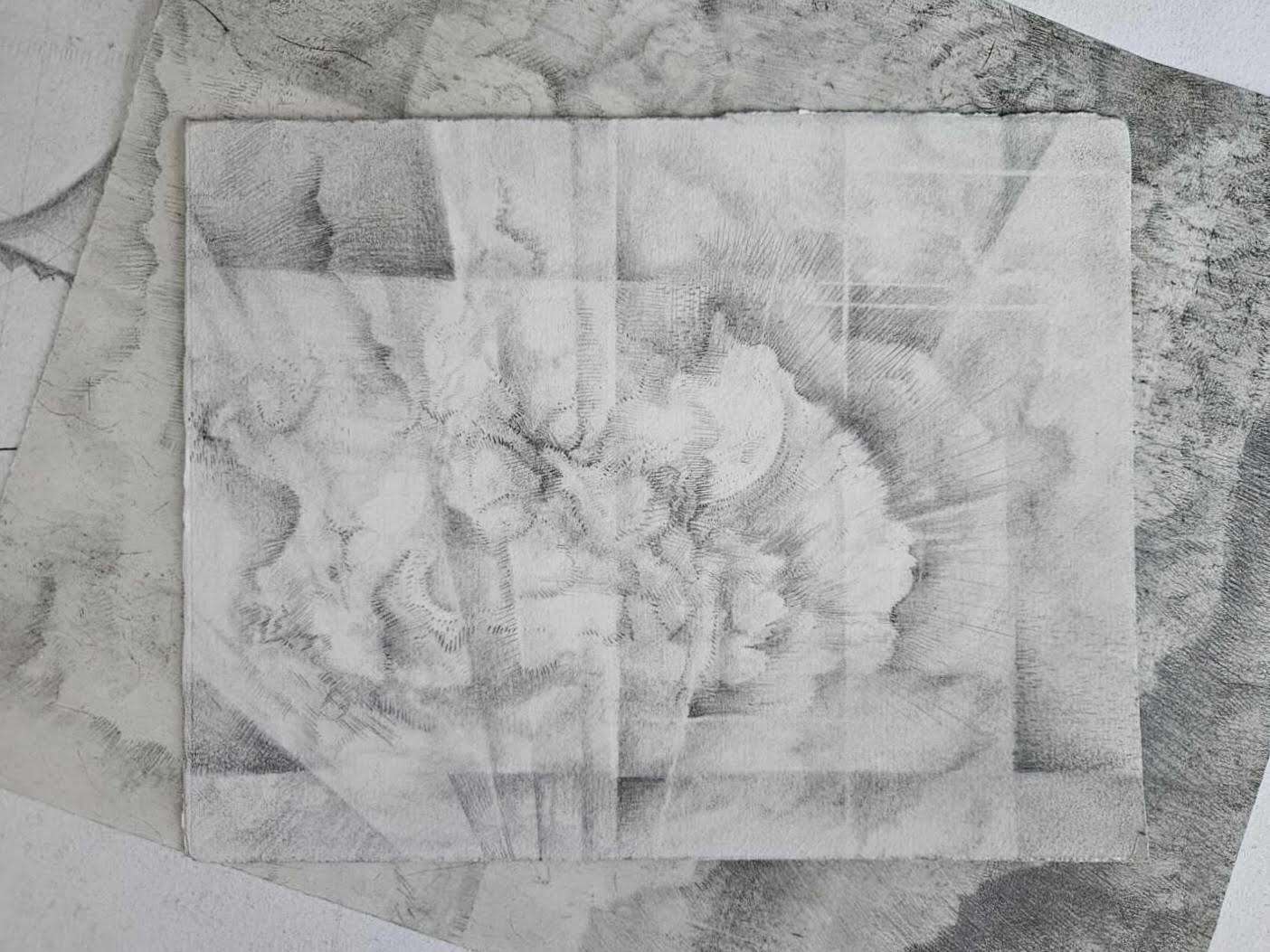
I think it’s about time we revisit art for art’s sake. My own experiences as an artist, and those of my partner, Cam, have led me to the conclusion that we live in a world where despite the reputation the phrase carries, it remains extraordinarily important.
“Art for art’s sake” has a bad reputation of being grounded in privilege, in thinly veiled discomfort with overtly political art, and as a mode of artmaking only available to those that have the luxury of ignoring the real world. And it has in many ways earned that reputation—this is especially true when “art for art’s sake” is understood as a metric by which the more something is done for the sake of anything besides art the less artistic it is.
But we have to be careful.
The phrase is circular, and “art” can be extremely difficult to define, so it seems to me the wide net the saying casts has led to critiques of some versions of art for art’s sake being unduly used to dismiss anything that could be described as such. And as a result, we lose the language to describe the breadth and depth of what makes art and artistic creation such a lasting, compelling force.
—
Of course, what makes “art” such a slippery word is also what makes it so fascinating. On the one hand, art is something that one makes: a painting, a drawing, a print, a “piece of art”—and on the other hand, art is something that one does: painting is an art, drawing is an art, printmaking is an art. So we have art (result, artistic object) and art (action, artistic process). It’s not quite precise enough for me, but it’s something akin to art-as-noun and art-as-verb.
(These are in no way mutually exclusive, and the delineation gets complicated in some fun ways by performance art, for example, but I’m going to stick with visual art both to keep the distinction slightly more simple and to keep things within my area of personal experience.)
Importantly, the implications of “art for art’s sake” change depending on which definition of art you put where.
Art (process) for art’s (object) sake is fairly straightforward. Most intentional processes are done for the sake of their result (brewing coffee, walking somewhere, sleeping, etc), and I’m not sure anyone would take issue with the idea that on some level art (process) is defined by the fact the it is done to make art, or in the other direction, that something is art (object) because it was made artistically. But this is circular in a way that avoids the question. It’s when you double up the definition you’re using that you get the more interesting implications.
Art (object) for art’s (object) sake says that art exists for its own sake. This is often (though certainly not always) where theorists and philosophers ground their analyses of art. In this case, the implication is that the unique quality of the artistic object is found in the fact that it exists purely (or at least primarily) for contemplation, as a beautiful object in the world, and one’s understanding should be based on what is immediately presented by the work. What, then, counts as an artistic object? For some (I find Hannah Arendt’s version of this point the most compelling, as she addresses both the object and its creator), an object can only be considered art if the object has no purpose other than being art, and in turn if the process has no goal other than making that object.
In other words, art is at its most artistic when done for its own sake. I have sympathy for this position, but taken as an absolute rule it’s the type of thinking that, for example, dismisses ornamented household objects—primarily made and used by women—as perhaps beautiful, but merely “use objects” rather than true art. So the critique argues that by the above logic the artist, the process behind the work, and the context the work was made in are all erased or deemphasized in a way that tends to reinforce or replicate existing oppressive structures.
There is, however, truth to the idea that artistic objects to some degree exist for their own sake. The fact that it is more than “just” a use object is part of what makes something art. A blanket doesn’t need to be beautiful to be warm.
Then on the other hand you have what often comes from the perspective of the artist: that the art is done for its own sake. Much of what Cam and I talked about as “art for art’s sake” was the pleasure that comes from the artistic process itself—an urge towards creation that I increasingly feel is the core of what makes art unique. I wouldn’t claim that this is the only reason people make art, because most of the time art isn’t thrown out as soon as an artist thinks it’s finished. But again, there’s truth to this that can get lost if one dismisses art for art’s sake as a whole. Part of why I prefer doing film photography over digital is the length of the process. And whether film or digital, the process of finding the photograph in what I’m looking at is just as important to me as the resulting image itself.
Notably, none of these three frameworks foreground art as a means of communication with an audience (art for its message’s sake, so to speak). Thus, none of them foreground art as a means of political rhetoric. And it’s this particular point where I’ve seen the most friction arise regarding art for art’s sake.
—
L: What led you to the style of your current project?
C: My current technique [graphite drawing] is based off trying to replicate or mimic or emulate the style of a print of mine without access to a press… [I] used the information that was already in the print. I liked how it looked but it wasn’t super feasible financially (copper is expensive), I wanted to see if I could make a similar challenge or project especially after graduating and losing access to a print shop. Doing graphite is also a way to bring myself back to basics. When I was a TA my professor’s mentality was that the freshmen had to “earn” color and interesting materials—everyone had to start with graphite. I had been doing large and colorful and maximalist works that were taking at least six months from idea to execution and I was sick of it… I really enjoyed the process of finding an image to flesh out in something I had already made. I was a big fan of the texture of the plate, going back to drawing after doing more experimental printmaking… it’s nice to take a break and just draw for a little while… I was also trying to draw clouds. Clouds are hard to draw, they suck. Most beautiful things ever, but I wasn’t finding much joy trying to represent them literally. I would look at old engravings and it wasn’t feeling super awesome or exciting. I wanted to capture the feeling that I get from looking at the sky.
—
There is a well established tenet of popular, online, left wing aesthetics: all art is political.
Putting aside the question of whether this is an effective tactic in usually-bad-faith internet arguments with right-wingers about the Super Bowl half time show, I agree that all art, artistic production, and indeed all human activity reflect and are bracketed by political, material conditions. Both in terms of the way the artist’s identity impacts how one should understand the resulting artistic object (the version of this point I see most often), and also in terms of the very literal materials and tools available to an artist. (My art and that of Cam’s have been directly influenced in ways both frustrating and constructive by the lack of resources that comes with finishing an arts program.)
But even given my agreement with the specific meaning “all art is political” is claimed to have, I get the sense that hidden in the folds of such a broad statement is a further, implicit claim: that art is at its best as a radical, liberatory tool, that art is only a worthwhile endeavor if it is political. And thus, its even less snappy reverse: art that doesn’t explicitly say something about politics is doing it wrong.
And art certainly can be radical and liberatory. But frankly, if we value radical, liberatory action (as I do), we have to come to terms with the fact that art is not always the best tool for the job. Protest signs only get us so far. Artists can only “use their platform” for so much.
And yet, in tension with that fact, art remains fundamentally worthwhile and a vital aspect of the human experience. Most artists aren’t professionals, the vast majority of people making art don’t have a “platform,” and it’s a mistake to dismiss them as unimportant. All art is political may sit opposite from art for art’s sake, but at its worst and in isolation it commits the same sin: prescriptively excluding aspects of the artistic experience without which we can’t talk about art in good faith.
—
L: How would you describe your relationship to art?
C: Well I am the proud owner of a BFA, which puts a lot of it into context. A BFA is a funny thing to have. I was thinking about this because we were going to some museums, and my experience making work and being an artist has made me such a hater. And has changed my perception of a lot of art. I get very excited with certain work, what could be described as an ‘intimate’ relation, but it also means that a lot of stuff on display just isn’t interesting to me any more. I gravitate towards techniques I admire or work I enjoy for different aspects that are exciting. I put a certain amount of pressure on myself to be continually making stuff, or at least trying to produce a good amount of art, which feels silly sometimes when there’s a lot of other stuff going on, but it does feel pretty good to do. I don’t know, it’s something I do take a lot of pride in, when I have made work that accomplishes what I set out to accomplish. I don’t think it’s ever something I’d stop doing, even if it doesn’t become part of a career or make me any money (God forbid) I’d still be interested in keeping it a part of my life, I’ve invested a lot of time into it and for good reason, it makes life better for me. And I think I’m a very tactile person. I’ll fall into a pit of despair if I don’t do something with my hands, and art is my favorite outlet for that.
—
There are as many reasons to make art, as there are artists in the world. So I doubt there is anyone out there that makes art purely for its own sake. I certainly don’t. Cam and I both make art for the sake of all sorts of things distinct from the art (process) or the art (object) itself—communicating love or keeping our skills sharp or feeling more present and grounded and sane in today’s world or any number of other things. But ultimately, for me, that’s all downstream from the pleasure I find in the process of photography, and through that process creating objects that represent an attempt to isolate and highlight something singular in the mundane.
I’m treading carefully here. Because it would be an absurd thing to claim that in today’s climate art shouldn’t be political. But rather than being understood as indicative of privilege or a disconnect from reality, it should amaze us and be taken as proof of something deeply human that, in the face of so much despair, people insist on making beautiful things.
The point I really want to hammer home is that “art for art’s sake” doesn’t need to be an elitist or exclusionary prescription of what art should be. If used in good faith, it operates as an important part of any thorough description of the phenomenon that is making and experiencing art—it operates as a reminder of something that’s already true.