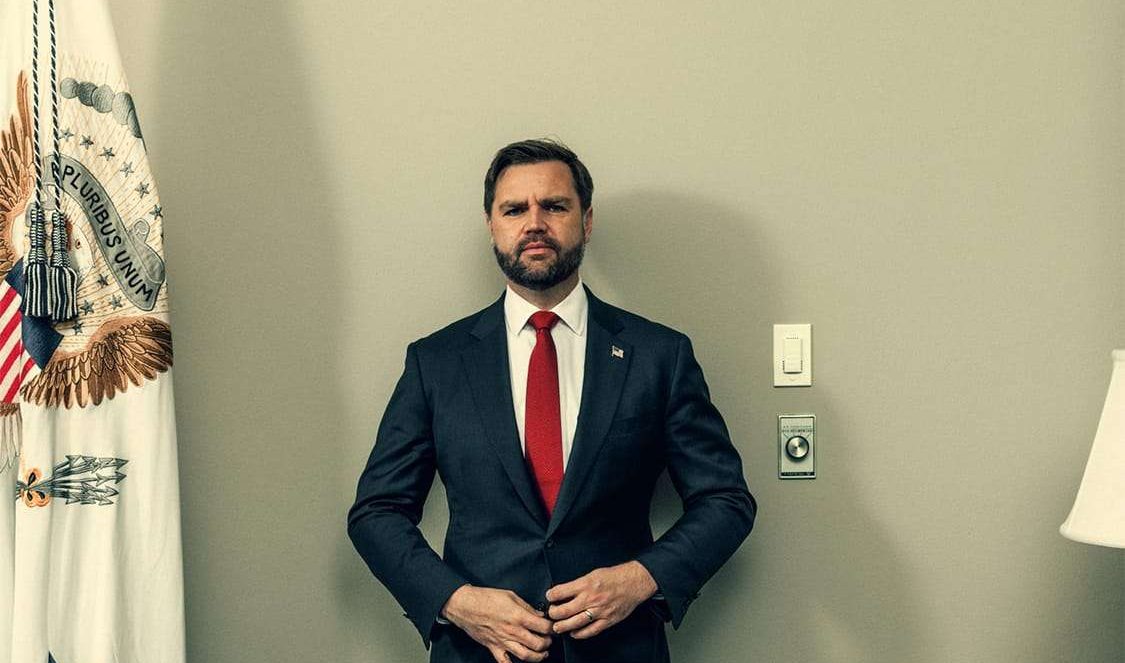
Recently, a dear friend of mine who happens to be Jewish asked me if I knew that the Yiddish word “vānts” (or “vontz,” as it is also transliterated) is pronounced in the same way as the last name of the current Vice President of the United States. The word means “bedbug.” Colloquially, it is used to describe an annoying and unpleasant person. The overlapping of signifier and signified describes J.D. Vance’s public persona perfectly. There is a reason, after all, as to why during the 2024 presidential campaign people noticed how the Republican candidate for Vice President never genuinely smiled. And I dare you to say that he is the one public figure you would want to have a beer with, regardless of political positions. Albeit unsurprisingly the colloquial meaning of the Yiddish word perfectly describes Vance’s new book, Communion, as well. This is his own variant of Saul’s story of conversion, although in his case the latter did not happen on the way to Damascus but in the halls of Yale Law School and the offices of Silicon Valley’s tech billionaires. Then, as a Senator serving Ohio, he underwent a second conversion from a typical early 21st century institutional Republican who compared Donald Trump to Adolph Hitler, to becoming his Vice President and justifier in chief. This, one can argue, is his real conversion, the one the book is indeed about.
In between, Vance chronicles his journey from his childhood evangelical Protestantism to atheism and his recent embracing of a theologically and politically unconvincing, to say the least, version of Catholicism. In other words, Communion is not a book about religion or one’s religious journey. It is a political move of a man who claims to be condemning elitism all while repeatedly demonstrating how desperately he wants to be President of the United States. As regards faith, Vance is intellectually unprepared and unable to write a serious book about religion, let alone Catholicism. Not even one chronicling a personal conversion, “one man’s story” as he puts it, from the perspective of a male politician who is aware that he is neither a theologian nor a student of religion and yet can use his intellectual force and political vision to make a case about politics and one’s faith. This is what John F. Kennedy did when he tackled the question of Catholicism in his historical 1960 “Address to the Greater Houston Ministerial Association.” Likewise, Mario Cuomo convincingly argued that there was no contradiction between his deep and genuine Catholic faith and his pro-choice political position. The party affiliation is here beside the point.
Kennedy and Cuomo understood that their political subject position and the question of their Catholicism were a part of the larger question of the development of 20th century modernity in the U.S. at their moment in time, which they faced without intellectual prejudice and self-serving political expeditiousness. This is not because they were naïve politicians, let alone political saints as some would like to make them. Rather, they knew that that was the only way to gain the necessary political agency to try to move the country forward, making such agency a subject rather than an object of modernity’s development. This was for Kennedy and Cuomo also a way to open political space in the direction of inclusion and democracy. Hence, they were able to provide legitimate political visions for America, which they crystallized in the idea of the New Frontier in Kennedy’s case and the “A Tale of Two Cities” speech Cuomo delivered at the Democratic Convention of 1984 in San Francisco. It is not coincidence that both JFK and Cuomo previously wrote A Nation of Immigrants and Forest Hills Diary: The Crisis of Low-Income Housingrespectively, books that proposed concrete solutions for two prominent modern issues rather than singing a nostalgic fantasy about a supposed world long gone as Vance did in his previous book Hillbilly Elegy.
Communion presents no serious vision of how to govern the nation, move it forward and engage in a world that is no longer framed by the bipolar ideological structure of the Cold War. It is partly a boring, self-serving memoir and partly a reactionary, essentially dishonest political platform disguised as back-to-the-roots of the good old days, which, anyway, always happen to feel and look better than the way they were precisely because they are gone. It is the work of a mediocre mind and poor writer who thinks of himself as the exact opposite, as a brilliant and cultured individual that believes that a few references to the Bible, the work of a French scholar who at best he misread and a few articles from respectable publications are enough to lecture his readers and provide an antidote to the postmodern condition he despises and considers the evil of all evils, without realizing that he is falling prey precisely to that condition.
Let me be clear here. The book does not fall into the category of anti-intellectualism, which, in any case, has a historical intellectual basis and a long civic and political tradition that for us dates back to Rousseau and the longing for a return to the natural, which here would take the guise of Midwestern realism and of the province that beats the center as in a Sherwood Anderson’s story or a good John Mellencamp’s song. Neither is Vance consumed by vanity and self-hatred, as often is the case with anti-intellectual figures, such as Justice Thomas. On the contrary. Not only does Vance come out as the self-confessed arrogant that he is, as he proved even recently when he “lectured” Pope Leo on Catholic theology. And he certainly reserves hatred for everything and everyone that does not make the cut in his very narrow understanding of modern America, though a better way to put it would be lack thereof.
The book starts out with Vance telling his readers that while he achieved the American Dream in the guise of significant wealth, political power, and, eventually, status, along the way he realized that he had “lost something important that had, for all my outward disadvantages, enriched me as a kid.” This is the loss of his Christian faith, which he had first discovered in his youth while living with his father, who eventually, albeit unwillingly, abandoned him because of “family dynamics,” which Vance cares not to detail despite acknowledging that growing up he experienced “emotional and physical abuse.” The father had welcomed drug addicts in need to detox that the “local hospitals had turned . . . away,” in Vance’s view a shining example of a sense of community as well as of the “Christian obligation to serve the poor.” Never mind that any civilized country on this planet has a universal public health system and public health structures that tackle its citizens’ drug addiction. In similar fashion, he points out the churchgoers among whom he grew up who were “unconcerned with whether they’d ever be rich or powerful,” exactly what Vance is. They were “more content and less restless than friends in my Ivy League circles” because of their “ferocious love of God” that the future Vice President had replaced with what he judges as his main cardinal sin, “the arrogant desire to rise above the others.”
In a nutshell, this is J.D. Vance, the book’s author, the former Protestant who regained his Christian faith by way of Catholicism after a bout with atheism, and the aspiring future president. He’s a professional half-truth teller who gives himself a way out of the structural problems the people he claims to support face by taking advantage of the same structures that creates those problems, pretends he does not (his preferred way of fooling the inadvertent reader), and then condemns those structures without offering any credible political solution except for a return to a Christian world that never was in the first place. Because if one were to follow Vance’s logic, one would need to conclude that the lack of a universal health care system in our country is the ontological proof that God failed and failed America. Obviously, this is hardly the case, as it is not the job of The Player, as William Faulkner would write, to provide healthcare for a country’s citizens.
This modus operandi runs throughout the book, starting from the very beginning, when Vance tells us that “I made my money in venture capital.” This is like Meyer Lensky or Lucky Luciano saying, “I made my money in the liquor business,” except that along the way a few bodies were buried in the concrete of the Brooklyn bridge and a few others underneath the meadows in Jersey. He does not explain how a working-class kid whose beloved grandmother told him at one point that she could no longer afford health care made a small fortune in venture capital. What he does detail is the following: how “sadness and a sense of betrayal” for the good old days in the community in which he grew up could afford a decent living led him to atheism; how political problems in America are the result of the biases of the country’s “educated class” that he absorbed as an undergraduate at Ohio State University; how apps and a culture that reject marriage replaced social relations, by which he means men marrying women and having kids; and, last but not least, how our unhealthy relationship with work that “elite professional life demands” causes “the disconnection from much of what makes us human.” The latter, Vance concludes, is due to “the logic of the capitalist division of labor taken to the extreme: specialize in one area of your life and the other specialists take care of everything else.”
If, after reading this j’accuse to capitalism by way of Marxian vocabulary you expect Vance to turn to a thoughtful analysis of our social and economic problems, fear not. The fact that many of our fellow Americans must work two or three jobs to make ends meet is not part of the catalogue of things that cause the disconnection from our humanity, what, if I were as versed in Marxian vocabulary as our Vice President, I would name alienation. All Vance can give us is two hundred more pages of a long lament and indictment of “the striving and credentialism of the modern era” (here the hint that modernity is the problem), which has very little goodness to offer and is responsible for suppressing our Christian heritage, what was good about our society and institutions, beginning with Yale University. There, Vance “came to realize how disfavored Christianity was among the most well-educated members of our society.” Had he cared to do some good research and look around New Haven while in law school, he would have learned that well before Yale turned its back on Christianity it carried out the systemic eugenics denigration of New Haven’s southern and eastern European immigrants and African Americans. He would have also learned how the university created a social and economic desert around its own campus, singlehandedly destroying harmonious multiracial and multiethnic neighborhoods, inhabited by Christian folks, Catholic and Protestants alike.
Moreover, for a man who clearly is in need of certainties in his life, who has difficulty entertaining the old Hegelian idea that there is necessarily no contradiction in keeping two opposite ideas in mind at once, and who indicts capitalism’s extreme division of labor and points the finger at the so-called intellectual elites as the root of society’s problems, it is quite awkward how throughout Communion he continues to return to the hierarchical idea of an educated elite, even outside of academia. For example, Vance describes how fellow Yale Law student Dominic Legge, who was “engaged to be married” eventually felt the call and turned into a Dominican friar and then put Vance on the path to Catholicism, as a man “with excellent academic credentials.” The same goes for Father Henry Stephan, the “Princeton undergraduate . . . accepted into multiple PhD programs to study political and moral philosophy” who became Vance’s Catholic consigliere.
Yet, it was not an ordained priest who changed Vance’s relationship with God and life. Neither was his non-Christian wife Usha, who Vance met, of course, at that much maligned Ivy League institution that turns out to be the connecting tissue of all the people that mattered to Vance after he left Ohio following a stint in the Marine Corp as a correspondent and public affairs specialist. It was, perhaps not entirely surprising, a German born tech billionaire and unsuccessful (If I were an American Protestant instead of a Mediterranean Catholic, I would write “failed”) applicant for clerk to the United States Supreme Court, Peter Thiel, “possibly the smartest person I’ve ever met” as Vance describes him. The young Vance heard him lecturing at, where else, Yale, which impacted the law student a great deal. Thiel is to Vance what God is to Saul on the way to Damascus. He made Vance realize that his striving for social prestige and recognition, for membership in the elite, was not the purpose of one’s life. More importantly, Vance writes, in his Yale talk, Thiel “identified very openly as a Christian.” While this identification per se did not lead Vance to reconsider his relationship with and embrace Christianity at the time, it did open the door to achieve exactly that after graduating law school, moving to the Silicon Valley, marrying Usha, and returning to Ohio to work as a venture capitalist before entering politics.
What Thiel did by identifying as openly Christian, which, accidentally, hundreds of millions of people in America and around the world also do, is not to be afraid of being who one is. And Vance is, first and foremost, an insecure man with a sad, traumatic childhood afraid of the complex problems of the modern world. He believes that an old-fashioned view of masculinity is what one needs to be “the author” of one’s “own destiny” rather than “a person to whom things happen.” As a result, in New Haven, he dismissed psychotherapy because “the thought of being a victim made me want to puke.” He replaced it with confession after a Catholic friend told him that the latter “is like therapy but with less whining and more guilt.” For the same reason, he started thinking that his first son would need to have not all the advantages of a rich and powerful father but what in his view truly counts: character. What, Vance asked himself, “if he got into Harvard, accepted a prestigious job, and was a terrible person?” What if “he was less likely to be a man of character, virtue, and purpose?”
This view might sound commendable. Who would not want a son to be a good person? Yet, in Vance’s case this is nothing but good old-fashioned puritanism, the kind that calls for “character” instead of “personality,” what the culture of the new capitalist modern world created in the early 1920s, whose cipher is Hollywood, which, coherently, Christian reactionaries consider the evil of all evil. This is why Vance hates therapy, which Freud posed as an antidote to both the repression of puritanism and the culture of personality of early 20th century capitalist modernity. Equally, this explains why Vance can talk the talk but not walk the walk when he denounces the extreme division of labor of the capitalist system without thinking of its twin brother (the gender is not an option): private property. It also explains why Vance and his fellow Republican reactionaries attack the conditions of life, its qualities or lack thereof in their view, culture, but not its organization and structures while blaming a very generic idea of society that “is becoming pathologically hostile to having kids.” Finally, it explains his adoration of Thiel, the modern pioneer who conquers the technological frontier while claiming his Christianity, while making a few billion dollars of course.
No wonder, then, that Vance recalls that as the Covid crisis hit China, the first thing he did was taking all of his money “out of the market” and drove “to a sporting goods store and bought one thousand rounds of ammunition” before heading to Walmart to buy ungodly quantities of rice and beans. This is the other side of puritanism, the shining City upon the Hill to be defended at all costs, even from an invisible enemy that only science, in the guise of a vaccine, and time could defeat. Unlike what Vance thinks, it is this self-imposed form of isolationism fueled by the fear of the external enemy that is inside us, not a few months of social distance that is at the chore of our lack of communion addressed in the last section of the book, where the Vice President gives a list of all America’s and Western civilization’s enemies, prefaced by the claim that the Western civilization is more than liberalism, freedom and democracy. It embodies “the concepts of natural rights, including freedom of speech; a sense of duty to one’s neighbors; an obligation of the strong to protect the weak; a belief in free will and individual conscience.”
It would be easy to point out how the administration of which he is the second most powerful and important member has been acting in the exact opposite way, both at home and abroad. This, however, is beside the point. What is relevant, instead, is how Vance thinks about liberalism, freedom, and democracy. By way of referring to two people involved in the failed attempt to assassinate Hitler toward the end of WWII and a Cold War security conference in Munich, Germany, Vance argues that the latter, just like that failed attempt on Hitler’s life, was about defending Western Civilization, rather than “just ideas” such as liberalism, freedom, and democracy. And defending Western civilization, Vance concludes, meant defending an order “built by Christian leaders of a Christian civilization” (Jews and Muslims need not apply, let alone atheists and agnostics) that has now been replaced with a “secular global liberalism that maintained the vocabulary of rights while shedding the religious foundation that gave them meaning.” Again, it would be easy but beside the point to show how the values that Vance attributes to Western civilization, whatever that is, have roots in pre-Christian cultures and were practiced in non-Christian civilizations, starting with the native tribes of North America that were massacred with a gun in one hand and the Bible in the other, Vance’s preferred symbols of his idea of Western civilization. The essential problem, however, is how a person who wants to be President of the United States and currently the second in command to take on such a duty thinks of ideologies, life’s essential conditions, and the most inclusive and beneficial form of organizing social and communal life as “just ideas,” as if liberalism (or, for that matter, any -ism), freedom and democracy were devoid of, had no impact on and were not shaped by the material conditions of life.
What this (mis)understanding proves is Vance’s intellectual deficiency, which results in a truncated, postmodern version of what the American culture critic Sacvan Bercovitch named the “American jeremiad.” In essence, Bercovitch showed how the Puritans’ sermons of European origins recalled the mission to build the aforementioned City upon the Hill, denounce the present generation for straying from that sacred mission, and reframes the crisis as divine intervention functional to spur progress and fulfill the original promise. By so doing, Bercovitch argued, radical dissent is redirected not towards questioning the structures in place, but to reaffirm the special mission of origin and therefore American exceptionalism.
What is missing in Vance’s story is the third element, the crisis as divine intervention to move us forward by way of going backward to the origins. In its place, Vance places the fear of the outsider in all its forms, starting with the outsider par excellence in modern America, the immigrants, Vance’s favorite scapegoat, which he uses to indict the educational system and rewrite history according to his self-serving view of it. Consequently, he laments how school taught him “the evils of ‘nativism,’ but never about the social forces that caused ‘nativism’ to arrive in the first place,” beginning with the “poor immigrant networks [that] led anarchist bombing campaigns against the federal government in the 1910s” or “the new forms of organized crime – like La Cosa Nostra – that sprang up as new European arrivals clashed with an Anglo-American legal system.” There is no explanation as to why a tiny number of those “poor immigrants” turned into anarchists who at times used bombs against the federal government in response to the latter and the big industrial powers’ oppression and curtailment of their rights. One would also assume that the educational system Vance scorns did not teach him about the countless immigrants blown up in coal mines (some near to Vance’s birthplace) or permanently maimed in steel factories. Similarly, Vance omits that there was no such a thing as organized crime in modern America before the Anglo-American legal and political geniuses introduced Prohibition with the enthusiastic help and support of the very Christian Temperance Movement.
The same self-serving strategy is on display when the Yale law School graduate laments that our social fabric suffers because of Mexican workers who are “willing to work on the cheap” and that “too much immigration destroys the social cohesion necessary to form labor unions.” I have a feeling that workers, Mexican or otherwise, are hardly “willing” to provide cheap labor to those who employ them, about whom Vance has nothing to say. But it occurs to me that all the Vice President needs to do to fix this issue is to convince his boss and a few fellow Republicans to join the Democrats and raise the minimum wage from the current poverty level of seven bucks and a quarter an hour to a reasonable twenty-five dollars. As for the social cohesion necessary to form labor unions, maybe some editors at HarperCollins, the book’s publisher, should have pointed out to the Vice President that well over two third of unionized workers in the U.S. are African Americans, Latinos, and Asians, many of them immigrants or children of immigrants, just like those who built the union movement after the Civil War, and, especially the early 20th century were. I, instead, will limit myself to point out that getting rid of The Taft–Hartley Act of 1947, the law passed over President Truman’s veto that rolled back the powers and rights that the 1935 New Deal Wagner Act had given to workers, many of whom served and died in WWII, would go a long way toward facilitating the formation of labor unions and strengthening social cohesion. But all this too, in the end, is beside the point. Because all this pantomime of a book achieves is demonstrating that being lectured on America and Catholicism by a bedbug of a man who has no clue about what either of those things means is supremely annoying. As annoying as a “vānts.”