Towards the beginning of the Epic of Gilgamesh, the narrator commands the audience to find a stone tablet hidden in a locked box and read about the heroic exploits of Gilgamesh, king of Uruk. This metaliterary device frames the ancient text as a message from the deep recesses of time.
With Simon Armitage’s Gilgamesh: A New Verse Translation (W.W. Norton 2026) in hand, our access to this Mesopotamian manuscript has been renewed. The Epic of Gilgamesh is the world’s oldest known poem, and Armitage is an experienced translator of historical poetry, having published editions of classical and medieval English texts.
In advance of Armitage’s visit to the International Poetry Forum at Heinz Memorial Chapel on April 28, I asked him a set of questions about his relationship to the epic and the epic’s relationship to modern audiences. Our exchange occurred over e-mail, organized here into tablets that connect his responses to broader themes in the epic and its reception history.
Tablet I. Meeting Gilgamesh
Although stories about a king of Uruk named Gilgamesh circulated for some 1,500 years in antiquity, it wasn’t until 1872 that modern audiences first learned of them after a self-trained scholar identified portions of the Epic of Gilgamesh among boxes and boxes of cuneiform tablets in the British Museum.
It can take time to rebuild a reputation, and the Epic of Gilgamesh’s literary reputation has only grown throughout the 20th and 21st centuries. It is now an established representative of world literature and has inspired writers, musicians, even game designers.
ME: When did you first encounter the Epic of Gilgamesh? What was the circumstance, and how did you respond at the time?
SA: It’s one of those poems that’s always been there in the background. The backdrop to all poetry to some extent. A foundation text. I think Stephen Mitchell’s version [Gilgamesh: A New English Version, Free Press 2004] was the first I read front to back — very fluid and flowing. Before that — and after — I just encountered it as extracts.
Tablet II. Cultural Translation
“Imagine a jigsaw,” writes Armitage in his translator’s note in Gilgamesh. Translators of the Epic of Gilgamesh are working with a text that is incomplete and still evolving; that exists in multiple manuscripts from different times and places; that is written in a language and script that few people in the world can read. As a result, some argue that the task is best managed by experts in the linguistic field of Assyriology. Armitage, however, makes a case for literary adaptations of “old poetry” that offer “readability and a sense of poetic wholeness.”
ME: What, if anything, is lost in this approach? I’m thinking about the cultural specificity of figures of speech, humor, and intertextual references. How did you handle that?
SA: All translation is an illusion. All translation is a compromise. There is no original poem, no single authorship or ownership here, just a provisional story and evolving versions of it. Mine is a further evolution. It’s as faithful as it needs to be and as poetic as it chooses to be. It’s about creating a plausible universe for the poem to exist in.
Tablet III. Gods and Men
In his introduction to Gilgamesh, Armitage describes how the Epic of Gilgamesh blends the real with the fantastic, taking place in a world with “verifiable geography” but also “stone oarsmen, a celestial bull, a man made from clay, the gods in their heaven.” Gilgamesh is himself a mix of the ordinary and the extraordinary; he is one-third human and two-thirds divine. Likewise, the immortal gods that intervene in his life are very human in their behavior and relationships. And then there is Enkidu, a man of the wild who begins as Gilgamesh’s rival but transforms into his beloved companion. It is Enkidu’s death that forces Gilgamesh to confront his own mortality and seek out the immortal Uta-napishti.
ME: Which character in the Epic interests you the most?
SA: I suppose Enkidu is the connoisseur’s choice and Gilgamesh himself the obvious one. At some points in the text they overlap, take on each other’s characteristics, before exchanging roles almost. I find the king [Gilgamesh] interesting because of his flaws. His grief at the loss of his comrade is heart-rending, but it’s mixed in and mixed up with the fear of his own death, which reads as cowardly and self-regarding at times. Perhaps that’s the very thing that brings forward his existence as a human being, despite his divine origins. From a dramatic point of view, I enjoy Uta-napishti’s arrival in the story — sole survivor of the Great Flood who lives at the end of the world and turns up at the end of the poem. He knows Gilgamesh’s quest is doomed to failure but still offers him hope.
Tablet IV. Timelessness
When the Epic of Gilgamesh was rediscovered in Victorian England, it gained immediate fame thanks to Uta-napishti’s story-within-the-story of a catastrophic flood. The similarities between this flood and the biblical Flood spurred debate about the historicity of that sacred text and its relationship to a broader mythical tradition.
Since then, the Epic has prompted discussions of masculinity, sexuality, environmentalism, and other contemporary themes. Armitage’s translation, though written with the cadences and lexicon of modern English, does not force any of these conversations. Rather, Gilgamesh leaves readers to make connections themselves.
ME: What connections feel most vivid and urgent to you?
SA: Issues of political power and tyranny. They barely need explaining; the connections with the world we live in are startlingly obvious. And issues of loss — we’re no nearer coming to terms with our mortality than humans were three thousand years ago. In fact, we’re probably further away.
Tablet V. Performance
Before taking up the Epic of Gilgamesh, Armitage produced adaptations of the Iliad and the Odyssey, electing to dramatize them for the stage and, in the case of the Odyssey, for radio as well. This is essentially a double act of translation, altering the epics’ linguistic and structural forms. Gilgamesh: A New Verse Translation preserves the ancient epic’s poetic verse, but it is conceivable that Armitage would also want to turn it into a drama.
ME: Do you think Gilgamesh would work as a stage or radio play?
SA: It’s SO dramatic. During my translation I worked on a theatrical presentation of the poem with students from Liverpool Institute of Performing Arts, and it was so helpful, particularly in exploring each character’s motivations. A lot of my introductory essay to the published poem came out of those rehearsals and workshops. Now I’ve finished I’m really keen to dramatise the poem for theatre and/or film and/or radio. In my mind’s eye I can already see the gruesome head of Humbaba, and the creepy Scorpion-People.
Tablet VI. Seeing Gilgamesh
If Armitage ever wanted to supplement his mental images with ancient visual models, he would have little to draw upon. In antiquity, the Epic of Gilgamesh was foremost a textual phenomenon. The few ancient images related to the narrative depict its climactic moments of action, specifically Gilgamesh and Enkidu killing Humbaba or the Bull of Heaven.
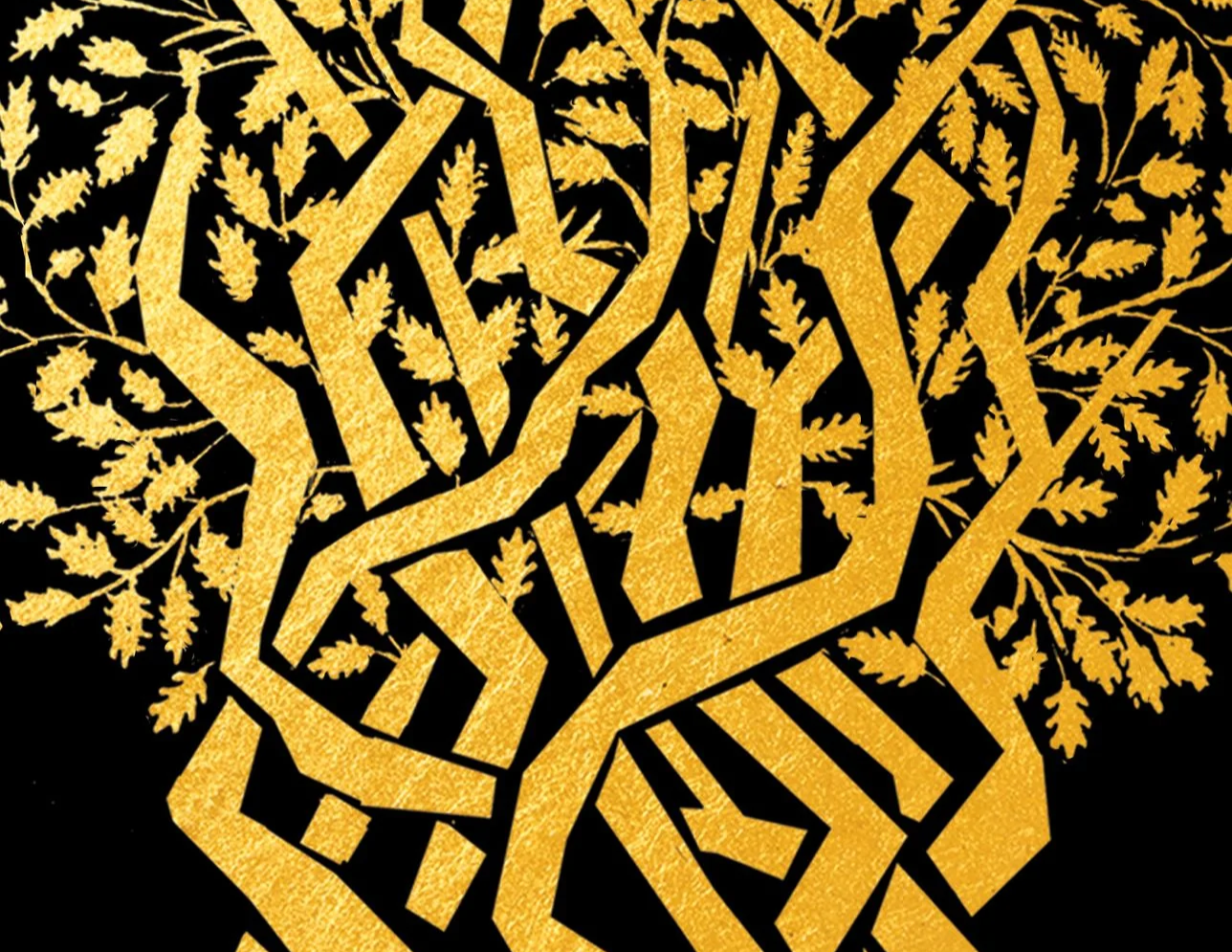
The cover art for Armitage’s Gilgamesh takes a quieter approach. It features a broad golden tree with a canopy of leaves and a trunk made up of seven jagged, intertwined parts.
ME: I’m not sure how much input you had into the cover design of the book, but the image of the seven-trunked golden tree is beautiful. What does it signify for you?
SA: It’s the Cedar Forest. Where Gilgamesh and Enkidu slaughter the guardian of the trees. It’s the crime that catapults him towards catastrophe, and also introduces an environmental theme to contemporary readers, which the cover emphasizes. The trees have become sacred and chopping them down is an act of desecration.
To heighten the impact of their actions, the tablet containing the episode of the killing of Humbaba opens with a description of the Cedar Forest before Gilgamesh and Enkidu have a chance to disturb and destroy it. In Armitage’s rendering,
Cedars thrived on the sun-kissed slopes
and the shade they cast was richly perfumed.
Like a matted garment, briars and brambles
choked the paths through the trees and the thickets.
The text then describes the sounds of its animal inhabitants.
A bird called out, then the forest echoed
with the racket of more birds calling in answer.
A long cicada sounded its note,
triggering a chorus of piping and hymning.
This verbal sketch of a forest dense with sights, scents, and sounds was only integrated into the epic in the last decade or so, thanks to a newly identified tablet. It is a reminder of just how much is still unknown about this text. If there really were a locked box where we could find the Epic of Gilgamesh in its complete form, it would provide the missing pieces of this unfinished jigsaw puzzle, but we would still need a guide like Armitage to help us understand what it says.