
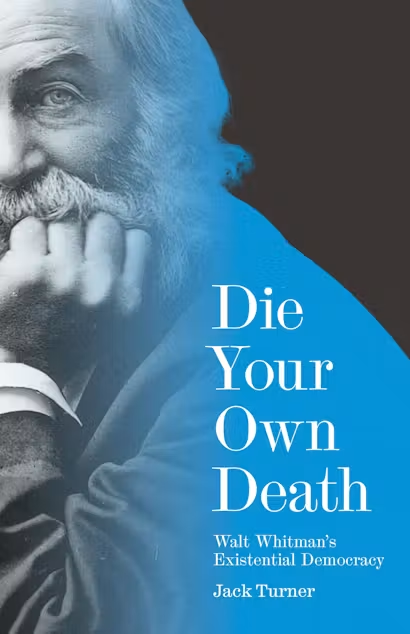
Die Your Own Death is a political philosophical study of the relationship between death and democracy in Whitman’s political thought. It unpacks his suggestions that democracy helps reconcile us to mortality without relying on a transcendent God and accepting death strengthens freedom and equality. These two claims together comprise Whitman’s vision of what I call “existential democracy”—democracy as a political form that urges us to come to terms with our individuality, vulnerability, nonsovereignty, finitude, and mortality. “I exist as I am, that is enough,” Whitman writes in “Song of Myself” (1855). The poem’s democratic egalitarian persona accepts his mortally embodied self as existentially sufficient. No longer needing redemption from either God or church, he is free to construct his own understanding of the sources and nature of existence, as well as to buck any authority using the promise of heaven and threat of hell to elicit submission. Such intellectual and spiritual freedom constitute democratic selfhood and are essential to democratic citizenship.
Democracy for Whitman is not just a form of government or a practice of politics; it is a nonconformist disposition and egalitarian way of life. Its bedrock principle is equal human dignity. It holds that all individuals are morally sacred and spiritually rich. Whitman embodies democracy when he identifies as “A learner with the simplest, a teacher of the thoughtfulest . . . A prisoner, fancy-man, rowdy, lawyer, physician or priest.” Democracy’s faith is that the least schooled have something to teach, the most schooled something to learn. Prisoners, fancy-men, and rowdies bring staggering insight from democracy’s hidden corners, provoking lawyers, physicians, and priests to rethink the conventions they uphold.
At the heart of Whitman’s democracy is a desire to equalize philosophical and spiritual authority. The devolution of authority away from monarchical and ecclesiastical institutions that occurred during the Protestant Reformation, English Revolutions, colonial settlement of North America, American founding, and early nineteenth-century reform movements were, in Whitman’s eyes, a prelude to a more fundamental transfer of philosophical and spiritual authority to average citizens in their unsponsored, ordinary personhood. In the preface to the first edition of Leaves of Grass, Whitman wrote: “There will soon be no more priests. Their work is done. They may wait awhile . . . perhaps a generation or two . . . dropping off by degrees.
A new order shall arise, and they shall be the priests of man, and every man shall be his own priest. The churches built under their umbrage shall be the churches of men and women. . . . They shall find inspiration in real objects today, symptoms of the past and future.” Whitman figures nineteenth-century democratization as the logical culmination of Martin Luther’s break from Rome. Just as Luther argued that “faith alone” suffices for salvation, making individuals “the freest of kings” and “priests forever” within their personal experiences of God, Whitman declares “every man his own priest.” He supersedes Luther by calling readers back not to the authority of scripture or local congregations, but rather to the authority of their own worldly experience, of “real objects today.”
Whitman’s spirituality moves beyond pantheism. In a playfully blasphemous moment in “Song of Myself,” his poetic persona states, “nothing, not God, is greater to one than one’s-self is.” Rather than seeing God in every part of the whole, Whitman portrays the part, the individual, as equal to the maker of the whole. Suggesting that each and every self is equal to God pushes the idea of God past the point of absurdity: if each and every self is equal to God, then God ceases to have the transcendent or totalistic characteristics defining divinity. Destroying the distinction between the divine and the mundane, Whitman suggests that reality may be all mundane. His poetic experimentation with atheism enables him to say,
“Be not curious about God, / For I who am curious about each am not curious about God.” The glory of the mundane makes God unnecessary. Whitman further suspects that the glories of mortal life make immortality unnecessary.
The book’s title—Die Your Own Death—evokes Martin Heidegger’s famous point in Being and Time (1927) that every individual “must take dying upon itself.” Witnessing and grieving another’s death is no substitute for approaching and confronting one’s own. This is why—Heidegger claims—that “death is always essentially my own.” Heidegger also thought that clear-eyed consciousness of mortality encouraged free-dom. Consciousness of mortality evokes the transitory nature of wealth, status, and worldly attachment. Most people try to avoid thinking of death; engaging death therefore enacts non-conformity. Confronting the fact that one will die—often at an unexpected moment, not of one’s choosing—forces people to grapple with the strange meanings of individuality, partiality, nonsovereignty, time, and agency. Thinking of death raises the questions: What is my relationship to others? If death can separate me from those I most love, then how connected are we really? How will they remember me? Why does death strike so randomly? How should I live in light of death’s caprice? How should I make use of the time that I have? What effects can I truly have on the world?
There is no evidence that Heidegger read Whitman. Whitman’s work nevertheless anticipates Heidegger’s preoccupation with the connection between confronting mortality and living authentically. I do not offer a Heideggerian reading of Whitman.
Such a project would be disrespectful of Whitman’s independent intellectual stature. I do offer an interpretation of Whitman, however, that amplifies themes that were central to the existentialist movement that Heidegger helped found: the nature of being for both the person and the species, the relationship between experience and worldliness, the role of death in how we live and how we tell the stories of our lives.
Excerpted from Die Your Own Death: Walt Whitman’s Existential Democracy Copyright © 2026 by Jack Turner. Available from Princeton University Press.