On Tuesday, February 20, 2001, photographer Renée Cox joined the stage to debate William Donohue, the president of the Catholic League for Religious and Civil Rights, a conservative lay organization founded in 1973 with a stated mission to defend the rights of Roman Catholics. The event—called “Exploring the ‘Yo Mama’ Controversy: Art, Outrage, and the First Amendment”—was organized by the First Amendment Center and held in midtown Manhattan. The occasion was the recent uproar over Yo Mama’s Last Supper, Cox’s contemporary take on Leonardo da Vinci’s classic painting. In this version, Cox, who has described herself as a “born and raised Catholic, Jamaican-American Princess,” stood in for Jesus, fully nude and surrounded by a cast of mostly Black disciples. The work appeared in the Brooklyn Museum’s exhibition Committed to the Image: Contemporary Black Photographers, which had opened the previous week.
Controversy had erupted before the show even launched. Two days prior, a reporter from New York’s Daily News brought Cox’s photomontage to the attention of the Catholic League, assuming it was exactly the kind of thing that would set Donohue off. And it did. Donohue, who had made a name for himself as the leading lay watchdog for negative portrayals of Roman Catholicism, quickly purchased a copy of the exhibition catalogue. He was struck by what he saw as the blatant “anti-Catholicism” displayed in the work and in the museum’s decision to feature it. Cox’s piece also caught the eye of New York’s Mayor Rudy Giuliani, who likewise condemned it as offensive. “If it were done against another group there would be outcry in this city that would demand that they take the photograph down,” he told reporters, “but anti-Catholicism is just accepted prejudice.”
Giuliani was experiencing a bout of déjà vu. A year earlier, artist Chris Ofili’s mixed media painting Holy Virgin Mary had ignited similar controversy and accusations of sacrilege when it appeared in the Brooklyn Museum’s 1999 exhibition Sensation. Ofili depicted an Africanized version of Mary adorned with elephant dung. Giuliani and Donohue quickly took offense and appeared repeatedly in televised news and in print, from CNN to the New York Times, blasting what they considered pervasive and ongoing anti-Catholicism that had seemed to become par for the course among New York’s art community and intelligentsia. Indeed, concerns about a “new” anti-Catholicism seemed to be coming to a head in these years. Catholic neoconservative George Weigel had first named this threat in the early 1990s, when he listed feminist and queer activists among the leaders of a renewed antipathy toward Catholic religion and values. Now, it seemed, mainstream arts institutions happily condoned explicit attacks on Catholics. And not just in New York.
As debate raged over Cox’s Yo Mama’s Last Supper, some Catholics in Chicago protested Dick Detzner’s painting The Last Pancake Breakfast, which featured a bottle of Mrs. Butterworth’s syrup in the role of Jesus flanked by disciples like breakfast cereal icons Tony the Tiger and Toucan Sam. It was part of Detzner’s Corporate Sacrilege series, which included send-ups of the Adoration, the Ten Commandments, and the Crucifixion—the latter, titled Yee Hee Hee, features the Pillsbury Doughboy on a cross getting poked by the hand of god. Just weeks after Cox’s work was in the headlines, Chicana lesbian artist Alma Lopez would come under fire for Our Lady, a digital photograph of the Virgin of Guadalupe wearing a bikini of roses, which was shown at the Museum of International Folk Art in Santa Fe, New Mexico.
This clash between accusations of anti-Catholic sacrilege and threats to free speech provided the occasion for Cox and Donohue to take center stage that Tuesday afternoon. Advertisements for the debate captured this heated culture wars rhetoric, proposing questions about whether the public should fund “offensive” art. One even asked: “Can offensive art cause hate speech?” The temperature was turned up, and the “fiery exchange” between Donohue and Cox did not disappoint.
Donohue blasted Cox’s work as “anti-Catholic propaganda” and argued that such offensive art would not be allowed had it targeted minorities. “Our society tolerates anti-Catholicism to a degree it does not tolerate racism, antisemitism, gay-bashing,” he maintained. Proposing a hypothetical, he asked if Cox would object to an image of a white man urinating into the mouth of Martin Luther King, Jr. According to Catalyst, the Catholic League’s journal, Cox became “indignant but never answered him on whether she would simply regard this as art.” A few days later, Cox brought up Donohue’s what-if scenario in an interview for Salon. “I don’t think of those things,” she said, “I don’t go there. There is no art that can offend me.” What did offend her, she explained, was that it took City Hall days to respond when police officers gunned down Amadou Diallo, an unarmed Black man, “but they can comment on my art in two or three hours. That offends me.”
During the debate, Cox countered that the issue with Yo Mama’s Last Supper had less to do with anti- Catholicism than with the politics of racial and gender representation. “I feel like perhaps, as an African American woman,” she explained, “that somehow maybe that is the biggest affront to people.” Donohue responded that representing Jesus as a Black man or woman wasn’t the problem. It was the nudity that crossed the line. “Had you managed to keep your clothes on,” he quipped, “you wouldn’t have gotten any criticism.”
It would be easy to dismiss this debate over Yo Mama’s Last Supper as little more than another episode of culture wars sensationalism—one that brought Cox international notice and added to Donohue’s growing archive of anti-Catholicism. One New York Post writer even panned the event for seeming “more like a road show starring two hucksters” than a real debate. But sensationalism is rarely just that. And the heightened public debate accompanying a sensationalized culture wars outburst such as this one provides an opportunity to take stock of a cultural moment—and to ask what Cox might have been up to outside the limited framing of culture wars politics. We might start by looking to the work of art itself.
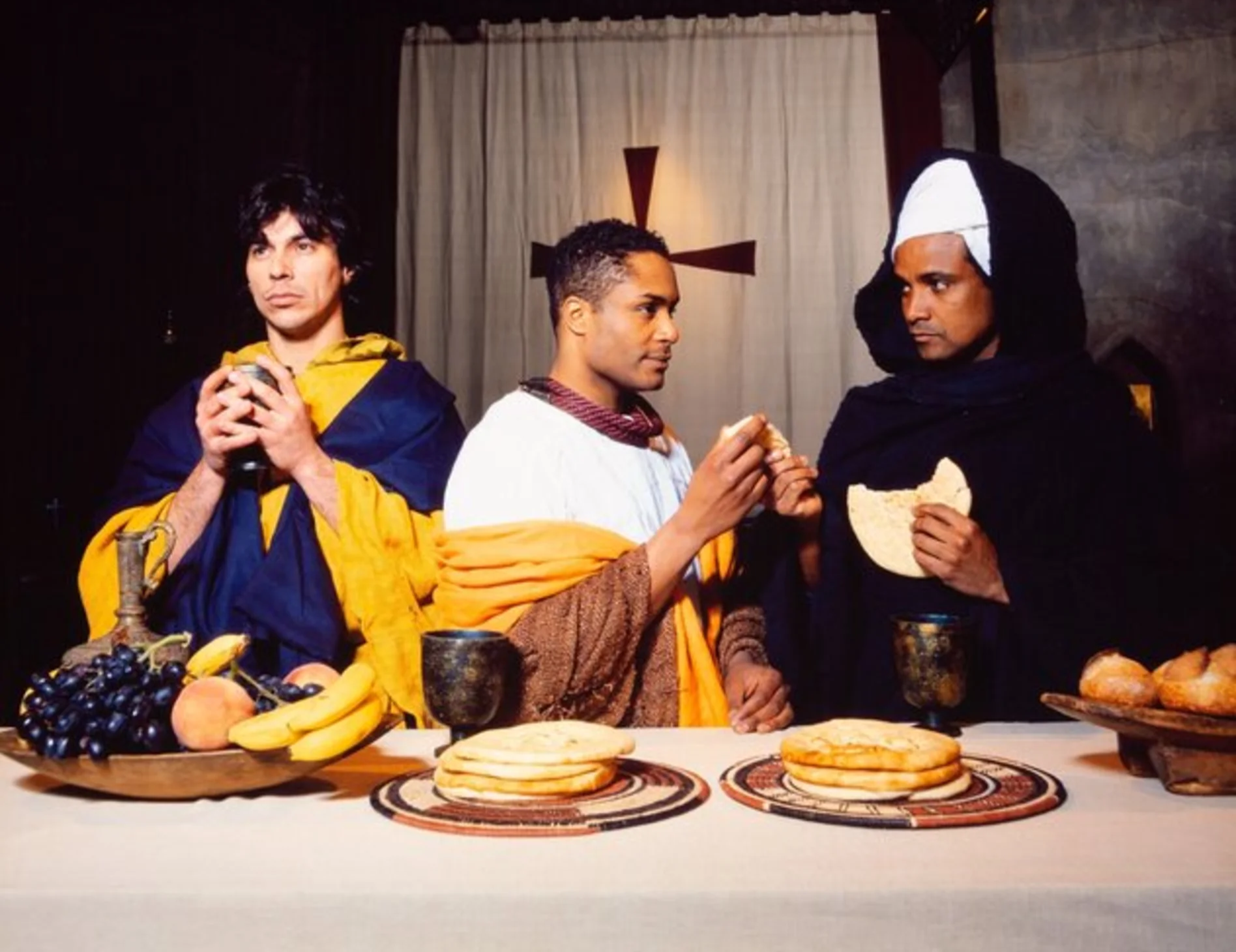
Shot in a church in Queens, Yo Mama’s Last Supper (1996) is a grand photo-montage with five panels, each measuring 31×31 inches. A nod to Leonardo’s Last Supper, the center panel features a Jesus figure, who faces the viewer while set slightly apart from the twelve apostles. Leonardo’s fair- skinned Jesus, eyes gazing downward, is seated and framed by a window. He’s flanked by twelve male apostles in two groups of three on both sides. Some face Jesus; others are caught up in conversation. In Cox’s Last Supper, Jesus occupies a single panel in the center, and the role of the savior is played by the artist her-self. She stands before her disciples, fully nude save for a white shawl wrapped around her arms and behind her back—a possible reference, writes historian Stephen Prothero, to “the chains of slave Christianity.” This Jesus, Black and female, gazes upward to the heavens. She is framed, from the waist up, by a vibrant gold curtain. Her stance—standing with arms outstretched in what art critic Eleanor Heartney calls a “benedictory gesture”—recalls the Jesus of the Last Supper but also invokes Jesus on the cross and the resurrected Christ, as she rises above her apostles.
Cox mirrors Leonardo’s painting of the apostles in groups of three, but she gives each trio their own panel. Her apostles are dressed in colorful robes, often purple, gold, and white, though one wears what looks like a nun’s habit. While the Renaissance Italian imagined the apostles as white, Cox pictures them Black—save Judas. “I was saying, ‘This is my dinner party,’” Cox explained in an interview, “Why not?” “With Judas,” she continued, “I was conscious of this. But I didn’t make him that Caucasian, either. I could have done blond, blue eyes and Aryan.” She says her version of Judas could be read as American Indian or Latino, insisting, “He’s not a super-Caucasian.” Cox’s remarks remind us that neither representation nor realism should be conflated with reality, that the “real” race of her Judas need not fully determine how he is read in such work.
This racial and ethnic ambiguity also recalls Leonardo’s painting, but in a different way. In The Last Supper, Judas appears darker than the other apostles. Historically, Judas has often been depicted through antisemitic stereotypes drawn from a long Christian tradition of blaming Jews for the death of Jesus. For many viewers, it appears that Leonardo painted Judas with stereotypically “Semitic” features, including darker skin, to exaggerate his “Jewishness” against the lighter depiction of the other apostles. Other readings attribute the darker complexion to Judas leaning back into a shadow. Either way, Leonardo’s rendering employs darker shading to single out the betrayer. Cox inverts this iconographic portrayal of whiteness and darkness, while also pressuring dominant gender and racial representations of Jesus and the apostles.
If Yo Mama’s Last Supper sits within a longer history of representations of Christ as Black, including Cox’s previous work It Shall Be Named, it also appears alongside the many plays on Leonardo’s Last Supper as well as representations of Christ as a woman in the history of modern art. Plays on Leonardo’s work abound. There are comedic spoofs, like A. J. B. Lane’s 2018 political cartoon in the Boston Globe lampooning Trump as the Christ figure. The embattled president is surrounded by “disciples” like Steve Bannon and Stormy Daniels. Another—Omarosa Newman—jokes, “Really? Just one of us?” (referencing, of course, the role of the betrayer). And then there is Andy Warhol’s Last Supper series, created in the mid-1980s. In some of the series’ works, which number over a hundred, the gay, Catholic pop artist superimposed commercial brand logos and advertisements over Leonardo’s image. Later pieces, such as MADSAKI’s Last Supper (The Big C) II (inspired by Andy Warhol) (2019) and Dick Detzner’s Last Pancake Breakfast (2000), play on Warhol’s play on Leonardo. Cox’s Last Supper joins these plays on plays, while adding her own embodied take. In fact, this was not even her first dinner party. Cox had created a precursor to Yo Mama’s Last Supper called Black Panther Last Supper in 1993, though it was not shown in a gallery until 2023.
Just as important for situating Cox’s work are feminist reimaginings of The Last Supper and the figure of Christ. Judy Chicago’s Dinner Party (1979), the topic of another chapter in Provoking Religion, no doubt provides one of the most monumental feminist reworkings. Chicago cast no clear Christ figure in her rendition, but artist Mary Beth Edelson’s earlier poster Some Living American Women Artists (1972) places feminist icon Georgia O’Keefe in the starring role. Edelson superimposed an image of the artist’s face onto that of Jesus in a copy of Leonardo’s version and surrounded her with women artists, including Faith Ringgold, Yoko Ono, and Alice Neel. Edelson offered a clear feminist statement, if not an explicitly theological one.
Other feminist artists challenged theological and political assumptions about the gender of Jesus more directly. English sculptor Edwina Sandys’s Christa (1974) was probably the first modern representation of Christ as a woman to make major headlines. Sandys originally made the bronze sculpture depicting a crucified woman Christ for the United Nations Decade (1976–85), a campaign to promote equal rights that followed the first women’s meeting at the UN in Mexico City in 1975. But Sandys’s Christa sparked little controversy until 1984, when it was exhibited during Holy Week in the Episcopal Cathedral of St. John the Divine in New York City.
The New York Times reported responses ranging from “joy to dismay.” For opponents, Sandys’s sculpture flew in the face of historical and theological truth. Walter Dennis, suffragan bishop of the Episcopal Diocese of New York, explained that it was okay to “enhance” symbols of Christ by altering his skin tone or ethnicity, but making Christ a woman was “symbolically reprehensible” because it was “totally changing the symbol.” But defenders argued that, even if the historical Jesus was male, Christa could symbolize the role of women in the church and the fight for equality. Feminist biblical scholar Phyllis Trible explained that Christa alluded to “Christ’s mystical body that transcends sex” and did not require “denying the male Jesus of history.” Episcopal Bishop Paul Moore, Jr., a well-known progressive Christian leader, recorded his initial shock in a press release: “Years of speaking of God in male terms, years of imagining God primarily as male, did not prepare me for this image.” But, he insisted, the work revealed “theological truths” about Christian notions of Incarnation—how “the word became flesh and dwelt among us” (John 1:14)—that meant the suffering of Christ transcended sexual difference.
Like Sandys, many feminist artists in the 1970s and 1980s challenged sexist assumptions in Christian traditions, especially the notion that Christ must be represented as a man. Christa joins many other examples of women-Christ figures in modern art, including Almuth Lütkenhaus-Lackey’s sculpture Crucified Woman (1976), James Murphy’s sculpture Christine on the Cross (1984), and Margaret Argyle’s mixed textile panel Bosnian Christa (1993). Never one to shy away from controversial imagery, pop icon Madonna even scaled a mirrored cross in her 2006 Confessions Tour. This longer history and range of representations help us to see more of what’s going on in Cox’s Yo Mama’s Last Supper—to appreciate how it draws upon and diverges from the ways other artists have reimagined the Last Supper and the gender of Christ.
Standing fully nude at the center of the dinner table, Cox plays not only on the history of Christian art and iconography but also with conventions for representing Black women. If Judy Chicago hesitated to depict Black women’s sexuality at her Dinner Party—breaking with her now-iconic vulvar imagery to paint Sojourner Truth’s plate with three faces instead—Cox places it front and center, framed by the draped fabric of her white shawl. The use of photography underlines the message, as Cox recalls the explicit performances of white feminist artists like Carolee Schneemann or Cheri Gaulke. But she also signifies “more.” Cultural studies scholar Nicole Fleetwood explains how “black women’s bodily enactments signify beyond ‘explicit,’” figured as “excess” in relation to the norms of “the white female body and femininity.”
Cox plays with this “excess” and its attendant “hypervisibility,” which, Fleetwood writes, “is a performative strategy for black female cultural producers, one that emphasizes the faulty notions of a ‘visual truth’ of blackness by representing excess and fantasy.” Cox portrays this hypervisibility in ways that set her Last Supper apart from most others by gesturing to the visual politics of religion, race, gender, and representation. In the racist and sexist conventions of modern representation, Cox’s body cannot signify outside of the burden to represent “excess and fantasy,” so she puts all on the table.
But Yo Mama’s Last Supper also works against an erotic reading—that is, Cox presents the cultural dominance of such a reading only to undermine it. Her apostles hardly notice her. Her face is serious, gazing upward. Her posture conveys strength more than seduction. Cox has addressed her approach. “I chose to play the Christ figure in the nude because it represents a sense of purity,” she explains: “I come to the table with nothing to hide.” In other interviews, she says that nudity erases markers of class, creating a “pure state.”
The overdetermined significance of Black women’s bodies thus confronts a competing provocation to read nudity as a symbol of purity. Indeed, there is a long Christian tradition for such a provocation. In the early years of the movement, catechumens would undress before public baptisms. Writing in the fourth century, St. Cyril of Jerusalem explained the reasoning behind this practice: “Having stripped yourselves, ye were naked; in this also imitating Christ, who was stripped naked on the Cross, and by His nakedness put off from Himself the principalities and powers, and openly triumphed over them on the tree.” To be naked in this way, in the way Cox reveals herself, is to imitate Christ on the cross, to overlay representations of racial and sexual excess with the visual presence of the divine. “O wondrous thing!” Cyril continued, “ye were naked in the sight of all, and were not ashamed; for truly ye bore the likeness of the first-formed Adam, who was naked in the garden, and was not ashamed.”
Read in this light, we might ask whether culture wars debates over the work of artists like Renée Cox are best understood as debates between Christians and anti-Christian secular artists or as debates among competing approaches to Christianity itself. Indeed, the former framing—what I call the culture wars narrative—succeeds precisely by overshadowing the latter possibility. Cox’s work prompts us to see past that rhetorical sleight of hand.
**
Adapted with permission from Provoking Religion: Sex, Art, and the Culture Wars by Anthony M. Petro, published in 2025 by Oxford University Press.