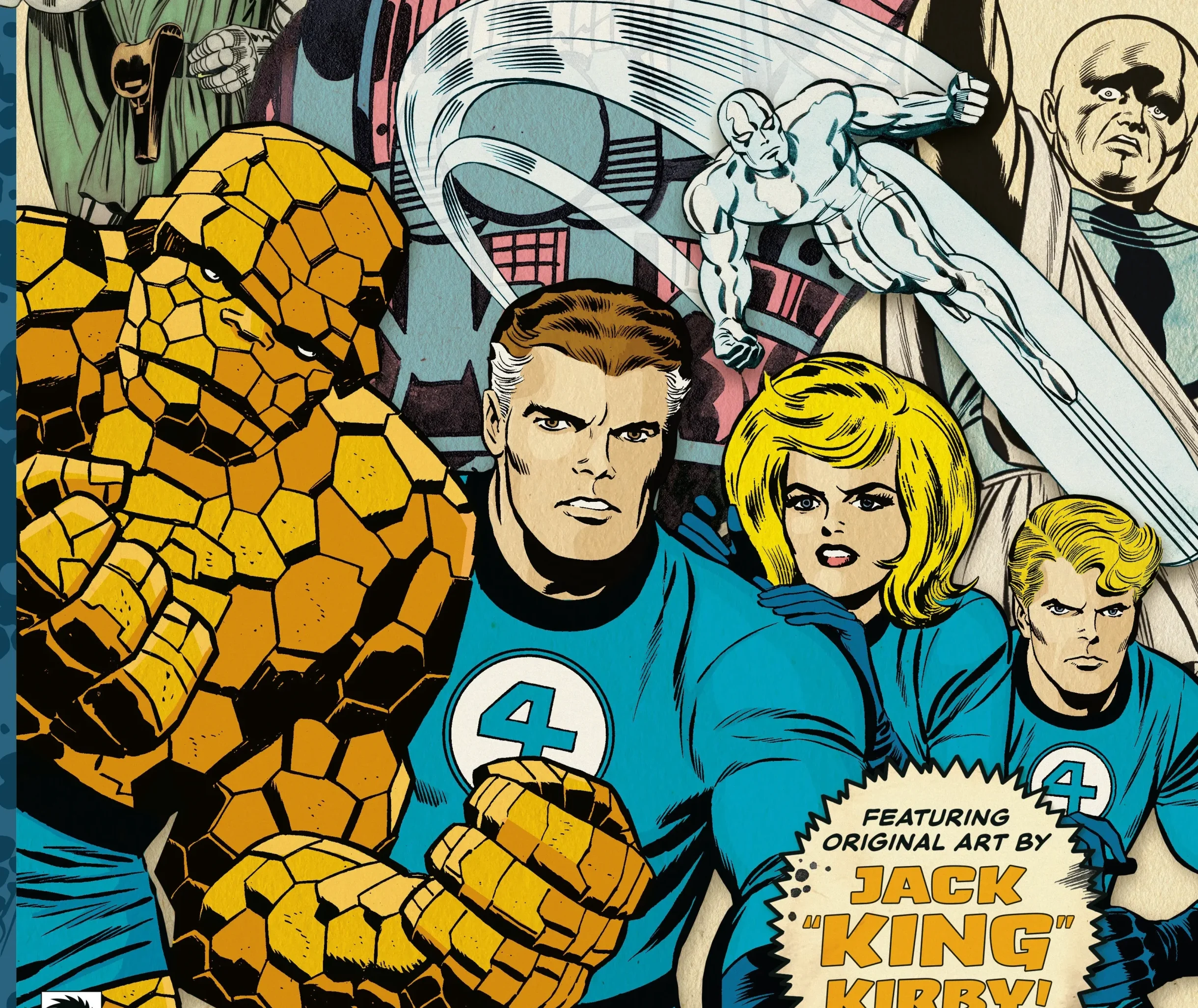
In Fantastic Four #6, published in June 1962, Jack Kirby and Stan Lee introduced the concept of “unstable molecules,” when Reed Richards, Mr. Fantastic, stretched his elasticized body out of a window of the team’s headquarters in The Baxter Building and then across the street in order to prop his elbows on the windowsill of a room in a nearby hospital and visit a sick boy who’s written a letter to the Fantastic Four. “The reason my costume stretches to any length,” Reed explains as he chats with the boy in the hospital bed, “is that it’s woven from chemical fibers containing unstable molecules that shift in structure when I affect the change” (“Captives of the Deadly Duo!” 134). As Kirby and Lee would declare a year later in “Questions and Answers About The Fantastic Four” in Fantastic Four Annual #1, unstable molecules “were one of Reed’s greatest discoveries” (46). They kept the Human Torch’s costume and street clothes from burning up when he ignited his flaming body, and the fabrics woven from them would disappear too when Susan Storm vanished as the Invisible Girl. Over time other characters, like Ant-Man in Tales to Astonish #35, would also make their costumes out of unstable molecules.
But aside from being a foundational scientific principle of the Marvel Universe, unstable molecules are also only another example of the almost accidental poetry generated by superhero comics. In James Sturm and Guy Davis’s 2003 graphic novel Unstable Molecules, which is presented as a biography of four characters from the late ’50s who—in this universe at least—were the models for Kirby and Lee’s characters, Reed’s discovery is a metaphor for the “tenuous and mercurial” relationships of the dysfunctional family at the core of the narrative. In Ramzi Fawaz’s groundbreaking 2016 study of queer history and superhero comics, The New Mutants, Fawaz suggests that the concept of unstable molecules “mimicked the malleable plastics and synthetics of postwar material science [and] revealed that the interaction between the physical self and the material world could produce nonnormative or ‘queer’ effects” (66-67).
In a way, in fact, the entire superhero genre is formed out of unstable molecules. Not only do its protagonists inhabit bodies that are constantly transforming—warped into new shapes by magic words, secret formulas, Red Kryptonite, obscure and often painful surgical procedures, and a whole spectrum of radioactive beams—but the vast body of narratives that comprise the genre are subject to constant transformations too as familiar characters are continually revised and retconned over decades by generation after generation of new creators and as these narratives are consumed, in turn, by new audiences. Is any popular genre as volatile and unstable, as sensitive to changing cultural contexts and forms of production, as superhero narratives? Consider, for instance, Superman, who was, at one moment in time, a working-class Depression-era hero and later a hyper-masculine jingoist icon, and then became, under Mort Weisinger’s editorial direction in the 1950s and early 1960s, a spectacle of bizarre and endless transformation. Beneath the veneer of a stolid paterfamilias presiding over a family-like structure of friends and other super beings—including Supergirl, Superdog, Supercat, Superhorse, and the entire population of the bottle city of Kandor—Superman was also a trippy, Red Kryptonite changeling who was continually, in the words of Grant Morrison in Supergods, “letting the freakishness, the alien-ness, all hang out” (69).
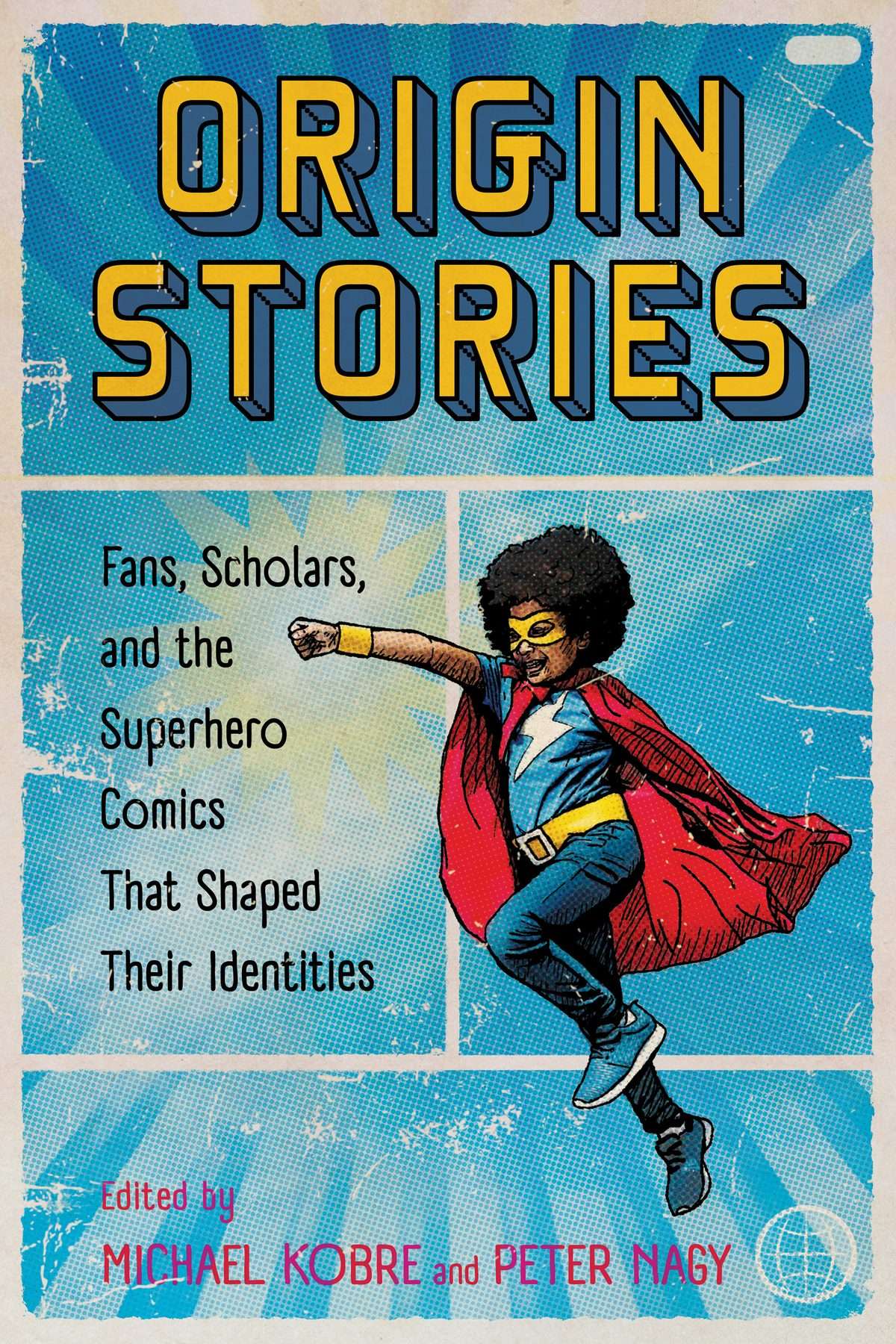
Superheroes, over almost a century of endless adventures and transformations, are intrinsically protean forms that can evoke and embody all kinds of desires, fantasies, and anxieties. Through this instability and multiplicity, superhero comics, as this collection suggests, invite all kinds of identification from their readers. In Origin Stories: Fans, Scholars, and the Superhero Comics that Shaped Their Identities, a diverse group of scholars, writers, and comics fans tell their own stories about the comics they loved and how those comics intersected with their lives. Weaving together personal narratives and critical analysis, in a kind of hybrid form comprised of its own unstable molecules, the essays examine how readers from widely different backgrounds find reflections of their own experiences in the wildly protean forms of superheroes. But as each essay also vividly demonstrates, that sense of identification becomes even more powerful when comics readers—like everyone in this collection—feel themselves, in some ways, to be outsiders from a larger public sphere. Sometimes that sense of marginalization is shaped by the pressures of identity categories like race, ethnicity, sexuality, class, and, often, the intersectional connections between them. And sometimes, comics fans can feel like outsiders because of what they experience, what they perceive, and what they desire. But always, as the essays here all demonstrate, that sense of somehow being outside of the mainstream of the dominant culture can be reflected and explored in the larger-than-life worlds of superhero comics.
The theoretical groundwork for Origin Stories builds on a set of suggestions made by Ramzi Fawaz and Darieck Scott in “Queer about Comics,” the introduction to a special issue of the journal American Literature, which itself builds on Fawaz’s book The New Mutants. Drawing on Michael Warner’s notion of discourse-publics to conceptualize the relationship between readers and the fantasy content of superhero comics, Fawaz and Scott remind us that while superhero comics have been historically pigeonholed as simple normative fantasies of armored bodies enacting nationalist agendas, they’ve also often been characterized as a marginalized medium for marginalized audiences. Dismissed over the years by all kinds of social crusaders as childish, delinquent, and antisocial, comic books are consumed by a diverse audience of fans, who, for much of the history of the medium (at least before the conquest of popular culture by Marvel Studios and other superhero franchises in the 21st century), were commonly stereotyped themselves as backward, strange, and perverse—particularly the most ardent fans, whose fervent attachment to comic books functioned as a marker of their alienation from the cultural and social mainstream. In this interaction between a medium that was marginalized for much of its history and readers who often felt like outsiders too, comic book stories could function, in Michael Warner’s term, as a counterpublic, a self-consciously marginal discourse space capable of generating all kinds of fantasies about “deviant” bodies and identities, fantasies that were consumed by an audience of outsiders in a process that could shape the way those readers saw themselves, the world, and the way they existed in that world.
The essays in Origin Stories are loosely modeled on the brief personal/analytical descriptions of their early attachments to superheroes that Scott and Fawaz provide in “Queer about Comics,” which illustrate how comics initiate readers into non-normative counterpublics. The collection builds on what is demonstrated, for instance, by Scott, who describes his childhood fascination with the Black Amazon Nubia, a “dark-skinned, glamorous, powerful black woman warrior” he remembers seeing for the first time on the cover of Wonder Woman #206 in 1973 (205). Through an analysis of Nubia that reveals the character to be a fantasy of “black power and beauty” that lived on for decades in Wonder Woman fan communities and scholarship (before being reintroduced in comics in recent years), Scott argues that his identification with the character marked his initial experience of queer self-recognition (205).
This collection is also predicated on the idea—as many scholars, fans, and comics creators have long argued—that the very nature of comics as a form invites an imaginative and deeply subjective interaction between the reader and the work. In her essay in this collection, Anna Peppard cites “Scott McCloud’s seminal theories of ‘closure’ (63) and ‘amplification through simplification’ (30)” as formal elements in comics that foster a reader’s “participatory investment” in the images, characters, and storyworlds of comics (107). Other contributors cite Frederick Luis Aldama’s assertion that comics readers “co-create the story” (91). As Aldama himself writes in Latinx Superheroes in Mainstream Comics:
[C]o-creating is the mental process involved in the audience’s apprehension then emotion and cognitive meaning making of the comic book storyworld. Indeed, it is the wonderfully generative capacity of this co-creating potential in comic book readers that not only allows readers and audiences to imagine movement and three dimensions in the static, two-dimensional in-print comic book storyworld spaces, but allows them to feel and think about identities and experiences distant from their own. (90-91)
Through this process of co-creation, through the reader’s participatory investment in the story, comics readers can find worlds to which they belong, worlds in which they see themselves reflected and affirmed in fantasies about the power and pleasure of perceived deviance and difference. These are also worlds that offer them community, providing them membership in fictional coalitions (super teams) and fan subcultures that are often formed through shared experiences of social estrangement.
To cite just one example of the complex interaction between comics, the readers’ co-creation, and the communities that comics fans can form, consider the reaction of fans in 2024 when Marvel Comics phased out its yearslong “Krakoa” storyline in its X-Men titles, in which the long-persecuted mutants who inhabited the Marvel universe had formed their own nation, with its own utopian ideals, culture, and customs, and, inevitably, its own internal conflicts too. As perhaps the quintessential example of an outsider community in superhero comics, The X-Men had long been embraced by all kinds of marginalized readers, particularly in the LGBTQ community, and for these readers the mutant counter-culture of Krakoa—with its joyous fluidity of relationships, genders, and even bodily forms—represented a kind of freedom and acceptance that couldn’t be found outside the pages of a superhero comic. After the storyline ended, as the company mandated a return to a more traditional status quo in the comics’ continuity, many of these fans expressed both their disappointment at the company’s decision and, likewise, the passionate attachment they’d felt to the storyline and the fan communities it generated. Writing on the ComcsXF site, Anna Peppard, who explores her intense connection to the X-Man Nightcrawler in this collection, recalled that her initial concerns about the Krakoa storyline were eased by the response from other fans and the robust conversation surrounding the comics. “…[W]hat eventually sold me on the era was the fan community surrounding it,” she wrote. “The passion people had for this era transformed it, for me, into something transformative.” As another ComicsXF contributor, Jude Jones, observed in a critical forum on a 2025 issue in which the mutants had gathered together to memorialize their lost homeland of Krakoa, the creation of the ComicsXF site itself, as an online community of writers and readers, was at least in part a response to the storyline. “The current iteration of ComicsXF in large part exists because of Krakoa,” he wrote, before going on to make an even more emphatic claim. “I, in large part, exist because of ComicsXF … Krakoa is why I’m here,” Jones wrote, linking his words to another ComicsXF article in which he’d confessed that the opportunity to write about Krakoa for the site and share his responses with other fans had literally saved his life as a Black man struggling with depression. “…[W]ithout Krakoa,” Jones said, “I might not be alive.”
Superhero comics then, through this process of co-creation and the passionate responses that particular stories and characters engender, can function as counterpublics—discourse spaces, in Michael Warner’s terminology, which exist in the minds of readers and in the communities that readers and creators form. Moreover, within these counterpublics, comics fans and outsiders of all kinds can, to use a familiar trope, reveal their true identities. And that, of course, is exactly what the contributors to this collection do in their individual essays, in which they combine detailed deeply researched readings of superhero stories with personal narratives about family relationships, transgressive desires, and the uncertainties and dangers of navigating boundaries of race, gender, sexuality, and multiple forms of difference.
In all of the essays in Origin Stories, the unstable molecules that comprise the superhero genre are reconfigured to reveal more complicated truths, as familiar tropes of the genre—secret identities, transformations, masks—become parts of different kinds of origin stories. In sharing these stories, the essays collected here speak to each other too, as they all explore the forces, in our culture and in ourselves, that instill a sense of difference and marginalization, that tag us somehow as outsiders from the mainstream of a larger public sphere. But in their own ways, these essays also all affirm the power of a passionate reader’s imagination to co-create out of the most fantastic images and words an alternate sense of identity and a different kind of space in which to exist, where difference and marginalization can be reimagined as strength and freedom. And in sharing these stories and these possibilities, the different voices in this collection also form a kind of counterpublic of their own, a community of readers and writers within these pages in which feeling different and loving the wildest, most improbable characters and stories can be celebrated and affirmed—a community, in fact, that’s waiting for you, the person reading these words now, to join it too.
Excerpted from Origin Stories: Fans, Scholars, and the Superhero Comics That Shaped Their Identities Copyright (c) 2026 by Michael Kobre and Peter Nagy. Used with permission of the publisher, University of Mississippi Press. All rights reserved.